
Love Letters of a Violinist, and Other Poems
Eric Mackay
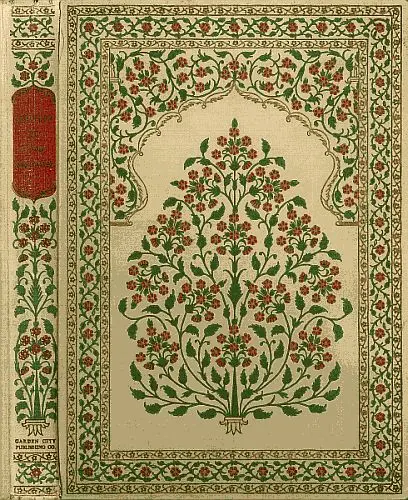
THE CLASSIC COLLECTION · 1851
"Rubáiyát of Omar Khayyam, Rendered into English Verse by Omar Khayyam" is a translation published in 1859 by Edward FitzGerald of Persian quatrains attributed to the medieval astronomer-poet Omar Khayyam. Initially unsuccessful, the work gained immense popularity throughout the English-speaking world, inspiring countless editions and Omar Khayyam clubs. The poems sparked enduring debate about their true meaning: were they expressions of religious skepticism and Epicurean philosophy, or mystical Sufi verses misunderstood by the translator? The authenticity of the original Persian quatrains themselves remains uncertain.
Introduction adapted from the source catalogue; source summaries may be automatically generated.
Free to read · English · 17,741 words · No account needed
MAKE TIME FOR A GOOD BOOK
On by default. Untick to stop anonymous reading totals. Each page counts after 10 seconds in view. How this works.
Anonymous counting is on unless you have switched it off.
It was an occasion of no small moment to Mr. Fitzgerald's fame, and to the intellectual gratification of many thousands of readers, when he took his little packet of "Ruba'iyyat" to Mr. Quaritch in the latter part of the year 1858. It was printed as a small quarto pamphlet, bearing the publisher's name but not the author's; and although apparently a complete failure at first,--a failure which Mr. Fitzgerald regretted less on his own account than on that of his publisher, to whom he had generously made a present of the book,--received, nevertheless, a sufficient distribution by being quickly reduced from the price of five shillings and placed in the box of cheap books marked a penny each. Thus forced into circulation, the two hundred copies which had been printed were soon exhausted. Among the buyers were Dante Gabriel Rossetti, Swinburne, Sir Richard Burton, and William Simpson, the accomplished artist of the Illustrated London News. The influence exercised by the first three, especially by Rossetti, upon a clique of young men who later grew to distinction, was sufficient to attract observation to the singular beauties of the poem anonymously translated from the Persian. Most readers had no possible opportunity of discovering whether it was a disguised original or an actual translation;--even Burton enjoyed probably but little chance of seeing a manuscript of the Persian "Ruba'iyyat." The Oriental imagery and allusions were too thickly scattered throughout the verses to favor the notion that they could be the original work of an Englishman; yet it was shrewdly suspected by most of the appreciative readers that the "translator" was substantially the author and creator of the poem. In the refuge of his anonymity, Fitzgerald derived an innocent gratification from the curiosity that was aroused on all sides. After the first edition had disappeared, inquiries for the little book became frequent, and in the year 1868 he gave the MS. of his second edition to Mr. Quaritch, and the "Ruba'iyyat" came into circulation once more, but with several alterations and additions by which the number of stanzas was somewhat increased beyond the original seventy-five. Most of the changes were, as might have been expected, improvements; but in some instances the author's taste or caprice was at fault,--notably in the first Ruba'iy. His fastidious desire to avoid anything that seemed baroque or unnatural or appeared like plagiarism, may have influenced him; but it was probably because he had already used the idea in his rendering of Jami's "Salaman," that he sacrificed a fine and novel piece of imagery in his first stanza and replaced it by one of much more ordinary character. If it were from a dislike to pervert his original too largely, he had no need to be so scrupulous, since he dealt on the whole with the "Ruba'iyyat" as though he had the license of absolute authorship, changing, transposing, and manipulating the substance of the Persian quatrains with a singular freedom. The vogue of "old Omar" (as he would affectionately call his work) went on increasing, and American readers took it up with eagerness. In those days the mere mention of Omar Khayyam between two strangers meeting fortuitously acted like a sign of freemasonry and established frequently a bond of friendship. Some curious instances of this have been related. A remarkable feature of the Omar-cult in the United States was the circumstance that single individuals bought numbers of copies for gratuitous distribution before the book was reprinted in America. Its editions have been relatively numerous, when we consider how restricted was the circle of readers who could understand the peculiar beauties of the work. A third edition appeared in 1872, with some further alterations, and may be regarded as virtually the author's final revision, for it hardly differs at all from the text of the fourth edition, which appeared in 1879. This last formed the first portion of a volume entitled "Rubaiyat of Omar Khayyam; and the Salaman and Absal of Jami; rendered into English verse." The "Salaman" (which had already been printed in separate form in 1856) is a poem chiefly in blank verse, interspersed with various meters (although it is all in one measure in the original) embodying a love-story of mystic significance; for Jami was, unlike Omar Khayyam, a true Sufi, and indeed differed in other respects, his celebrity as a pious Mussulman doctor being equal to his fame as a poet. He lived in the fifteenth century, in a period of literary brilliance and decay; and the rich exuberance of his poetry, full of far-fetched conceits, involved expressions, overstrained imagery, and false taste, offers a strong contrast to the simpler and more forcible language of Khayyam. There is little use of Arabic in the earlier poet; he preferred the vernacular speech to the mongrel language which was fashionable among the heirs of the Saracen conquerors; but Jami's composition is largely embroidered with Arabic.
Your reading position is saved on this browser. Take it to another device with a library code. Reading pages adapt to text, rather than matching a printed edition.
BEHIND THE BOOK
This eBook is for the use of anyone anywhere in the United States and most other parts of the world at no cost and with almost no restrictions whatsoever. You may copy it, give it away or re-use it under the terms of the Project Gutenberg License included with this eBook or online at www.gutenberg.org. If you are not located in the United States, you will have to check the laws of the country where you are located before using this eBook. Read the source licence.
The original source file, including credits and licence, is retained by this library. Request an original-format copy at no charge. Please include the book title and Project Gutenberg identifier #35260.
KEEP YOUR CURIOSITY GOING
Eric Mackay
Edmund Gosse
Sophia Margaretta Hensley
Gilbert Parker
George MacDonald

Elizabeth Bibesco