
Love Letters of a Violinist, and Other Poems
Eric Mackay
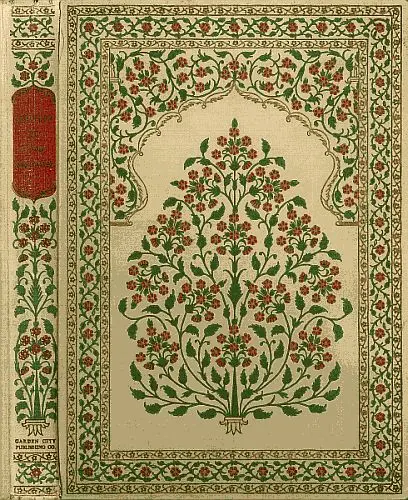
THE CLASSIC COLLECTION · 1851
"Rubáiyát of Omar Khayyam, Rendered into English Verse by Omar Khayyam" is a translation published in 1859 by Edward FitzGerald of Persian quatrains attributed to the medieval astronomer-poet Omar Khayyam. Initially unsuccessful, the work gained immense popularity throughout the English-speaking world, inspiring countless editions and Omar Khayyam clubs. The poems sparked enduring debate about their true meaning: were they expressions of religious skepticism and Epicurean philosophy, or mystical Sufi verses misunderstood by the translator? The authenticity of the original Persian quatrains themselves remains uncertain.
Introduction adapted from the source catalogue; source summaries may be automatically generated.
Free to read · English · 17,741 words · No account needed
MAKE TIME FOR A GOOD BOOK
On by default. Untick to stop anonymous reading totals. Each page counts after 10 seconds in view. How this works.
Anonymous counting is on unless you have switched it off.
"Euphranor" furnishes a good many characterizations which would be useful for any writer treating upon Cambridge society in the third decade of this century. Kenelm Digby, the author of the "Broadstone of Honour," had left Cambridge before the time when Euphranor held his "dialogue," but he is picturesquely recollected as "a grand swarthy fellow who might have stepped out of the canvas of some knightly portrait in his father's hall--perhaps the living image of one sleeping under some cross-legged effigies in the church." In "Euphranor," it is easy to discover the earliest phase of the unconquerable attachment which Fitzgerald entertained for his college and his life-long friends, and which induced him in later days to make frequent visits to Cambridge, renewing and refreshing the old ties of custom and friendship. In fact, his disposition was affectionate to a fault, and he betrayed his consciousness of weakness in that respect by referring playfully at times to "a certain natural lubricity" which he attributed to the Irish character, and professed to discover especially in himself. This amiability of temper endeared him to many friends of totally dissimilar tastes and qualities; and, by enlarging his sympathies, enabled him to enjoy the fructifying influence of studies pursued in communion with scholars more profound than himself, but less gifted with the power of expression. One of the younger Cambridge men with whom he became intimate during his periodical pilgrimages to the university, was Edward B. Cowell, a man of the highest attainment in Oriental learning, who resembled Fitzgerald himself in the possession of a warm and genial heart and the most unobtrusive modesty. From Cowell he could easily learn that the hypothetical affinity between the names of Erin and Iran belonged to an obsolete stage of etymology; but the attraction of a far-fetched theory was replaced by the charm of reading Persian poetry in companionship with his young friend, who was equally competent to enjoy and to analyze the beauties of a literature that formed a portion of his regular studies. They read together the poetical remains of Khayyam--a choice of reading which sufficiently indicates the depth and range of Mr. Cowell's knowledge. Omar Khayyam, although not quite forgotten, enjoyed in the history of Persian literature a celebrity like that of Occleve and Gower in our own. In the many Tazkirat (memoirs or memorials) of Poets, he was mentioned and quoted with esteem; but his poems, laboring as they did under the original sin of heresy and atheism, were seldom looked at, and, from lack of demand on the part of readers, had become rarer than those of most other writers since the days of Firdausi. European scholars knew little of his works beyond his Arabic treatise on Algebra, and Mr. Cowell may be said to have disentombed his poems from oblivion. Now, thanks to the fine taste of that scholar, and to the transmuting genius of Fitzgerald, no Persian poet is so well known in the western world as Abu-'l-fat'h 'Omar, son of Ibrahim the tentmaker of Naishapur, whose manhood synchronizes with the Norman conquest of England, and who took for his poetic name (takhallus) the designation of his father's trade (Khayyam). The "Ruba'iyyat" (Quatrains) do not compose a single poem divided into a certain number of stanzas; there is no continuity of plan in them, and each stanza is a distinct thought expressed in musical verse. There is no other element of unity in them than the general tendency of the Epicurean idea, and the arbitrary divan form by which they are grouped according to the alphabetical arrangement of the final letters; those in which the rhymes end in a constituting the first division, those with b the second, and so on. The peculiar attitude towards religion and the old questions of fate, immortality, the origin and the destiny of man, which educated thinkers have assumed in the present age of Christendom, is found admirably foreshadowed in the fantastic verses of Khayyam, who was no more of a Mohammedan than many of our best writers are Christians. His philosophical and Horatian fancies--graced as they are by the charms of a lyrical expression equal to that of Horace, and a vivid brilliance of imagination to which the Roman poet could make no claim--exercised a powerful influence upon Fitzgerald's mind, and colored his thoughts to such a degree that even when he oversteps the largest license allowed to a translator, his phrases reproduce the spirit and manner of his original with a nearer approach to perfection than would appear possible. It is usually supposed that there is more of Fitzgerald than of Khayyam in the English "Ruba'iyyat," and that the old Persian simply afforded themes for the Anglo-Irishman's display of poetic power; but nothing could be further from the truth. The French translator, J. B. Nicolas, and the English one, Mr. Whinfield, supply a closer mechanical reflection of the sense in each separate stanza; but Mr. Fitzgerald has, in some instances, given a version equally close and exact; in others, rejointed scattered phrases from more than one stanza of his original, and thus accomplished a feat of marvelous poetical transfusion. He frequently turns literally into English the strange outlandish imagery which Mr. Whinfield thought necessary to replace by more intelligible banalities, and in this way the magic of his genius has successfully transplanted into the garden of English poesy exotics that bloom like native flowers.
Your reading position is saved on this browser. Take it to another device with a library code. Reading pages adapt to text, rather than matching a printed edition.
BEHIND THE BOOK
This eBook is for the use of anyone anywhere in the United States and most other parts of the world at no cost and with almost no restrictions whatsoever. You may copy it, give it away or re-use it under the terms of the Project Gutenberg License included with this eBook or online at www.gutenberg.org. If you are not located in the United States, you will have to check the laws of the country where you are located before using this eBook. Read the source licence.
The original source file, including credits and licence, is retained by this library. Request an original-format copy at no charge. Please include the book title and Project Gutenberg identifier #35260.
KEEP YOUR CURIOSITY GOING
Eric Mackay
Edmund Gosse
Sophia Margaretta Hensley
Gilbert Parker
George MacDonald

Elizabeth Bibesco