A History of Parliamentary Elections and Electioneering in the Old Days Showing the State of Political Parties and Party Warfare at the Hustings and in the House of Commons from the Stuarts to Queen Victoria
Joseph Grego
THE CLASSIC COLLECTION · 1880
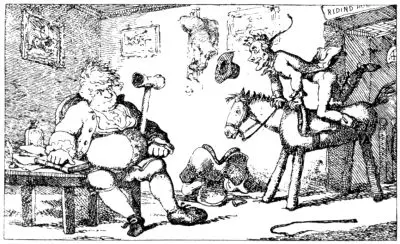
"Rowlandson the Caricaturist; a Selection from His Works. Vol. 1" by Joseph Grego is a collection of caricatures and illustrations written in the late 19th century. This volume showcases the works of Thomas Rowlandson, focusing on his unique style of graphic humor and providing anecdotal descriptions of his famous caricatures, as well as a comprehensive sketch of his life, times, and contemporaries. The work appeals to enthusiasts of satire, humor, and art history, providing a glimpse into Rowlandson's prolific contributions during a vibrant period of social and political change. The opening of the volume serves as a preface where Grego sets the stage for Rowlandson's significance in the world of caricature and the challenges he faced in gaining recognition. It discusses the artist's remarkable ability to capture the absurdities and eccentricities of societal life through his work, with a particular emphasis on the colorful and vibrant age in which he lived. The preface prepares readers for an exploration of Rowlandson's whimsical and often humorous portrayals of political figures, everyday people, and various social scenarios, invoking an atmosphere of curiosity and appreciation for Rowlandson's artistic genius.
Introduction adapted from the source catalogue; source summaries may be automatically generated.
Free to read · English · 133,025 words · No account needed
MAKE TIME FOR A GOOD BOOK
On by default. Untick to stop anonymous reading totals. Each page counts after 10 seconds in view. How this works.
Anonymous counting is on unless you have switched it off.
We are not informed whether the paternal estate was restored to solvency. Among the various 'valuable legacies' which, it is related, fell to the caricaturist's share (only to be scattered broadcast), it is very possible that, in some sort, an inheritance from his father formed part of these unexpected 'good gifts.' It seems, although we have no direct records of the remaining relatives, that Rowlandson had a sister, since we learn that his brother-in-law was Howitt, famous as an artist for his delineation of animals, for his spirited hunting subjects, being eminent as a sportsman, rider, and angler; and, like the caricaturist, somewhat of a spoiled child--a wayward genius--of a congenial soul, and vivacious impulses, a trifle too given to yield to careless convivial company, or the allurements which the hour might hold forth, oblivious of sober consequences to follow.
Thomas Rowlandson, the uncle, had married a certain Mademoiselle Chattelier, who was, it is evident, a lady with some command of wealth; and from the partiality and indulgence of this aunt, our artist, we are told, 'derived that assistance which his father's reverse of fortune had withheld.'
Another reference to the family name further occurs amongst the announcements of marriages for September 1800 (Gentleman's Magazine, vol. 70, p. 898), where we find that Thomas Rowlandson, Esq., of Watling Street, espoused Miss Stuart, daughter of George Stuart, Esq., of the Grove, Camberwell, Surrey. It is obvious that Rowlandson senior intended to give his son a sound training. As a school-boy, the future celebrity wandered into the precincts of that Soho district to which he afterwards clung in his varying fortunes with the persistence developed by habit.
The caricaturist began to draw his first instalments from the fount of knowledge at the scholastic symposium of Doctor Barvis in Soho Square, 'at that time, and subsequently, an academy of some celebrity.' We are told this establishment was kept by Doctor Barrow when young Rowlandson was pursuing his studies. The respectability of the school, and its soundness as an educational institution, is satisfactorily demonstrated to our mind from the circumstance that the great Edmund Burke had elected to confide his beloved son, with whose training, it is well known, the philosopher took especial pains, to the charge of Doctor Barrow; and Richard Burke, the gentle gifted youth whose untimely death hastened the decease of his patriotic father, was a school-fellow of our artist. J. G. Holman, who was destined to acquire reputation as a dramatic writer and performer, was another school-fellow. It appears that, within the walls of this academy, Rowlandson made the acquaintance of John Bannister, whose inimitable talents were afterwards to delight the town, and whose name is a lasting ornament to the histrionic profession; it was, further, in Soho Square that young Rowlandson and young Angelo, the son of the well-known Henry Angelo (one of the best recognised and most respected foreigners domiciled in London of his day), fencing-master to the Royal Family, became fast and firm friends. The intimacy existing between this worthy trio, dating from these early days, continued steadfastly through life. All these lads were, in different degrees, enthusiasts of the graphic art; Angelo and Bannister had strong predilections for the arts, and both drew as amateurs in their subsequent careers, although, with Rowlandson, they originally meditated following up the artist's profession seriously. As to our friend Rolley, like all beginners gifted with the pictorial vein, he could make sketches intuitively before he had learnt to do anything else, as seems the rule with youths who possess the artistic faculty and an imaginative temperament; his powers of fancy directed his hand at a precociously juvenile age to the practice of exercising his abilities with pencil and pen. 'From the early period of his childhood,' it is recorded, 'Rowlandson gave presage of his future talent;' he could make sketches before he learned to write, and, according to the usual course, 'he drew humorous characters of his master and many of his scholars, before he was ten years old. The margins of his school-books were covered with these his handiworks.'
Your reading position is saved on this browser. Take it to another device with a library code. Reading pages adapt to text, rather than matching a printed edition.
Joseph Grego
Joseph Grego
BEHIND THE BOOK
This eBook is for the use of anyone anywhere in the United States and most other parts of the world at no cost and with almost no restrictions whatsoever. You may copy it, give it away or re-use it under the terms of the Project Gutenberg License included with this eBook or online at www.gutenberg.org. If you are not located in the United States, you will have to check the laws of the country where you are located before using this eBook. Read the source licence.
The original source file, including credits and licence, is retained by this library. Request an original-format copy at no charge. Please include the book title and Project Gutenberg identifier #45980.
KEEP YOUR CURIOSITY GOING

Charles G. (Charles Griffith) Ross
Hannah Webster Foster

Emily Lawless
Edwin Hamlin Carr

Charles De Lano Hine
Andrew Ure