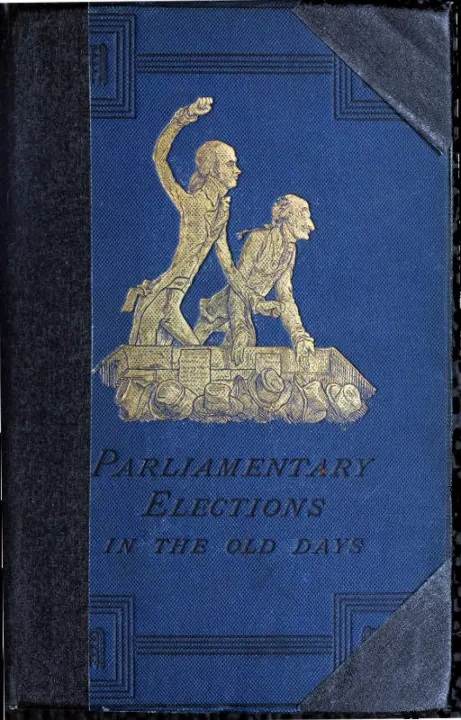
A History of Parliamentary Elections and Electioneering in the Old Days Showing the State of Political Parties and Party Warfare at the Hustings and in the House of Commons from the Stuarts to Queen Victoria
Joseph Grego
THE CLASSIC COLLECTION · 1880
"Rowlandson the Caricaturist; a Selection from His Works. Vol. 1" by Joseph Grego is a collection of caricatures and illustrations written in the late 19th century. This volume showcases the works of Thomas Rowlandson, focusing on his unique style of graphic humor and providing anecdotal descriptions of his famous caricatures, as well as a comprehensive sketch of his life, times, and contemporaries. The work appeals to enthusiasts of satire, humor, and art history, providing a glimpse into Rowlandson's prolific contributions during a vibrant period of social and political change. The opening of the volume serves as a preface where Grego sets the stage for Rowlandson's significance in the world of caricature and the challenges he faced in gaining recognition. It discusses the artist's remarkable ability to capture the absurdities and eccentricities of societal life through his work, with a particular emphasis on the colorful and vibrant age in which he lived. The preface prepares readers for an exploration of Rowlandson's whimsical and often humorous portrayals of political figures, everyday people, and various social scenarios, invoking an atmosphere of curiosity and appreciation for Rowlandson's artistic genius.
Introduction adapted from the source catalogue; source summaries may be automatically generated.
Free to read · English · 133,025 words · No account needed
MAKE TIME FOR A GOOD BOOK
On by default. Untick to stop anonymous reading totals. Each page counts after 10 seconds in view. How this works.
Anonymous counting is on unless you have switched it off.
It appears from the statements of Rudolph Ackermann, Rowlandson's industry was such that the considerate owner of the fashionable Repository--favourite lounge of the dilettanti as it was--at last found it difficult, as regards the selling department, to keep pace with his friend's creative abilities. In short, the artist produced drawings faster than the public, as it seems evident, felt inclined to purchase them for the time being, and it became a perplexing problem how to increase the demand proportionately to the supply; for the multiplication of the sketches for awhile--probably under the spur of some emergency, or the pressure of apprehensions for the future--became so overwhelming that the worthy publisher, in his relation as a practical man of business, fancied he foresaw the approaching depreciation of the value of Rowlandson's drawings making such strides, on the strength of an overstocked market, he was afraid, in the end, the artist's remuneration would be so seriously diminished, that it would not be worth his while to persevere, unless a new line could be successfully struck out.
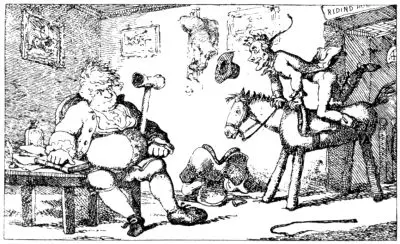
These anticipations were probably well founded, and we cannot but acknowledge that our artist had discarded prudence, and become thoroughly reckless--at least, as far as we can judge by appearances, for possibly he had more confidence in the ultimate request for his studies than was entertained by his friendly employers, and time has proved the soundness of his judgment. If the story we are told of his novel method of multiplying his drawings is serious, it will strike the reader that Mr. Ackermann had reason to feel anxious, on his protégé's account. It is related that Rowlandson would saunter from his neighbouring lodgings in the Adelphi, round to the Repository of Arts, and, as the title of Mr. Ackermann's establishment was no misnomer, every possible appliance was therein found ready to hand. The artist would then order a saucer of vermillion, and another of Indian ink, ready ground, from the colourist's room, with reed pens, and several sheets of drawing-paper; he would then combine his inks in the proportions he thought proper, in the flesh lines vermillion predominated, in draperies Indian ink, shadows were a warm mixture of the two, and distant objects were faintly rendered in Indian ink alone. The outline was filled in on this principle, but, as the designer's own manual and dexterous rapidity had ceased to satisfy him, he had ingeniously discovered an expeditious method of multiplication sufficient for his purpose, without resorting to the sister art of engraving. The drawing was made on the principle essential in any engraving which has to give impressions, that is, the subject was reversed, right being changed to left--the only extra care required; the outline was somewhat stronger, and the reed-pen more fully charged than was the usual practice, and when the design was completed it formed the matrix from which, before the ink became fixed, by means of a press, and paper damped to the proper consistency, it was easy to print off duplicates as long as the ink held out. We are rather inclined to speculate that, ingenious as the process seems, in description, it would by no means turn out a perennial flowing fountain, and two or three decent replicas would exhaust the original, however judiciously manipulated. The copies obtained by this manifold contrivance were corrected and strengthened, according to their requirements; the series of impressions were then shaded with Indian ink, so as to lend the figures contour and solidity, and express the lighter distance; and then came the final tinting, in delicate washes of colour, and the completed works were ready for introduction to the public. The writer does not believe that this modus operandi was ever followed up systematically; that it has been resorted to on occasions, his own observations have demonstrated; and he confesses to a passing acquaintance with a collection of drawings by the artist (belonging to a gentleman of distinction, who is quite satisfied as to their merits), which are for the most part the results of this system, and he has more than once, in the course of his peregrinations, come across the matrix design, very spread and mysterious as to outline, having been exhausted in the working, but shaded with spirit, coloured, and sent into the world, a shameless left-handed production, craftily smuggled into circulation to confuse collectors, and throw discredit on its dexter counterparts. This accounts for a certain proportion of the duplicates after Rowlandson, which are of frequent occurrence; and often have purchasers felt their self-esteem lowered, when another possessor of the same design in a firmer outline has assured them that they have been deceived into buying a mere copy, oblivious that the guilty pair are both due to the hand of the master, and that possibly other members of the same illicit family are lurking in the folios of rival amateurs. A grand central gathering of works by Rowlandson, presuming a person of sufficient enterprise could be found to prosecute the scheme of a comprehensive exhibition of the artist's works, would reveal some curiosities in the way of reproductive capability.
Your reading position is saved on this browser. Take it to another device with a library code. Reading pages adapt to text, rather than matching a printed edition.
Joseph Grego
Joseph Grego
BEHIND THE BOOK
This eBook is for the use of anyone anywhere in the United States and most other parts of the world at no cost and with almost no restrictions whatsoever. You may copy it, give it away or re-use it under the terms of the Project Gutenberg License included with this eBook or online at www.gutenberg.org. If you are not located in the United States, you will have to check the laws of the country where you are located before using this eBook. Read the source licence.
The original source file, including credits and licence, is retained by this library. Request an original-format copy at no charge. Please include the book title and Project Gutenberg identifier #45980.
KEEP YOUR CURIOSITY GOING

Charles G. (Charles Griffith) Ross
Hannah Webster Foster

Emily Lawless
Edwin Hamlin Carr

Charles De Lano Hine
Andrew Ure