THE CLASSIC COLLECTION✦Round the Block: An American NovelCLASSIC FREE BOOKS
Round the Block: An American Novel
John Bell Bouton
THE CLASSIC COLLECTION · 1887
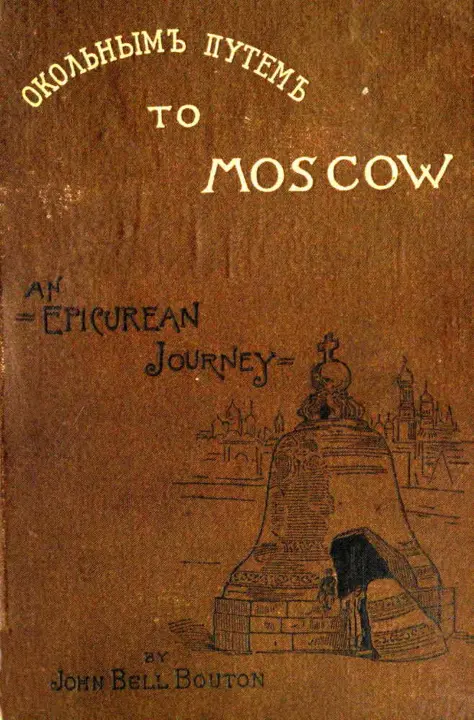
"Roundabout to Moscow: An Epicurean Journey" by John Bell Bouton is a travel narrative written in the late 19th century. The book chronicles the author's observations and experiences as he journeys through various European locations, eventually leading up to Russia. It showcases his encounters with different cultures, specifically discussing the skewed perceptions about Russia held by English travelers and contrasting them with his own insights and experiences as an American tourist. At the start of the narrative, Bouton introduces readers to the lavish comforts of the train de luxe from Paris to Nice. He provides a detailed description of the journey, the elegance of the train, and the hospitality encountered. As the journey unfolds, the author reflects on the contrasts between the opulence of his travel experience and the realities of the places he visits. Notably, he takes a critical stance on the widespread English prejudices against Russia, arguing for a more honest and open engagement with the country's true character, supported by his observations as he travels. The opening sets the stage for Bouton's broader explorations and reflections throughout his travels in Europe and into Russia, inviting readers to reconsider their preconceived notions.
Introduction adapted from the source catalogue; source summaries may be automatically generated.
Free to read · English · 94,830 words · No account needed
MAKE TIME FOR A GOOD BOOK
On by default. Untick to stop anonymous reading totals. Each page counts after 10 seconds in view. How this works.
Anonymous counting is on unless you have switched it off.
The tourist’s purse should be well stuffed if he wants to buy Florentine mosaics at the shops of the most famous manufacturers. The prices of some of their products would be called high even in New York. Extra fine pieces are ticketed at five thousand francs and upward. Some of the makers of mosaics have grown rich on American patronage. It is not at their shops that you get bargains. There is no shade of color, I believe, which the artist can not find among the stones, shells, or corals with which he produces his wonderful effects. As all great works of art require a master for their accomplishment, it stands to reason that the finest original landscapes, portraits, and flower and fruit pieces can never be very cheap, as most people estimate cheapness. But it is possible to pick up fairly good mosaics in Florence at reasonable rates, though these are not the rates asked by the seller. He does not expect you to give more than a half or two thirds his nominal price. I have visited a number of factories of fancy goods in Italy, and observed that nearly, all the labor is performed by mere children. They toil many hours in the day, and are poorly paid. Under the pretense that they are being educated to a trade, they continue for years to do a journeyman’s work, and it is to their cunning hands that we owe some of the most marvelous imitations of masterpieces in wood-carving, filigree, and mosaic. When, therefore, the manufacturer takes off a half or a third of his asking price, he is still making a large profit on his goods. No American need think that he can ever get the better of an art-dealer in Europe. That is impossible.
One of the most interesting sights in the environs of Florence is the Carthusian Monastery. I had the pleasure of visiting it with a party of American ladies. The monastery is an immense structure, covering acres of land, and contains ten or a dozen chapels of different sizes. This is enough to give each monk a chapel all to himself--the inmates not exceeding that number. For reasons best known to the Italian Government, it has been decided to wind up certain spiritual retreats, and this Carthusian Monastery among them. But the work is done gradually, and the buildings and grounds will not revert to the Government until the last of the few remaining monks is dead. They do not seem likely to die in a hurry. Some of them would take the prizes in any human exhibition for fatness and sleekness. Their loose and flowing robes of some cream-colored stuff, perhaps, impart an unreal fullness to their figures. One wonders if their lives are quite as austere as represented. The monk who piloted our party about is magnificent in physique. He stands about six feet two inches, as straight as an arrow, weighs fully two hundred pounds, has a winning, slightly sunburned Italian face, and is in manner a perfect gentleman. To the ladies he is at once dignified and courteous. Somewhere in some other days he must have mingled with refined society, and I catch myself in a state of keen surprise when I contrast his presumably monastic life here with the gay times that he may have had elsewhere. He is very fluent in Italian and French, as if he were making up (poor fellow!) for the enforced silence of his vows. For we are told that this ready talker is allowed to converse with his brethren no more than one hour in a week. We are shown his suite of small, miserable, cheerless rooms where he receives and eats his frugal meals, which are shoved to him through a hole in the wall by a hand attached to an unseen person. We see the wretched straw pallet on which he stretches his giant frame, and the bare table where he makes his solitary repast. Then we look again at his healthy face, and still wonder by what alchemy he can transmute his solitude and privation into apparent contentment and even happiness. The ladies all think that our handsome guide must “have a history.” They imagine that somewhere among his antecedents is the inevitable “woman.” They speculate fondly on the probabilities of some love-affair which drove our friend from a luxurious court to this penitential abode. They unanimously agree that it is “too bad” to keep such a fine-looking gentleman confined in a monastery, when society outside is pining for precisely that kind of material. But our monk makes no revelation of his own thoughts. After he has patiently taken us all over the monastery, and picked flowers for the ladies as mementos of their visit, he bids them good-by with the one unchanging expression of contentment on his face. May his ample shadow never be less, nor his beard of raven blackness be shorn of its luxuriant proportions!
Your reading position is saved on this browser. Take it to another device with a library code. Reading pages adapt to text, rather than matching a printed edition.
BEHIND THE BOOK
This eBook is for the use of anyone anywhere in the United States and most other parts of the world at no cost and with almost no restrictions whatsoever. You may copy it, give it away or re-use it under the terms of the Project Gutenberg License included with this eBook or online at www.gutenberg.org. If you are not located in the United States, you will have to check the laws of the country where you are located before using this eBook. Read the source licence.
The original source file, including credits and licence, is retained by this library. Request an original-format copy at no charge. Please include the book title and Project Gutenberg identifier #65966.
KEEP YOUR CURIOSITY GOING
Wilfrid Scawen Blunt
Wilfrid Scawen Blunt

E. W. (Edgar Watson) Howe
Francis Greenleaf Allinson & Anne C. E. (Anne Crosby Emery) Allinson
Cyrenus Cole

John Martineau