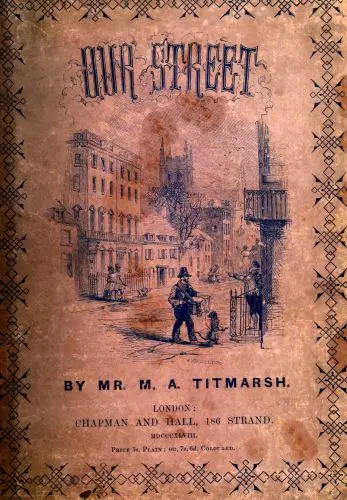
“Our Street”
William Makepeace Thackeray
THE CLASSIC COLLECTION · 1867
"Roundabout Papers" by William Makepeace Thackeray is a collection of essays and reflections written during the mid-19th century. The work captures Thackeray's keen observations on society, personal experiences, and literature through a variety of vignettes and humorous anecdotes, showcasing his characteristic blend of wit and critical insight. At the start of "Roundabout Papers," Thackeray describes a serene autumn in the quaint town of Chur, Switzerland, where he reflects on the history of the area and the peculiar figure of St. Lucius. The author observes the pastoral life around him, contrasting it with the hustle of modern progress. He introduces a lazy boy absorbed in reading novels and muses on the impact of literature on youth, celebrating the thrill and adventure found in storytelling while cautioning against excess. This opening establishes a contemplative yet humorous tone, inviting readers to engage with Thackeray’s thoughts on reading, youth, and the peculiarities of human nature.
Introduction adapted from the source catalogue; source summaries may be automatically generated.
Free to read · English · 121,024 words · No account needed
MAKE TIME FOR A GOOD BOOK
On by default. Untick to stop anonymous reading totals. Each page counts after 10 seconds in view. How this works.
Anonymous counting is on unless you have switched it off.
Having got my cattle-agent out of the door, I resume my consideration of that little mark on the doorpost, which is scored up as the text of the present little sermon; and which I hope will relate, not to chalk, nor to any of its special uses or abuses (such as milk, neck-powder, and the like), but to servants. Surely ours might remove that unseemly little mark. Suppose it were on my coat, might I not request its removal? I remember, when I was at school, a little careless boy, upon whose forehead an ink-mark remained, and was perfectly recognizable for three weeks after its first appearance. May I take any notice of this chalk-stain on the forehead of my house? Whose business is it to wash that forehead? and ought I to fetch a brush and a little hot water, and wash it off myself?
Yes. But that spot removed, why not come down at six, and wash the doorsteps? I dare say the early rising and exercise would do me a great deal of good. The housemaid, in that case, might lie in bed a little later, and have her tea and the morning paper brought to her in bed: then, of course, Thomas would expect to be helped about the boots and knives; cook about the saucepans, dishes, and what not; the lady's-maid would want somebody to take the curl-papers out of her hair, and get her bath ready. You should have a set of servants for the servants, and these under servants should have slaves to wait on them. The king commands the first lord in waiting to desire the second lord to intimate to the gentleman usher to request the page of the ante-chamber to entreat the groom of the stairs to implore John to ask the captain of the buttons to desire the maid of the still-room to beg the housekeeper to give out a few more lumps of sugar, as his Majesty has none for his coffee, which probably is getting cold during the negotiation. In our little Brentfords we are all kings, more or less. There are orders, gradations, hierarchies, everywhere. In your house and mine there are mysteries unknown to us. I am not going in to the horrid old question of “followers.” I don't mean cousins from the country, love-stricken policemen, or gentlemen in mufti from Knightsbridge Barracks; but people who have an occult right on the premises; the uncovenanted servants of the house; gray women who are seen at evening with baskets flitting about area-railings; dingy shawls which drop you furtive curtsies in your neighborhood; demure little Jacks, who start up from behind boxes in the pantry. Those outsiders wear Thomas's crest and livery, and call him “Sir;” those silent women address the female servants as “Mum,” and curtsy before them, squaring their arms over their wretched lean aprons. Then, again, those servi servorum have dependants in the vast, silent, poverty-stricken world outside your comfortable kitchen fire, in the world of darkness, and hunger, and miserable cold, and dank, flagged cellars, and huddled straw, and rags, in which pale children are swarming. It may be your beer (which runs with great volubility) has a pipe or two which communicates with those dark caverns where hopeless anguish pours the groan, and would scarce see light but for a scrap or two of candle which has been whipped away from your worship's kitchen. Not many years ago--I don't know whether before or since that white mark was drawn on the door--a lady occupied the confidential place of housemaid in this “private residence,” who brought a good character, who seemed to have a cheerful temper, whom I used to hear clattering and bumping overhead or on the stairs long before daylight--there, I say, was poor Camilla, scouring the plain, trundling and brushing, and clattering with her pans and brooms, and humming at her work. Well, she had established a smuggling communication of beer over the area frontier. This neat-handed Phyllis used to pack up the nicest baskets of my provender, and convey them to somebody outside--I believe, on my conscience, to some poor friend in distress. Camilla was consigned to her doom. She was sent back to her friends in the country; and when she was gone we heard of many of her faults. She expressed herself, when displeased, in language that I shall not repeat. As for the beer and meat, there was no mistake about them. But apres? Can I have the heart to be very angry with that poor jade for helping another poorer jade out of my larder? On your honor and conscience, when you were a boy, and the apples looked temptingly over Farmer Quarringdon's hedge, did you never--? When there was a grand dinner at home, and you were sliding, with Master Bacon, up and down the stairs, and the dishes came out, did you ever do such a thing as just to--? Well, in many and many a respect servants are like children. They are under domination. They are subject to reproof, to ill temper, to petty exactions and stupid tyrannies not seldom. They scheme, conspire, fawn, and are hypocrites. “Little boys should not loll on chairs.” “Little girls should be seen, and not heard;” and so forth. Have we not almost all learnt these expressions of old foozles: and uttered them ourselves when in the square-toed state? The Eton master, who was breaking a lance with our Paterfamilias of late, turned on Paterfamilias, saying, He knows not the nature and exquisite candor of well-bred English boys. Exquisite fiddlestick's end, Mr. Master! Do you mean for to go for to tell us that the relations between young gentlemen and their schoolmasters are entirely frank and cordial; that the lad is familiar with the man who can have him flogged; never shirks his exercise; never gets other boys to do his verses; never does other boys' verses; never breaks bounds; never tells fibs--I mean the fibs permitted by scholastic honor? Did I know of a boy who pretended to such a character, I would forbid my scapegraces to keep company with him. Did I know a schoolmaster who pretended to believe in the existence of many hundred such boys in one school at one time, I would set that man down as a baby in knowledge of the world. “Who was making that noise?” “I don't know, sir.”--And he knows it was the boy next him in school. “Who was climbing over that wall?” “I don't know, sir.”--And it is in the speaker's own trousers, very likely, the glass bottle-tops have left their cruel scars. And so with servants. “Who ate up the three pigeons which went down in the pigeon-pie at breakfast this morning?” “O dear me! sir, it was John, who went away last month!”--or, “I think it was Miss Mary's canary-bird, which got out of the cage, and is so fond of pigeons, it never can have enough of them.” Yes, it WAS the canary-bird; and Eliza saw it; and Eliza is ready to vow she did. These statements are not true; but please don't call them lies. This is not lying; this is voting with your party. You MUST back your own side. The servants'-hall stands by the servants'-hall against the dining-room. The schoolboys don't tell tales of each other. They agree not to choose to know who has made the noise, who has broken the window, who has eaten up the pigeons, who has picked all the plovers'-eggs out of the aspic, how it is that liqueur brandy of Gledstane's is in such porous glass bottles---and so forth. Suppose Brutus had a footman, who came and told him that the butler drank the Curacoa, which of these servants would you dismiss?--the butler, perhaps, but the footman certainly.
Your reading position is saved on this browser. Take it to another device with a library code. Reading pages adapt to text, rather than matching a printed edition.
William Makepeace Thackeray
William Makepeace Thackeray
Charles Dickens & William Makepeace Thackeray
William Makepeace Thackeray
BEHIND THE BOOK
This eBook is for the use of anyone anywhere in the United States and most other parts of the world at no cost and with almost no restrictions whatsoever. You may copy it, give it away or re-use it under the terms of the Project Gutenberg License included with this eBook or online at www.gutenberg.org. If you are not located in the United States, you will have to check the laws of the country where you are located before using this eBook. Read the source licence.
The original source file, including credits and licence, is retained by this library. Request an original-format copy at no charge. Please include the book title and Project Gutenberg identifier #2608.
KEEP YOUR CURIOSITY GOING
Wilfrid Scawen Blunt
Wilfrid Scawen Blunt

E. W. (Edgar Watson) Howe

David Patterson (Spirit) Hatch

David Patterson (Spirit) Hatch

David Patterson (Spirit) Hatch