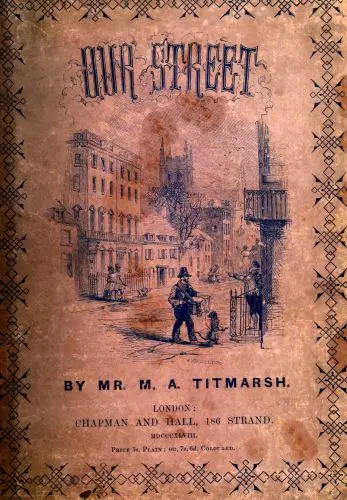
“Our Street”
William Makepeace Thackeray
THE CLASSIC COLLECTION · 1867
"Roundabout Papers" by William Makepeace Thackeray is a collection of essays and reflections written during the mid-19th century. The work captures Thackeray's keen observations on society, personal experiences, and literature through a variety of vignettes and humorous anecdotes, showcasing his characteristic blend of wit and critical insight. At the start of "Roundabout Papers," Thackeray describes a serene autumn in the quaint town of Chur, Switzerland, where he reflects on the history of the area and the peculiar figure of St. Lucius. The author observes the pastoral life around him, contrasting it with the hustle of modern progress. He introduces a lazy boy absorbed in reading novels and muses on the impact of literature on youth, celebrating the thrill and adventure found in storytelling while cautioning against excess. This opening establishes a contemplative yet humorous tone, inviting readers to engage with Thackeray’s thoughts on reading, youth, and the peculiarities of human nature.
Introduction adapted from the source catalogue; source summaries may be automatically generated.
Free to read · English · 121,024 words · No account needed
MAKE TIME FOR A GOOD BOOK
On by default. Untick to stop anonymous reading totals. Each page counts after 10 seconds in view. How this works.
Anonymous counting is on unless you have switched it off.
“Mr. Roundabout,” says a lady sitting by me, “how comes it that in your books there is a certain class (it may be of men, or it may be of women, but that is not the question in point)--how comes it, dear sir, there is a certain class of persons whom you always attack in your writings, and savagely rush at, goad, poke, toss up in the air, kick, and trample on?”
I couldn't help myself. I knew I ought not to do it. I told her the whole story, between the entrees and the roast. The wound began to bleed again. The horrid pang was there, as keen and as fresh as ever. If I live half as long as Tithonus,* that crack across my heart can never be cured. There are wrongs and griefs that CAN'T be mended. It is all very well of you, my dear Mrs. G., to say that this spirit is unchristian, and that we ought to forgive and forget, and so forth. How can I forget at will? How forgive? I can forgive the occasional waiter who broke my beautiful old decanter at that very dinner. I am not going to do him any injury. But all the powers on earth can't make that claret-jug whole.
* “Tithonus,” by Tennyson, had appeared in the preceding (the 2nd) number of the Cornhill Magazine.
So, you see, I told the lady the inevitable story. I was egotistical. I was selfish, no doubt; but I was natural, and was telling the truth. You say you are angry with a man for talking about himself. It is because you yourself are selfish, that that other person's Self does not interest you. Be interested by other people and with their affairs. Let them prattle and talk to you, as I do my dear old egotists just mentioned. When you have had enough of them, and sudden hazes come over your eyes, lay down the volume; pop out the candle, and dormez bien. I should like to write a nightcap book--a book that you can muse over, that you can smile over, that you can yawn over--a book of which you can say, “Well, this man is so and so and so and so; but he has a friendly heart (although some wiseacres have painted him as black as bogey), and you may trust what he says.” I should like to touch you sometimes with a reminiscence that shall waken your sympathy, and make you say, Io anche have so thought, felt, smiled, suffered. Now, how is this to be done except by egotism? Linea recta brevissima. That right line “I” is the very shortest, simplest, straightforwardest means of communication between us, and stands for what it is worth and no more. Sometimes authors say, “The present writer has often remarked;” or “The undersigned has observed;” or “Mr. Roundabout presents his compliments to the gentle reader, and begs to state,” &c.: but “I” is better and straighter than all these grimaces of modesty: and although these are Roundabout Papers, and may wander who knows whither, I shall ask leave to maintain the upright and simple perpendicular. When this bundle of egotisms is bound up together, as they may be one day, if no accident prevents this tongue from wagging, or this ink from running, they will bore you very likely; so it would to read through “Howel's Letters” from beginning to end, or to eat up the whole of a ham; but a slice on occasion may have a relish: a dip into the volume at random and so on for a page or two: and now and then a smile; and presently a gape; and the book drops out of your hand; and so, bon soir, and pleasant dreams to you. I have frequently seen men at clubs asleep over their humble servant's works, and am always pleased. Even at a lecture I don't mind, if they don't snore. Only the other day when my friend A. said, “You've left off that Roundabout business, I see; very glad you have,” I joined in the general roar of laughter at the table. I don't care a fig whether Archilochus likes the papers or no. You don't like partridge, Archilochus, or porridge, or what not? Try some other dish. I am not going to force mine down your throat, or quarrel with you if you refuse it. Once in America a clever and candid woman said to me, at the close of a dinner, during which I had been sitting beside her, “Mr. Roundabout, I was told I should not like you; and I don't.” “Well, ma'am,” says I, in a tone of the most unfeigned simplicity, “I don't care.” And we became good friends immediately, and esteemed each other ever after.
Your reading position is saved on this browser. Take it to another device with a library code. Reading pages adapt to text, rather than matching a printed edition.
William Makepeace Thackeray
William Makepeace Thackeray
Charles Dickens & William Makepeace Thackeray
William Makepeace Thackeray
BEHIND THE BOOK
This eBook is for the use of anyone anywhere in the United States and most other parts of the world at no cost and with almost no restrictions whatsoever. You may copy it, give it away or re-use it under the terms of the Project Gutenberg License included with this eBook or online at www.gutenberg.org. If you are not located in the United States, you will have to check the laws of the country where you are located before using this eBook. Read the source licence.
The original source file, including credits and licence, is retained by this library. Request an original-format copy at no charge. Please include the book title and Project Gutenberg identifier #2608.
KEEP YOUR CURIOSITY GOING
Wilfrid Scawen Blunt
Wilfrid Scawen Blunt
E. W. (Edgar Watson) Howe

David Patterson (Spirit) Hatch

David Patterson (Spirit) Hatch

David Patterson (Spirit) Hatch