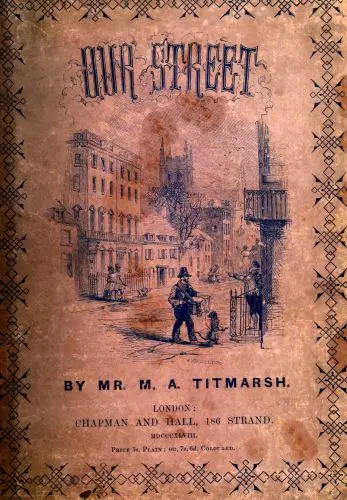
“Our Street”
William Makepeace Thackeray
THE CLASSIC COLLECTION · 1867
"Roundabout Papers" by William Makepeace Thackeray is a collection of essays and reflections written during the mid-19th century. The work captures Thackeray's keen observations on society, personal experiences, and literature through a variety of vignettes and humorous anecdotes, showcasing his characteristic blend of wit and critical insight. At the start of "Roundabout Papers," Thackeray describes a serene autumn in the quaint town of Chur, Switzerland, where he reflects on the history of the area and the peculiar figure of St. Lucius. The author observes the pastoral life around him, contrasting it with the hustle of modern progress. He introduces a lazy boy absorbed in reading novels and muses on the impact of literature on youth, celebrating the thrill and adventure found in storytelling while cautioning against excess. This opening establishes a contemplative yet humorous tone, inviting readers to engage with Thackeray’s thoughts on reading, youth, and the peculiarities of human nature.
Introduction adapted from the source catalogue; source summaries may be automatically generated.
Free to read · English · 121,024 words · No account needed
MAKE TIME FOR A GOOD BOOK
On by default. Untick to stop anonymous reading totals. Each page counts after 10 seconds in view. How this works.
Anonymous counting is on unless you have switched it off.
I am not going to expatiate on the battle. I have read in the correspondent's letter of a Northern newspaper, that in the midst of the company assembled the reader's humble servant was present, and in a very polite society, too, of “poets, clergymen, men of letters, and members of both Houses of Parliament.” If so, I must have walked to the station in my sleep, paid three guineas in a profound fit of mental abstraction, and returned to bed unconscious, for I certainly woke there about the time when history relates that the fight was over. I do not know whose colors I wore--the Benician's, or those of the Irish champion; nor remember where the fight took place, which, indeed, no somnambulist is bound to recollect. Ought Mr. Sayers to be honored for being brave, or punished for being naughty? By the shade of Brutus the elder, I don't know.
In George II.'s time, there was a turbulent navy lieutenant (Handsome Smith he was called--his picture is at Greenwich now, in brown velvet, and gold and scarlet; his coat handsome, his waistcoat exceedingly handsome; but his face by no means the beauty)--there was, I say, a turbulent young lieutenant who was broke on a complaint of the French ambassador, for obliging a French ship of war to lower her topsails to his ship at Spithead. But, by the King's orders, Tom was next day made Captain Smith. Well, if I were absolute king, I would send Tom Sayers to the mill for a month, and make him Sir Thomas on coming out of Clerkenwell. You are a naughty boy, Tom! but then, you know, we ought to love our brethren, though ever so naughty. We are moralists, and reprimand you; and you are hereby reprimanded accordingly. But in case England should ever have need of a few score thousand champions, who laugh at danger; who cope with giants; who, stricken to the ground, jump up and gayly rally, and fall, and rise again, and strike, and die rather than yield--in case the country should need such men, and you should know them, be pleased to send lists of the misguided persons to the principal police stations, where means may some day be found to utilize their wretched powers, and give their deplorable energies a right direction. Suppose, Tom, that you and your friends are pitted against an immense invader--suppose you are bent on holding the ground, and dying there, if need be--suppose it is life, freedom, honor, home, you are fighting for, and there is a death--dealing sword or rifle in your hand, with which you are going to resist some tremendous enemy who challenges your championship on your native shore? Then, Sir Thomas, resist him to the death, and it is all right: kill him, and heaven bless you. Drive him into the sea, and there destroy, smash, and drown him; and let us sing Laudamus. In these national cases, you see, we override the indisputable first laws of morals. Loving your neighbor is very well, but suppose your neighbor comes over from Calais and Boulogne to rob you of your laws, your liberties, your newspapers, your parliament (all of which SOME dear neighbors of ours have given up in the most self-denying manner): suppose any neighbor were to cross the water and propose this kind of thing to us? Should we not be justified in humbly trying to pitch him into the water? If it were the King of Belgium himself we must do so. I mean that fighting, of course, is wrong; but that there are occasions when, &c.--I suppose I mean that that one-handed fight of Sayers is one of the most spirit-stirring little stories ever told and, with every love and respect for Morality--my spirit says to her, “Do, for goodness' sake, my dear madam, keep your true, and pure, and womanly, and gentle remarks for another day. Have the great kindness to stand a LEETLE aside, and just let us see one or two more rounds between the men. That little man with the one hand powerless on his breast facing yonder giant for hours, and felling him, too, every now and then! It is the little 'Java' and the 'Constitution' over again.”
Your reading position is saved on this browser. Take it to another device with a library code. Reading pages adapt to text, rather than matching a printed edition.
William Makepeace Thackeray
William Makepeace Thackeray
Charles Dickens & William Makepeace Thackeray
William Makepeace Thackeray
BEHIND THE BOOK
This eBook is for the use of anyone anywhere in the United States and most other parts of the world at no cost and with almost no restrictions whatsoever. You may copy it, give it away or re-use it under the terms of the Project Gutenberg License included with this eBook or online at www.gutenberg.org. If you are not located in the United States, you will have to check the laws of the country where you are located before using this eBook. Read the source licence.
The original source file, including credits and licence, is retained by this library. Request an original-format copy at no charge. Please include the book title and Project Gutenberg identifier #2608.
KEEP YOUR CURIOSITY GOING
Wilfrid Scawen Blunt
Wilfrid Scawen Blunt

E. W. (Edgar Watson) Howe

David Patterson (Spirit) Hatch

David Patterson (Spirit) Hatch

David Patterson (Spirit) Hatch