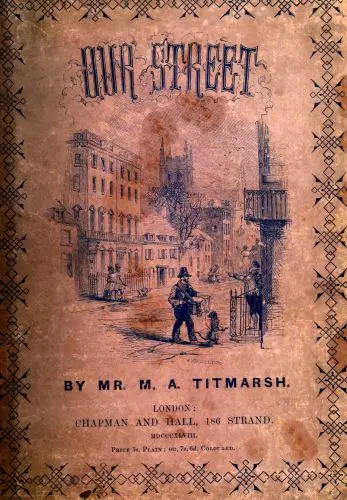
“Our Street”
William Makepeace Thackeray
THE CLASSIC COLLECTION · 1867
"Roundabout Papers" by William Makepeace Thackeray is a collection of essays and reflections written during the mid-19th century. The work captures Thackeray's keen observations on society, personal experiences, and literature through a variety of vignettes and humorous anecdotes, showcasing his characteristic blend of wit and critical insight. At the start of "Roundabout Papers," Thackeray describes a serene autumn in the quaint town of Chur, Switzerland, where he reflects on the history of the area and the peculiar figure of St. Lucius. The author observes the pastoral life around him, contrasting it with the hustle of modern progress. He introduces a lazy boy absorbed in reading novels and muses on the impact of literature on youth, celebrating the thrill and adventure found in storytelling while cautioning against excess. This opening establishes a contemplative yet humorous tone, inviting readers to engage with Thackeray’s thoughts on reading, youth, and the peculiarities of human nature.
Introduction adapted from the source catalogue; source summaries may be automatically generated.
Free to read · English · 121,024 words · No account needed
MAKE TIME FOR A GOOD BOOK
On by default. Untick to stop anonymous reading totals. Each page counts after 10 seconds in view. How this works.
Anonymous counting is on unless you have switched it off.
He who borrows, meaning to pay, is quite a different person from the individual here described. Many--most, I hope--took Jack's promise for what it was worth--and quite well knew that when he said, “Lend me,” he meant “Give me” twenty pounds. “Give me change for this half-crown,” said Jack; “I know it's a pewter piece;” and you gave him the change in honest silver, and pocketed the counterfeit gravely.
What a queer consciousness that must be which accompanies such a man in his sleeping, in his waking, in his walk through life, by his fireside with his children round him! “For what we are going to receive,” &c.--he says grace before his dinner. “My dears! Shall I help you to some mutton? I robbed the butcher of the meat. I don't intend to pay him. Johnson my boy, a glass of champagne? Very good, isn't it? Not too sweet. Forty-six. I get it from So-and-so, whom I intend to cheat.” As eagles go forth and bring home to their eaglets the lamb or the pavid kid, I say there are men who live and victual their nests by plunder. We all know highway robbers in white neck-cloths, domestic bandits, marauders, passers of bad coin. What was yonder cheque which Major Delamere proposed I should cash but a piece of bad money? What was Jack Thriftless's promise to pay? Having got his booty, I fancy Jack or the Major returning home, and wife and children gathering round about him. Poor wife and children! They respect papa very likely. They don't know he is false coin. Maybe the wife has a dreadful inkling of the truth, and, sickening, tries to hide it from the daughters and sons. Maybe she is an accomplice: herself a brazen forgery. If Turpin and Jack Sheppard were married, very likely Mesdames Sheppard and Turpin did not know, at first, what their husbands' real profession was, and fancied, when the men left home in the morning, they only went away to follow some regular and honorable business. Then a suspicion of the truth may have come: then a dreadful revelation; and presently we have the guilty pair robbing together, or passing forged money each on his own account. You know Doctor Dodd? I wonder whether his wife knows that he is a forger, and scoundrel? Has she had any of the plunder, think you, and were the darling children's new dresses bought with it? The Doctor's sermon last Sunday was certainly charming, and we all cried. Ah, my poor Dodd! Whilst he is preaching most beautifully, pocket-handkerchief in hand, he is peering over the pulpit cushions, looking out piteously for Messrs. Peachum and Lockit from the police-office. By Doctor Dodd you understand I would typify the rogue of respectable exterior, not committed to gaol yet, but not undiscovered. We all know one or two such. This very sermon perhaps will be read by some, or more likely--for, depend upon it, your solemn hypocritic scoundrels don't care much for light literature--more likely, I say, this discourse will be read by some of their wives, who think, “Ah mercy! does that horrible cynical wretch know how my poor husband blacked my eye, or abstracted mamma's silver teapot, or forced me to write So-and-so's name on that piece of stamped paper, or what not?” My good creature, I am not angry with YOU. If your husband has broken your nose, you will vow that he had authority over your person, and a right to demolish any part of it: if he has conveyed away your mamma's teapot, you will say that she gave it to him at your marriage, and it was very ugly, and what not? if he takes your aunt's watch, and you love him, you will carry it ere long to the pawnbroker's, and perjure yourself--oh, how you will perjure yourself--in the witness-box! I know this is a degrading view of woman's noble nature, her exalted mission, and so forth, and so forth. I know you will say this is bad morality. Is it? Do you, or do you not, expect your womankind to stick by you for better or for worse? Say I have committed a forgery, and the officers come in search of me, is my wife, Mrs. Dodd, to show them into the dining-room and say, “Pray step in, gentlemen! My husband has just come home from church. That bill with my Lord Chesterfield's acceptance, I am bound to own, was never written by his lordship, and the signature is in the doctor's handwriting?” I say, would any man of sense or honor, or fine feeling, praise his wife for telling the truth under such circumstances? Suppose she made a fine grimace, and said, “Most painful as my position is, most deeply as I feel for my William, yet truth must prevail, and I deeply lament to state that the beloved partner of my life DID commit the flagitious act with which he is charged, and is at this present moment located in the two-pair back, up the chimney, whither it is my duty to lead you.” Why, even Dodd himself, who was one of the greatest humbugs who ever lived, would not have had the face to say that he approved of his wife telling the truth in such a case. Would you have had Flora Macdonald beckon the officers, saying, “This way, gentlemen! You will find the young chevalier asleep in that cavern.” Or don't you prefer her to be splendide mendax, and ready at all risks to save him? If ever I lead a rebellion, and my women betray me, may I be hanged but I will not forgive them: and if ever I steal a teapot, and MY women don't stand up for me, pass the article under their shawls, whisk down the street with it, outbluster the policeman, and utter any amount of fibs before Mr. Beak, those beings are not what I take them to be, and--for a fortune--I won't give them so much as a bad half-crown.
Your reading position is saved on this browser. Take it to another device with a library code. Reading pages adapt to text, rather than matching a printed edition.
William Makepeace Thackeray
William Makepeace Thackeray
Charles Dickens & William Makepeace Thackeray
William Makepeace Thackeray
BEHIND THE BOOK
This eBook is for the use of anyone anywhere in the United States and most other parts of the world at no cost and with almost no restrictions whatsoever. You may copy it, give it away or re-use it under the terms of the Project Gutenberg License included with this eBook or online at www.gutenberg.org. If you are not located in the United States, you will have to check the laws of the country where you are located before using this eBook. Read the source licence.
The original source file, including credits and licence, is retained by this library. Request an original-format copy at no charge. Please include the book title and Project Gutenberg identifier #2608.
KEEP YOUR CURIOSITY GOING
Wilfrid Scawen Blunt
Wilfrid Scawen Blunt

E. W. (Edgar Watson) Howe

David Patterson (Spirit) Hatch

David Patterson (Spirit) Hatch

David Patterson (Spirit) Hatch