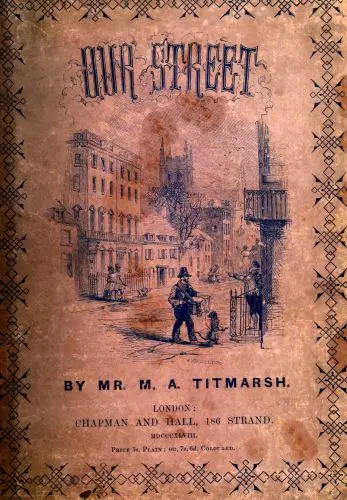
“Our Street”
William Makepeace Thackeray
THE CLASSIC COLLECTION · 1867
"Roundabout Papers" by William Makepeace Thackeray is a collection of essays and reflections written during the mid-19th century. The work captures Thackeray's keen observations on society, personal experiences, and literature through a variety of vignettes and humorous anecdotes, showcasing his characteristic blend of wit and critical insight. At the start of "Roundabout Papers," Thackeray describes a serene autumn in the quaint town of Chur, Switzerland, where he reflects on the history of the area and the peculiar figure of St. Lucius. The author observes the pastoral life around him, contrasting it with the hustle of modern progress. He introduces a lazy boy absorbed in reading novels and muses on the impact of literature on youth, celebrating the thrill and adventure found in storytelling while cautioning against excess. This opening establishes a contemplative yet humorous tone, inviting readers to engage with Thackeray’s thoughts on reading, youth, and the peculiarities of human nature.
Introduction adapted from the source catalogue; source summaries may be automatically generated.
Free to read · English · 121,024 words · No account needed
MAKE TIME FOR A GOOD BOOK
On by default. Untick to stop anonymous reading totals. Each page counts after 10 seconds in view. How this works.
Anonymous counting is on unless you have switched it off.
The conversation, you perceive, might be easily written down to this key; and if the hero and heroine were modern, they would not be suffered to go through their dialogue on stilts, but would converse in the natural graceful way at present customary. By the way, what a strange custom that is in modern lady novelists to make the men bully the women! In the time of Miss Porter and Madame D'Arblay, we have respect, profound bows and curtsies, graceful courtesy, from men to women. In the time of Miss Bronte, absolute rudeness. Is it true, mesdames, that you like rudeness, and are pleased at being ill-used by men? I could point to more than one lady novelist who so represents you.
Other people may not much like this extract, madam, from your favorite novel, but when you come to read it, YOU will like it. I suspect that when you read that book which you so love, you read it a deux. Did you not yourself pass a winter at Bath, when you were the belle of the assembly? Was there not a Lord Orville in your case too? As you think of him eleven lustres pass away. You look at him with the bright eyes of those days, and your hero stands before you, the brave, the accomplished, the simple, the true gentleman; and he makes the most elegant of bows to one of the most beautiful young women the world ever saw; and he leads you out to the cotillon, to the dear unforgotten music. Hark to the horns of Elfand, blowing, blowing! Bonne vieille, you remember their melody, and your heart-strings thrill with it still.
Of your heroic heroes, I think our friend Monseigneur Athos, Count de la Fere, is my favorite. I have read about him from sunrise to sunset with the utmost contentment of mind. He has passed through how many volumes? Forty? Fifty? I wish for my part there were a hundred more, and would never tire of him reselling prisoners, punishing ruffians, and running scoundrels through the midriff with his most graceful rapier. Ah, Athos, Porthos, and Aramis, you are a magnificent trio. I think I like d'Artagnan in his own memoirs best. I bought him years and years ago, price fivepence, in a little parchment-covered Cologne-printed volume, at a stall in Gray's Inn Lane. Dumas glorifies him and makes a Marshal of him; if I remember rightly, the original d'Artagnan was a needy adventurer, who died in exile very early in Louis XIV.'s reign. Did you ever read the “Chevalier d'Harmenthal?” Did you ever read the “Tulipe Noire,” as modest as a story by Miss Edgeworth? I think of the prodigal banquets to which this Lucullus of a man has invited me, with thanks and wonder. To what a series of splendid entertainments he has treated me! Where does he find the money for these prodigious feasts? They say that all the works bearing Dumas's name are not written by him. Well? Does not the chief cook have aides under him? Did not Rubens's pupils paint on his canvases? Had not Lawrence assistants for his backgrounds? For myself, being also du metier, I confess I would often like to have a competent, respectable, and rapid clerk for the business part of my novels; and on his arrival, at eleven o'clock, would say, “Mr. Jones, if you please, the archbishop must die this morning in about five pages. Turn to article 'Dropsy' (or what you will) in Encyclopaedia. Take care there are no medical blunders in his death. Group his daughters, physicians, and chaplains round him. In Wales's 'London,' letter B, third shelf, you will find an account of Lambeth, and some prints of the place. Color in with local coloring. The daughter will come down, and speak to her lover in his wherry at Lambeth Stairs,” &c., &c. Jones (an intelligent young man) examines the medical, historical, topographical books necessary; his chief points out to him in Jeremy Taylor (fol., London, M.DCLV.) a few remarks, such as might befit a dear old archbishop departing this life. When I come back to dress for dinner, the archbishop is dead on my table in five pages; medicine, topography, theology, all right, and Jones has gone home to his family some hours. Sir Christopher is the architect of St. Paul's. He has not laid the stones or carried up the mortar. There is a great deal of carpenter's and joiner's work in novels which surely a smart professional hand might supply. A smart professional hand? I give you my word, there seem to me parts of novels--let us say the love-making, the “business,” the villain in the cupboard, and so forth, which I should like to order John Footman to take in hand, as I desire him to bring the coals and polish the boots. Ask ME indeed to pop a robber under a bed, to hide a will which shall be forthcoming in due season, or at my time of life to write a namby-pamby love conversation between Emily and Lord Arthur! I feel ashamed of myself, and especially when my business obliges me to do the love-passages, I blush so, though quite alone in my study, that you would fancy I was going off in an apoplexy. Are authors affected by their own works? I don't know about other gentlemen, but if I make a joke myself I cry; if I write a pathetic scene I am laughing wildly all the time--at least Tomkins thinks so. You know I am such a cynic!
Your reading position is saved on this browser. Take it to another device with a library code. Reading pages adapt to text, rather than matching a printed edition.
William Makepeace Thackeray
William Makepeace Thackeray
Charles Dickens & William Makepeace Thackeray
William Makepeace Thackeray
BEHIND THE BOOK
This eBook is for the use of anyone anywhere in the United States and most other parts of the world at no cost and with almost no restrictions whatsoever. You may copy it, give it away or re-use it under the terms of the Project Gutenberg License included with this eBook or online at www.gutenberg.org. If you are not located in the United States, you will have to check the laws of the country where you are located before using this eBook. Read the source licence.
The original source file, including credits and licence, is retained by this library. Request an original-format copy at no charge. Please include the book title and Project Gutenberg identifier #2608.
KEEP YOUR CURIOSITY GOING
Wilfrid Scawen Blunt
Wilfrid Scawen Blunt

E. W. (Edgar Watson) Howe

David Patterson (Spirit) Hatch

David Patterson (Spirit) Hatch

David Patterson (Spirit) Hatch