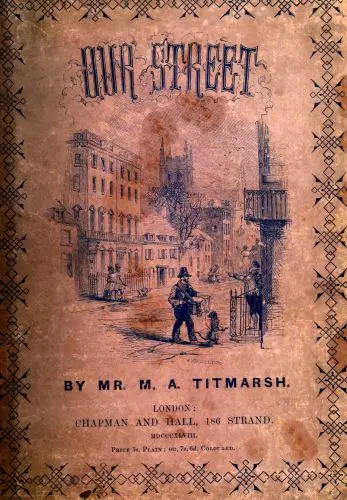
“Our Street”
William Makepeace Thackeray
THE CLASSIC COLLECTION · 1867
"Roundabout Papers" by William Makepeace Thackeray is a collection of essays and reflections written during the mid-19th century. The work captures Thackeray's keen observations on society, personal experiences, and literature through a variety of vignettes and humorous anecdotes, showcasing his characteristic blend of wit and critical insight. At the start of "Roundabout Papers," Thackeray describes a serene autumn in the quaint town of Chur, Switzerland, where he reflects on the history of the area and the peculiar figure of St. Lucius. The author observes the pastoral life around him, contrasting it with the hustle of modern progress. He introduces a lazy boy absorbed in reading novels and muses on the impact of literature on youth, celebrating the thrill and adventure found in storytelling while cautioning against excess. This opening establishes a contemplative yet humorous tone, inviting readers to engage with Thackeray’s thoughts on reading, youth, and the peculiarities of human nature.
Introduction adapted from the source catalogue; source summaries may be automatically generated.
Free to read · English · 121,024 words · No account needed
MAKE TIME FOR A GOOD BOOK
On by default. Untick to stop anonymous reading totals. Each page counts after 10 seconds in view. How this works.
Anonymous counting is on unless you have switched it off.
How did I come into this talk? I protest it was the word inn set me off--and here is one, the “Hotel de Belle Vue,” at the Hague, as comfortable, as handsome, as cheerful as any I ever took mine ease in. And the Bavarian beer, my dear friend, how good and brisk and light it is! Take another glass--it refreshes and does not stupefy--and then we will sally out, and see the town and the park and the pictures.
The prettiest little brick city, the pleasantest little park to ride in, the neatest comfortable people walking about, the canals not unsweet, and busy and picturesque with old-world life. Rows upon rows of houses, built with the neatest little bricks, with windows fresh painted, and tall doors polished, and carved to a nicety. What a pleasant spacious garden our inn has, all sparkling with autumn flowers and bedizened with statues! At the end is a row of trees, and a summer-house, over the canal, where you might go and smoke a pipe with Mynheer Van Dunck, and quite cheerfully catch the ague. Yesterday, as we passed, they were making hay, and stacking it in a barge which was lying by the meadow, handy. Round about Kensington Palace there are houses, roofs, chimneys, and bricks like these. I feel that a Dutchman is a man and a brother. It is very funny to read the newspaper, one can understand it somehow. Sure it is the neatest, gayest little city--scores and hundreds of mansions looking like Cheyne Walk, or the ladies' schools about Chiswick and Hackney.
LE GROS LOT.--To a few lucky men the chance befalls of reaching fame at once, and (if it is of any profit morituro) retaining the admiration of the world. Did poor Oliver, when he was at Leyden yonder, ever think that he should paint a little picture which should secure him the applause and pity of all Europe for a century after? He and Sterne drew the twenty thousand prize of fame. The latter had splendid instalments during his lifetime. The ladies pressed round him; the wits admired him, the fashion hailed the successor of Rabelais. Goldsmith's little gem was hardly so valued until later days. Their works still form the wonder and delight of the lovers of English art; and the pictures of the Vicar and Uncle Toby are among the masterpieces of our English school. Here in the Hague Gallery is Paul Potter's pale, eager face, and yonder is the magnificent work by which the young fellow achieved his fame. How did you, so young, come to paint so well? What hidden power lay in that weakly lad that enabled him to achieve such a wonderful victory? Could little Mozart, when he was five years old, tell you how he came to play those wonderful sonatas? Potter was gone out of the world before he was thirty, but left this prodigy (and I know not how many more specimens of his genius and skill) behind him. The details of this admirable picture are as curious as the effect is admirable and complete. The weather being unsettled, and clouds and sunshine in the gusty sky, we saw in our little tour numberless Paul Potters--the meadows streaked with sunshine and spotted with the cattle, the city twinkling in the distance, the thunderclouds glooming overhead. Napoleon carried off the picture (vide Murray) amongst the spoils of his bow and spear to decorate his triumph of the Louvre. If I were a conquering prince, I would have this picture certainly, and the Raphael “Madonna” from Dresden, and the Titian “Assumption” from Venice, and that matchless Rembrandt of the “Dissection.” The prostrate nations would howl with rage as my gendarmes took off the pictures, nicely packed, and addressed to “Mr. the Director of my Imperial Palace of the Louvre, at Paris. This side uppermost.” The Austrians, Prussians, Saxons, Italians, &c., should be free to come and visit my capital, and bleat with tears before the pictures torn from their native cities. Their ambassadors would meekly remonstrate, and with faded grins make allusions to the feeling of despair occasioned by the absence of the beloved works of art. Bah! I would offer them a pinch of snuff out of my box as I walked along my gallery, with their Excellencies cringing after me. Zenobia was a fine woman and a queen, but she had to walk in Aurelian's triumph. The procede was peu delicat? En usez vous, mon cher monsieur! (The marquis says the “Macaba” is delicious.) What a splendor of color there is in that cloud! What a richness, what a freedom of handling, and what a marvellous precision! I trod upon your Excellency's corn?--a thousand pardons. His Excellency grins and declares that he rather likes to have his corns trodden on. Were you ever very angry with Soult--about that Murillo which we have bought? The veteran loved that picture because it saved the life of a fellow-creature--the fellow-creature who hid it, and whom the Duke intended to hang unless the picture was forthcoming.
Your reading position is saved on this browser. Take it to another device with a library code. Reading pages adapt to text, rather than matching a printed edition.
William Makepeace Thackeray
William Makepeace Thackeray
Charles Dickens & William Makepeace Thackeray
William Makepeace Thackeray
BEHIND THE BOOK
This eBook is for the use of anyone anywhere in the United States and most other parts of the world at no cost and with almost no restrictions whatsoever. You may copy it, give it away or re-use it under the terms of the Project Gutenberg License included with this eBook or online at www.gutenberg.org. If you are not located in the United States, you will have to check the laws of the country where you are located before using this eBook. Read the source licence.
The original source file, including credits and licence, is retained by this library. Request an original-format copy at no charge. Please include the book title and Project Gutenberg identifier #2608.
KEEP YOUR CURIOSITY GOING
Wilfrid Scawen Blunt
Wilfrid Scawen Blunt

E. W. (Edgar Watson) Howe

David Patterson (Spirit) Hatch

David Patterson (Spirit) Hatch

David Patterson (Spirit) Hatch