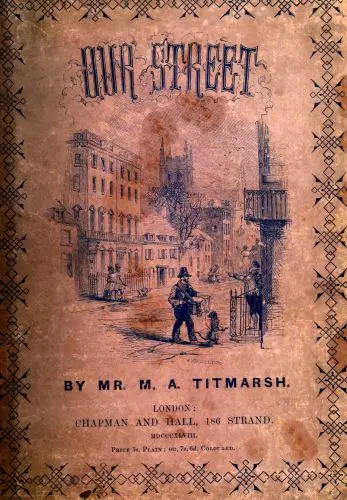
“Our Street”
William Makepeace Thackeray
THE CLASSIC COLLECTION · 1867
"Roundabout Papers" by William Makepeace Thackeray is a collection of essays and reflections written during the mid-19th century. The work captures Thackeray's keen observations on society, personal experiences, and literature through a variety of vignettes and humorous anecdotes, showcasing his characteristic blend of wit and critical insight. At the start of "Roundabout Papers," Thackeray describes a serene autumn in the quaint town of Chur, Switzerland, where he reflects on the history of the area and the peculiar figure of St. Lucius. The author observes the pastoral life around him, contrasting it with the hustle of modern progress. He introduces a lazy boy absorbed in reading novels and muses on the impact of literature on youth, celebrating the thrill and adventure found in storytelling while cautioning against excess. This opening establishes a contemplative yet humorous tone, inviting readers to engage with Thackeray’s thoughts on reading, youth, and the peculiarities of human nature.
Introduction adapted from the source catalogue; source summaries may be automatically generated.
Free to read · English · 121,024 words · No account needed
MAKE TIME FOR A GOOD BOOK
On by default. Untick to stop anonymous reading totals. Each page counts after 10 seconds in view. How this works.
Anonymous counting is on unless you have switched it off.
To the castle-gates of some of these monsters up rides the dapper champion of the pen; puffs boldly upon the horn which hangs by the chain; enters the hall resolutely, and challenges the big tyrant sulking within. We defy him to combat, the enormous roaring ruffian! We give him a meeting on the green plain before his castle. Green? No wonder it should be green: it is manured with human bones. After a few graceful wheels and curvets, we take our ground. We stoop over our saddle. 'Tis but to kiss the locket of our lady-love's hair. And now the vizor is up: the lance is in rest (Gillott's iron is the point for me). A touch of the spur in the gallant sides of Pegasus, and we gallop at the great brute.
“Cut off his ugly head, Flibbertygibbet, my squire!” And who are these who pour out of the castle? the imprisoned maidens, the maltreated widows, the poor old hoary grandfathers, who have been locked up in the dungeons these scores and scores of years, writhing under the tyranny of that ruffian! Ah ye knights of the pen! May honor be your shield, and truth tip your lances! Be gentle to all gentle people. Be modest to women. Be tender to children. And as for the Ogre Humbug, out sword, and have at him.
* The following paper was written in 1861, after the extraordinary affray between Major Murray and the money- lender in a house in Northumberland Street, Strand, and subsequent to the appearance of M. Du Chaillu's book on Gorillas.
We have all heard of a place paved with good intentions--a place which I take to be a very dismal, useless, and unsatisfactory terminus for many pleasant thoughts, kindly fancies, gentle wishes, merry little quips and pranks, harmless jokes which die as it were the moment of their birth. Poor little children of the brain! He was a dreary theologian who huddled you under such a melancholy cenotaph, and laid you in the vaults under the flagstones of Hades! I trust that some of the best actions we have all of us committed in our lives have been committed in fancy. It is not all wickedness we are thinking, que diable! Some of our thoughts are bad enough I grant you. Many a one you and I have had here below. Ah mercy, what a monster! what crooked horns! what leering eyes! what a flaming mouth! what cloven feet, and what a hideous writhing tail! Oh, let us fall down on our knees, repeat our most potent exorcisms, and overcome the brute. Spread your black pinions, fly--fly to the dusky realms of Eblis, and bury thyself under the paving-stones of his hall, dark genie! But ALL thoughts are not so. No--no. There are the pure: there are the kind: there are the gentle. There are sweet unspoken thanks before a fair scene of nature: at a sun-setting below a glorious sea: or a moon and a host of stars shining over it: at a bunch of children playing in the street, or a group of flowers by the hedge-side, or a bird singing there. At a hundred moments or occurrences of the day good thoughts pass through the mind, let us trust, which never are spoken; prayers are made which never are said; and Te Deum is sung without church, clerk, choristers, parson, or organ. Why, there's my enemy: who got the place I wanted; who maligned me to the woman I wanted to be well with; who supplanted me in the good graces of my patron. I don't say anything about the matter: but, my poor old enemy, in my secret mind I have movements of as tender charity towards you, you old scoundrel, as ever I had when we were boys together at school. You ruffian! do you fancy I forget that we were fond of each other? We are still. We share our toffy; go halves at the tuck-shop; do each other's exercises; prompt each other with the word in construing or repetition; and tell the most frightful fibs to prevent each other from being found out. We meet each other in public. Ware a fight! Get them into different parts of the room! Our friends hustle round us. Capulet and Montague are not more at odds than the houses of Roundabout and Wrightabout, let us say. It is, “My dear Mrs. Buffer, do kindly put yourself in the chair between those two men!” Or, “My dear Wrightabout, will you take that charming Lady Blancmange down to supper? She adores your poems, and gave five shillings for your autograph at the fancy fair.” In like manner the peacemakers gather round Roundabout on his part; he is carried to a distant corner, and coaxed out of the way of the enemy with whom he is at feud.
Your reading position is saved on this browser. Take it to another device with a library code. Reading pages adapt to text, rather than matching a printed edition.
William Makepeace Thackeray
William Makepeace Thackeray
Charles Dickens & William Makepeace Thackeray
William Makepeace Thackeray
BEHIND THE BOOK
This eBook is for the use of anyone anywhere in the United States and most other parts of the world at no cost and with almost no restrictions whatsoever. You may copy it, give it away or re-use it under the terms of the Project Gutenberg License included with this eBook or online at www.gutenberg.org. If you are not located in the United States, you will have to check the laws of the country where you are located before using this eBook. Read the source licence.
The original source file, including credits and licence, is retained by this library. Request an original-format copy at no charge. Please include the book title and Project Gutenberg identifier #2608.
KEEP YOUR CURIOSITY GOING
Wilfrid Scawen Blunt
Wilfrid Scawen Blunt

E. W. (Edgar Watson) Howe

David Patterson (Spirit) Hatch

David Patterson (Spirit) Hatch

David Patterson (Spirit) Hatch