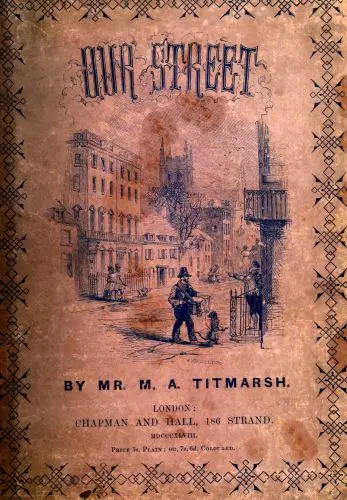
“Our Street”
William Makepeace Thackeray
THE CLASSIC COLLECTION · 1867
"Roundabout Papers" by William Makepeace Thackeray is a collection of essays and reflections written during the mid-19th century. The work captures Thackeray's keen observations on society, personal experiences, and literature through a variety of vignettes and humorous anecdotes, showcasing his characteristic blend of wit and critical insight. At the start of "Roundabout Papers," Thackeray describes a serene autumn in the quaint town of Chur, Switzerland, where he reflects on the history of the area and the peculiar figure of St. Lucius. The author observes the pastoral life around him, contrasting it with the hustle of modern progress. He introduces a lazy boy absorbed in reading novels and muses on the impact of literature on youth, celebrating the thrill and adventure found in storytelling while cautioning against excess. This opening establishes a contemplative yet humorous tone, inviting readers to engage with Thackeray’s thoughts on reading, youth, and the peculiarities of human nature.
Introduction adapted from the source catalogue; source summaries may be automatically generated.
Free to read · English · 121,024 words · No account needed
MAKE TIME FOR A GOOD BOOK
On by default. Untick to stop anonymous reading totals. Each page counts after 10 seconds in view. How this works.
Anonymous counting is on unless you have switched it off.
Those poor people in brass, on pedestals, hectoring about Trafalgar Square and that neighborhood, don't you think many of them--apart even from the ridiculous execution--cut rather a ridiculous figure, and that we are too eager to set up our ordinaire heroism and talent for port? A Duke of Wellington or two I will grant, though even of these idols a moderate supply will be sufficient. Some years ago a famous and witty French critic was in London, with whom I walked the streets. I am ashamed to say that I informed him (being in hopes that he was about to write some papers regarding the manners and customs of this country) that all the statues he saw represented the Duke of Wellington. That on the arch opposite Apsley House? the Duke in a cloak, and cocked hat, on horseback. That behind Apsley House in an airy fig-leaf costume? the Duke again. That in Cockspur Street? the Duke with a pigtail--and so on. I showed him an army of Dukes. There are many bronze heroes who after a few years look already as foolish, awkward, and out of place as a man, say at Shoolbred's or Swan and Edgar's. For example, those three Grenadiers in Pall Mall, who have been up only a few months, don't you pity those unhappy household troops, who have to stand frowning and looking fierce there; and think they would like to step down and go to barracks? That they fought very bravely there is no doubt; but so did the Russians fight very bravely; and the French fight very bravely; and so did Colonel Jones and the 99th, and Colonel Brown and the 100th; and I say again that ordinaire should not give itself port airs, and that an honest ordinaire would blush to be found swaggering so. I am sure if you could consult the Duke of York, who is impaled on his column between the two clubs, and ask his late Royal Highness whether he thought he ought to remain there, he would say no. A brave, worthy man, not a braggart or boaster, to be put upon that heroic perch must be painful to him. Lord George Bentinck, I suppose, being in the midst of the family park in Cavendish Square, may conceive that he has a right to remain in his place. But look at William of Cumberland, with his hat cocked over his eye, prancing behind Lord George on his Roman-nosed charger; he, depend on it, would be for getting off his horse if he had the permission. He did not hesitate about trifles, as we know; but he was a very truth-telling and honorable soldier: and as for heroic rank and statuesque dignity, I would wager a dozen of '20 port against a bottle of pure and sound Bordeaux, at 18s. per dozen (bottles included), that he never would think of claiming any such absurd distinction. They have got a statue of Thomas Moore at Dublin, I hear. Is he on horseback? Some men should have, say, a fifty years' lease of glory. After a while some gentlemen now in brass should go to the melting furnace, and reappear in some other gentleman's shape. Lately I saw that Melville column rising over Edinburgh; come, good men and true, don't you feel a little awkward and uneasy when you walk under it? Who was this to stand in heroic places? and is yon the man whom Scotchmen most delight to honor? I must own deferentially that there is a tendency in North Britain to over-esteem its heroes. Scotch ale is very good and strong, but it is not stronger than all the other beer in the world, as some Scottish patriots would insist. When there has been a war, and stout old Sandy Sansculotte returns home from India or Crimea, what a bagpiping, shouting, hurraying, and self-glorification takes place round about him! You would fancy, to hear McOrator after dinner, that the Scotch had fought all the battles, killed all the Russians, Indian rebels, or what not. In Cupar-Fife, there's a little inn called the “Battle of Waterloo,” and what do you think the sign is? (I sketch from memory, to be sure.)* “The Battle of Waterloo” is one broad Scotchman laying about him with a broadsword. Yes, yes, my dear Mac, you are wise, you are good, you are clever, you are handsome, you are brave, you are rich, &c.; but so is Jones over the border. Scotch salmon is good, but there are other good fish in the sea. I once heard a Scotchman lecture on poetry in London. Of course the pieces he selected were chiefly by Scottish authors, and Walter Scott was his favorite poet. I whispered to my neighbor, who was a Scotchman (by the way, the audience were almost all Scotch, and the room was All-Mac's--I beg your pardon, but I couldn't help it, I really couldn't help it)--“The professor has said the best poet was a Scotchman: I wager that he will say the worst poet was a Scotchman, too.” And sure enough that worst poet, when he made his appearance, was a Northern Briton.
Your reading position is saved on this browser. Take it to another device with a library code. Reading pages adapt to text, rather than matching a printed edition.
William Makepeace Thackeray
William Makepeace Thackeray
Charles Dickens & William Makepeace Thackeray
William Makepeace Thackeray
BEHIND THE BOOK
This eBook is for the use of anyone anywhere in the United States and most other parts of the world at no cost and with almost no restrictions whatsoever. You may copy it, give it away or re-use it under the terms of the Project Gutenberg License included with this eBook or online at www.gutenberg.org. If you are not located in the United States, you will have to check the laws of the country where you are located before using this eBook. Read the source licence.
The original source file, including credits and licence, is retained by this library. Request an original-format copy at no charge. Please include the book title and Project Gutenberg identifier #2608.
KEEP YOUR CURIOSITY GOING
Wilfrid Scawen Blunt
Wilfrid Scawen Blunt

E. W. (Edgar Watson) Howe

David Patterson (Spirit) Hatch

David Patterson (Spirit) Hatch

David Patterson (Spirit) Hatch