THE CLASSIC COLLECTION✦Jack DerringerCLASSIC FREE BOOKS
Jack Derringer
Basil Lubbock
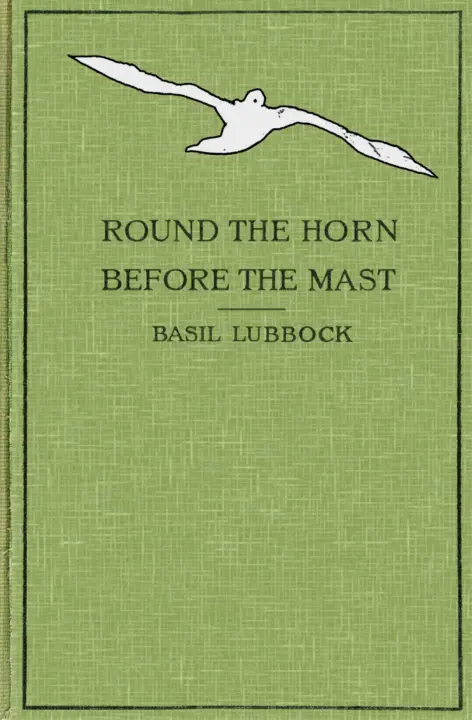
THE CLASSIC COLLECTION · 1915
"Round the Horn before the mast" by Basil Lubbock is a maritime memoir written in the early 20th century. It follows a gentleman volunteer who ships before the mast on the four‑masted barque Royalshire to experience deep‑water life on a grain passage from San Francisco around Cape Horn toward Europe. The narrative dwells on the gritty work, seamanship, and shipboard culture of the great windjammers, painting vivid portraits of officers, crew, and ports. It promises realism, humor, and danger rather than romance. The opening of this narrative finds the narrator in San Francisco after the Klondike, choosing the Royalshire, signing on, and pairing up with fellow recruit Don Henderson. He outfits like a common seaman and plunges into hard labor: unloading Japanese coal, scouring stringers and bilges, chipping and painting, wrestling wire moorings, and enduring rough fare—relieved by cricket matches and the Seamen’s Institute. The ship shifts to Oakland Creek and Port Costa to line the holds and load barley, while a suspicious Swedish sailmaker appears, a classic South Sea whaler is spotted, and the crew bends sail aloft in a stiff wind. There are swims in the Sacramento, a sandy-shore breakfast on a boat errand, and a grim episode when an apprentice from another ship drowns and the Royalshire’s “nipper” is nearly lost. After finishing cargo and returning to the bay, a mixed crew drifts aboard, the narrator briefly serves as steward, and the harbor erupts in celebration for returning troops as the ship is dressed overall. Before dawn, the men man the capstan, a tug takes hold, the anchor breaks out, and the Royalshire heads to sea.
Introduction adapted from the source catalogue; source summaries may be automatically generated.
Free to read · English · 84,274 words · No account needed
MAKE TIME FOR A GOOD BOOK
On by default. Untick to stop anonymous reading totals. Each page counts after 10 seconds in view. How this works.
Anonymous counting is on unless you have switched it off.
Solo. “Oh, Shenadoah, I’ll ne’er forget you,” Chorus. “Away, my rolling river!” Solo. “Till the day I die, I’ll love you ever,” Chorus. “Ah! ah! We’re bound away ’Cross the wide Missouri.”
So it runs on, the roar of the storm and the weird shrieking and humming in the rigging making an accompaniment hardly to be beaten by a first-class band. Even the clash of the deck ports resemble cymbals and the big drum.
Round we go, half a dozen voices roaring at the top of their pipes, Mac’s and Jamieson’s shrill, wild, and broken, old Foghorn’s two octaves below the rest of us, like the growling of a grizzly bear.
It’s wonderful how a chanty will get a topsail mastheaded. We sent the mizen upper-topsail up to the tune of
Solo. “Sing and heave, and heave and sing,” Chorus. “Hoodah, to my hoodah;”
Solo. “Heave, and make the handspikes spring,” Chorus. “Hoodah, hoodah day. And it’s blow ye winds, heigh-ho, For Cal--i--for--ni--o; For there’s plenty of gold, so I’ve been told, On the banks of the Sacramento!”
It is rather difficult for a landsman to understand the sense of the words in some of the chanties, and no doubt in most cases they need some explanation. Some of them refer to people and events long since gone and forgotten.
There is one chanty, however, which is, perhaps, as well-known ashore as afloat, and few songs have more beautiful words than “Hame, dearie, Hame,” and I cannot resist from giving the first verse.
Solo. “I stand on deck, my dearie, and in my fancy see, The faces of the loved ones that smile across the sea; Yes, the faces of the loved ones, but ’midst them all so clear, I see the one I love the best, your bonnie face, my dear.”
Chorus. “And its hame, dearie, hame! oh, it’s hame I want to be, My topsails are hoisted, and I must out to sea; For the oak, and the ash, and the bonnie birchen tree, They’re-all agrowin’ green in the North Countree.”
This is, of course, a capstan chanty, and it takes some beating when sung by a good chantying watch.
As we were chantying up the main upper-topsail to the tune of “As off to the South’ard we go,” a big sea fell aboard and washed Higgins and Bower into the lee scuppers.
Solo. “Sing, my lads, cheerily, heave, my lads, cheerily,” Chorus. “Heave away, cheerily, oh, oh!”
Solo. “For the gold that we prize, and sunnier skies,” Chorus. “Away to the south’ard we go.”
Your reading position is saved on this browser. Take it to another device with a library code. Reading pages adapt to text, rather than matching a printed edition.
BEHIND THE BOOK
This eBook is for the use of anyone anywhere in the United States and most other parts of the world at no cost and with almost no restrictions whatsoever. You may copy it, give it away or re-use it under the terms of the Project Gutenberg License included with this eBook or online at www.gutenberg.org. If you are not located in the United States, you will have to check the laws of the country where you are located before using this eBook. Read the source licence.
The original source file, including credits and licence, is retained by this library. Request an original-format copy at no charge. Please include the book title and Project Gutenberg identifier #76788.
KEEP YOUR CURIOSITY GOING
Wilfrid Scawen Blunt
Wilfrid Scawen Blunt

E. W. (Edgar Watson) Howe
Francis Greenleaf Allinson & Anne C. E. (Anne Crosby Emery) Allinson
Cyrenus Cole

John Martineau