
List, Ye Landsmen! A Romance of Incident
William Clark Russell
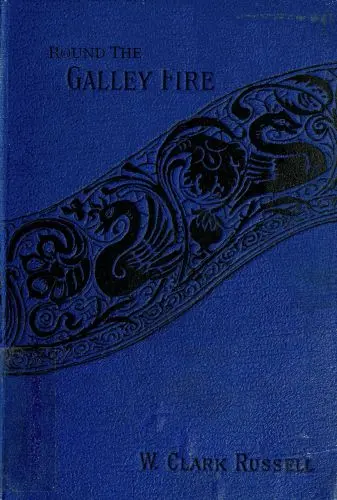
THE CLASSIC COLLECTION · 1883
"Round the Galley Fire" by W. Clark Russell is a collection of maritime stories written in the late 19th century. The book compiles entertaining yarns recounted by a narrator who invites readers into the cozy atmosphere of shipboard life, filled with sailors' adventures, mishaps, and the captivating allure of the sea. The opening of the book sets a vivid scene aboard an Australian passenger ship becalmed in the tropics. As passengers from different backgrounds abandon their usual decorum to celebrate the birthday of a young lady with a dance, the narrative paints a rich tableau of ship life, punctuated with laughter, music, and the contrasting solitude of the vast ocean. Amid the festivities, the tranquility is tinged with the melancholy notion of the ship being a mere speck amidst the infinite sea, foreshadowing the unpredictable adventures that sailors face. As the evening progresses, the situation on deck evolves, allowing for a taste of both joy and the looming presence of nature's unpredictability.
Introduction adapted from the source catalogue; source summaries may be automatically generated.
Free to read · English · 94,637 words · No account needed
MAKE TIME FOR A GOOD BOOK
On by default. Untick to stop anonymous reading totals. Each page counts after 10 seconds in view. How this works.
Anonymous counting is on unless you have switched it off.
“The steamer I commanded was a schooner-rigged vessel, built at Low Walker, and you may call her tonnage in round numbers 500. She left a North-country port on a certain day with a crew of seventeen hands and a cargo of coal, our destination being Cronstadt. My wife was on board, and this was the first voyage she had made with me. We had been married two years, and in that time I had made several trips, as you may imagine; these voyages--as I suppose I must call a trip across the North Sea, or a run along the Mediterranean--occupying only a few weeks. Every time I started, my wife wanted to go too; the owners had no objection, but I had. I told her the sea was all very well for lady passengers who had to cross it, but it was no place for a woman to make a home of. She would do far better keeping house ashore, and making all ready for my return; and so I would put her off. But when it came to this trip, she pleaded so earnestly, saying that she loved the sea, that the run would do her good, that she felt terribly lonely when I was away, and that her place was at my side let me be where I would, that I could no longer refuse. ‘Very well,’ said I, ‘for this once,’ my notion being that one voyage would do more for my wishes than fifty years of arguing; and so she came aboard. Well, sir, at the start we had fine weather. It was in the spring; the air was sharp, but the sky was blue and the sunshine strong and cheerful; and my wife heartily enjoyed it. There was no sea-sickness to baulk her relish; she was too much a sailor’s lass for that weakness. We were not much of a ship; you know the regular type, high bows, wall-sided, Plimsoll’s mark well awash, you may take your oath, the flying-bridge over the chart-house, and the pole-compass forking up like a scarecrow above that. But my wife thought the vessel made a fine sight--merely, I expect, because I commanded her. Poor girl! poor girl! often I’d come on deck and see her leaning over the side, when she’d call to me to admire the line of froth there--as if that was a thing an old fist like me would take notice of; and if a vessel passed she’d stand and watch it with a look of delight, as though nothing more beautiful was ever seen, though it might be an old sailing collier, sir, with nothing showing over the rail but a red night-cap, or a steam-waggon after our own pattern. But much as she enjoyed the water, her presence never gave me pleasure. I remember going below on the very night on which the ship was lost, and looking at my poor lass as she lay sleeping, and I recall that the sight of her worried me to a degree you’d scarcely think likely. I was for ever wishing her back home, snug and secure in the little house that she always had ready and bright and cheerful for me to return to. You might almost think such wishes unnatural, but I see them in their proper light now, and reckon there’s a world of truth in that old saying about coming events casting their shadows before them. It was a Tuesday afternoon. The weather had changed in the forenoon, and at midday it was blowing a strong breeze from the north-west. It had grown as cold as January, and now and again when a squall drove up there’d come a shower of hail that was like heaving a bucket of shot on to the decks. I had kept the patent log towing astern, our course being a trifle to the north of east, and on hauling it in at noon I found that we had made about a hundred and seventy miles run since quitting our port. There were no sights to be got, for, though the morning had opened fine, the sky was now as thick as mud. All this time the wind was freshening up into a gale. I put the log over again, keeping the vessel on the same course, under sail, and her engines going full ahead. The wind was well abaft the beam, the sea a following one, and there was nothing to stop the ship; she drove along handsomely, whitening the water all around her, and for a couple of miles astern, and making excellent sport for my wife, who stood holding on and taking in the scene with her eyes like diamonds, and her cheeks like roses. I never could have supposed that there was so much to admire in the sea as she had found. To me it was hardly much more than a waste of salt water that was to be crossed as soon as possible, full of hard work, exposure, poor pay, and heavy anxiety. My poor lass knew nothing of that part of it, except the pay. I think, had time been given her, and we’d been making a long voyage, she’d have converted me into a kind of poet, and taught me to see beauties even in thick weather and strong head seas.
Your reading position is saved on this browser. Take it to another device with a library code. Reading pages adapt to text, rather than matching a printed edition.
William Clark Russell

William Clark Russell
William Clark Russell

William Clark Russell
BEHIND THE BOOK
This eBook is for the use of anyone anywhere in the United States and most other parts of the world at no cost and with almost no restrictions whatsoever. You may copy it, give it away or re-use it under the terms of the Project Gutenberg License included with this eBook or online at www.gutenberg.org. If you are not located in the United States, you will have to check the laws of the country where you are located before using this eBook. Read the source licence.
The original source file, including credits and licence, is retained by this library. Request an original-format copy at no charge. Please include the book title and Project Gutenberg identifier #61750.
KEEP YOUR CURIOSITY GOING
Coulson Kernahan

Maurice Baring
Frances Wright
Cécile Tormay

Frederic Jesup Stimson

W. H. P. (William Henry Pope) Jarvis