
List, Ye Landsmen! A Romance of Incident
William Clark Russell
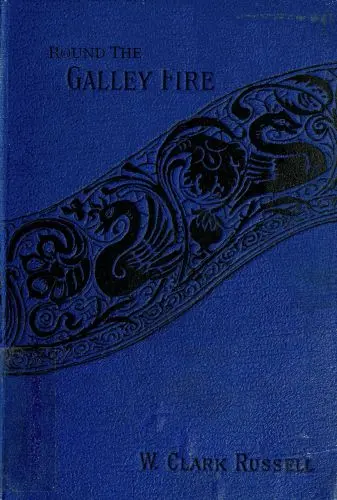
THE CLASSIC COLLECTION · 1883
"Round the Galley Fire" by W. Clark Russell is a collection of maritime stories written in the late 19th century. The book compiles entertaining yarns recounted by a narrator who invites readers into the cozy atmosphere of shipboard life, filled with sailors' adventures, mishaps, and the captivating allure of the sea. The opening of the book sets a vivid scene aboard an Australian passenger ship becalmed in the tropics. As passengers from different backgrounds abandon their usual decorum to celebrate the birthday of a young lady with a dance, the narrative paints a rich tableau of ship life, punctuated with laughter, music, and the contrasting solitude of the vast ocean. Amid the festivities, the tranquility is tinged with the melancholy notion of the ship being a mere speck amidst the infinite sea, foreshadowing the unpredictable adventures that sailors face. As the evening progresses, the situation on deck evolves, allowing for a taste of both joy and the looming presence of nature's unpredictability.
Introduction adapted from the source catalogue; source summaries may be automatically generated.
Free to read · English · 94,637 words · No account needed
MAKE TIME FOR A GOOD BOOK
On by default. Untick to stop anonymous reading totals. Each page counts after 10 seconds in view. How this works.
Anonymous counting is on unless you have switched it off.
It was in the month of May that the vessel in question was bound to Callao with a cargo of coal, but a strong north-westerly gale had driven her much further to the southward than the captain had any desire to find himself. The gale left them on a Wednesday morning, rolling their yardarms into it on a real Cape Horn swell. What is there to which to liken these prodigious heavings? The actual altitude of those liquid hills may seem small in comparison with the appearance they present when viewed from their hollows; but whatever may be their height, to lie dipping and wallowing among them in a vessel of the tonnage of that brig is to undergo an experience hardly less formidable than what was devised by the Mohocks, when they shut up old women in empty casks, and sent them spinning down Ludgate Hill. What straining and groaning and complaining of the tortured fabric, if it be of timber! Every beam, carling, tree-nail, transom, knee, stanchion, and futtock lifts up its dismal creaking and wailing voice as the bewildered craft, with her topsails rattling in the motionless atmosphere, is swung like a pendulum up the shoulder of the swelling mass of green water, leaning down as she goes until she is fairly on her beam-ends, with pots and pannikins, sea-boots and sea-chests, dishes, books, furniture, and whatever else may be inside of her, fetching away with dreadful noise to leeward, amid a volley of sea-blessings from skipper, cook, and steward, and muffled shouts from the watch below in the forecastle.
Luckily Cape Horn calms do not last very long; indeed, there is nothing but “weather” down in those regions, and a calm is only a short pause among the gales and squalls whilst they are considering whose turn it is next. Within an hour from the time of the first gale failing them, another gale from a little to the north-of-west was bowing down the bothered and beaten brig, which, under lower topsails and fore-topmast staysail, manfully struggled to look up to it with her head in the direction of Cape Horn and her wake streaming away over her weather quarter. It was one of those pictures of storm which are rarely seen in like perfection out of the parallels that divide Terra del Fuego from the South Shetlands--an ocean of mountainous seas, raising each of them a note of thunder as their arching summits crashed from a dark, oil-smooth ridge of green water into huge avalanches of snow: a sky of gloomy slate, along which masses of scud--torn, ragged, and tendril-shaped--were flying with incredible velocity. The horizon was broken with the incessant rising and falling of the pyramidal billows, dark as the night, against a ring of sooty clouds, from which, ever and anon, one would break away, like a winged messenger of evil, whitening and veiling the air with a kind of boiling appearance as it swept its furious and blinding discharge of snow and hail along. No wonder that in olden times the man who had passed these tempestuous and inclement seas should have considered himself an object of importance. Stand, in fancy, upon the deck of that labouring brig, and survey one of the countless aspects of marine life. The seas are breaking heavily over the port bow of the vessel, deluging her forward and racing aft in a foaming torrent as she sinks her stern to mount the huge surge that almost lays her yardarms level. The bitter, raw, flaying cold of the wind there is nothing in language to express. The flying spray smites the exposed face like a volley of sail needles. Now and again a squall of snow and hail comes along with so much fury in it that it takes the breath away from the strongest of the seamen cowering with their backs to it. The rigging crackles to every strain put upon it like burning wood. The snow upon the yards makes them glimmer like lines of pallid light as they furiously sway against the dismal ground of the dark and rushing sky. There are spears and arrow-heads of ice upon the bulwark rail, upon the catheads, upon the scuttle-butts lashed amidships; and though the seas repeatedly break over them they are always left standing. The helmsman, with his hard fists wrapped up in mits, rigged out in oilskins from his head to his huge, well-greased sea-boots, and with the after-thatch of his sou’-wester blown up by the gale, and standing out from his head like the tail of a gull, gets the full of it. Nothing of the man is visible but a fragment of mahogany face showing between the flannel ear-covers of his head-gear, and a pair of watering eyes, which he now and again wipes upon his mit when a pause in the yaws and come-to’s give him a chance to raise one of his hands from the spokes.
Your reading position is saved on this browser. Take it to another device with a library code. Reading pages adapt to text, rather than matching a printed edition.
William Clark Russell

William Clark Russell
William Clark Russell

William Clark Russell
BEHIND THE BOOK
This eBook is for the use of anyone anywhere in the United States and most other parts of the world at no cost and with almost no restrictions whatsoever. You may copy it, give it away or re-use it under the terms of the Project Gutenberg License included with this eBook or online at www.gutenberg.org. If you are not located in the United States, you will have to check the laws of the country where you are located before using this eBook. Read the source licence.
The original source file, including credits and licence, is retained by this library. Request an original-format copy at no charge. Please include the book title and Project Gutenberg identifier #61750.
KEEP YOUR CURIOSITY GOING
Coulson Kernahan

Maurice Baring
Frances Wright
Cécile Tormay

Frederic Jesup Stimson

W. H. P. (William Henry Pope) Jarvis