
List, Ye Landsmen! A Romance of Incident
William Clark Russell
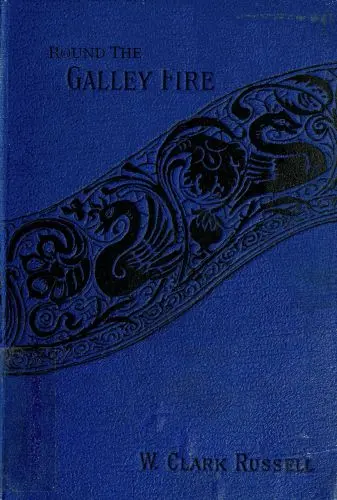
THE CLASSIC COLLECTION · 1883
"Round the Galley Fire" by W. Clark Russell is a collection of maritime stories written in the late 19th century. The book compiles entertaining yarns recounted by a narrator who invites readers into the cozy atmosphere of shipboard life, filled with sailors' adventures, mishaps, and the captivating allure of the sea. The opening of the book sets a vivid scene aboard an Australian passenger ship becalmed in the tropics. As passengers from different backgrounds abandon their usual decorum to celebrate the birthday of a young lady with a dance, the narrative paints a rich tableau of ship life, punctuated with laughter, music, and the contrasting solitude of the vast ocean. Amid the festivities, the tranquility is tinged with the melancholy notion of the ship being a mere speck amidst the infinite sea, foreshadowing the unpredictable adventures that sailors face. As the evening progresses, the situation on deck evolves, allowing for a taste of both joy and the looming presence of nature's unpredictability.
Introduction adapted from the source catalogue; source summaries may be automatically generated.
Free to read · English · 94,637 words · No account needed
MAKE TIME FOR A GOOD BOOK
On by default. Untick to stop anonymous reading totals. Each page counts after 10 seconds in view. How this works.
Anonymous counting is on unless you have switched it off.
What d’ye think of that for a nautical bust-up? Think of standing in mute despair after the ball had struck the magazine! How long did the chap as wrote this wash reckon it takes powder to hexplode arter it’s fired? Instead of being appalled and standing in mute despair, they should have taken to the boats; for, ye see, that convenient magazine was bound to give ’em plenty of time. And they calls this,” said he, turning the pages backwards and forwards, “‘Sea Songs.’ It’s the likes of this that is offered to shore-going folk as correct representations of the mariner’s calling, hey? Ain’t it true to life? Here’s a bit for ye--
‘William, who high upon the yard,
Rock’d with the billows to and fro,
Soon as her well-known voice he heard,
He sigh’d and cast his eyes below.
The cords glide swiftly through his glowing hands,
And quick as lightning on the deck he stands.’
What sort of cords did he come down by--the signal halliards? And isn’t it quite conceivable that, being on a man-o’-war, and aloft on duty, he should drop his job to come down to his Susan without leave of the officer in charge? Wonderfully true to life, sir, ain’t it, ispecially them bits about the sailor boy capering ashore, and jolly tars drinking and dancing at sea, as if cargoes consisted of nothing but casks of rum which sailors are allowed to broach whenever they want to be merry?”
He turned to the rude woodcut, and had another long look at it; then, suddenly twisting the sheets up in his hand, he thrust one end into the fire, singing out as he looked around him:
“Anybody want a light?”
This sour seaman was, of course, a very hard and exacting critic, belonging to a class of sailors who, when reading about the sea, should they come across the least oversight on the part of a writer, will fling his book or poem or song out of window, and vote the author a lubber and utterly ignorant of all that concerns the calling. I remember, when I wrote an account of the wreck of the Indian Chief, a sailor gravely told me he was cocksure the whole yarn was an out-and-out lie, because I had made the chief mate escape from the mizzenmast by getting into the maintop by the mizzen-topmast stay. No doubt I should have done better by sending the mate to make his way into the top from the topgallant masthead; but just because my sailor was sure that the mizzen-topmast stay of the Indian Chief set up half-way down the mainmast, he refused to believe the story of the wreck. Yet it is quite possible to read many of our English sea songs with wonder and ridicule without necessarily bringing to them the sourness and severity of judgment I found in the old seaman. The present generation of writers are not worse sinners in respect of accuracy than the past; but I am bound to say that their blunders are to the full as numerous. The production of a sea song is by no means conditional on a man’s having been to sea. The finest marine lyric in this or any other language, “Ye Mariners of England,” was written by a man who had no knowledge whatever of the sailor’s calling. There is nothing false in that glorious poem, no absurd references to bowlines and topsail sheets, and other words of which few landsmen have the least idea of the meaning. But can as much be said of Allan Cunningham’s popular poem, “A Wet Sheet and a Flowing Sea”? It is just possible that the poet may have used the word “sheet” rightly, and meant the song to refer to a small fore-and-aft vessel that when heavily pressed down might wet her sheets; but Jack, when he hears that ballad, is strongly disposed to believe that the writer thought that a “sheet” was a sail, and this being his suspicion, he could never sing the song with the least relish or enjoyment of even the beautiful air with which the words are associated. By all means let landsmen continue to write sea songs; but if they desire a larger audience than shore-goers for their compositions, if they wish to hear of their verses in the forecastle and learn that they are popular among sailors, let them rigorously avoid all technicalities, all the stupid old clap-trap about cans of grog and “Yeo, heave ho,” and “So ho!” and the like. For a song may be as salt as the sea itself, and yet be as free from the stereotyped nauticalisms as a page of “Hamlet.” Indeed, the real English sailor is not one-third as nautical as he is supposed to be; and the numerous inanities dedicated to his rollicking enjoyments when at sea, his Sues and Nans ashore, are about as true to his real character as the public-house effigy of him, on one leg, in shoes, and round hat at the back of his head, is like the original.
Your reading position is saved on this browser. Take it to another device with a library code. Reading pages adapt to text, rather than matching a printed edition.
William Clark Russell

William Clark Russell
William Clark Russell

William Clark Russell
BEHIND THE BOOK
This eBook is for the use of anyone anywhere in the United States and most other parts of the world at no cost and with almost no restrictions whatsoever. You may copy it, give it away or re-use it under the terms of the Project Gutenberg License included with this eBook or online at www.gutenberg.org. If you are not located in the United States, you will have to check the laws of the country where you are located before using this eBook. Read the source licence.
The original source file, including credits and licence, is retained by this library. Request an original-format copy at no charge. Please include the book title and Project Gutenberg identifier #61750.
KEEP YOUR CURIOSITY GOING
Coulson Kernahan

Maurice Baring
Frances Wright
Cécile Tormay

Frederic Jesup Stimson

W. H. P. (William Henry Pope) Jarvis