The Stark Munro Letters Being series of twelve letters written by J. Stark Munro, M.B., to his friend and former fellow-student, Herbert Swanborough, of Lowell, Massachusetts, during the years 1881-1884
Arthur Conan Doyle

THE CLASSIC COLLECTION · 1908
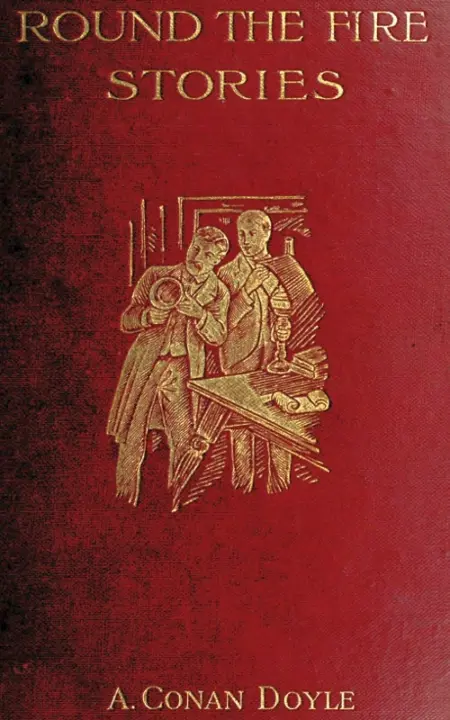
"Round the Fire Stories" by Arthur Conan Doyle is a collection of short stories written in the early 20th century. This anthology features tales that blend the grotesque and the terrible, effectively crafted for sharing on a chilly evening around a fire. The stories delve into various aspects of human experience and curiosity, hinting at macabre events and mysterious legacies. The opening of "Round the Fire Stories" introduces us to the character Lionel Dacre, a wealthy and eccentric collector of occult literature residing in Paris. A visit to his home leads to a curious examination of a leather funnel with a mysterious past, linked to the dark practices of historical torture. Dacre proposes an experiment involving the funnel, suggesting a connection to dreams and past horrors. The narrative sets up an air of suspense and reveals Dacre's intent to unearth the object’s intriguing story through a shared experience with the narrator, paving the way for a chilling exploration of history and the unknown.
Introduction adapted from the source catalogue; source summaries may be automatically generated.
Free to read · English · 103,913 words · No account needed
MAKE TIME FOR A GOOD BOOK
On by default. Untick to stop anonymous reading totals. Each page counts after 10 seconds in view. How this works.
Anonymous counting is on unless you have switched it off.
It was, as he had said, obvious that some one had been at work upon it. The settings of the uppermost row of four stones—the carnelian, peridot, emerald, and ruby-were rough and jagged as if some one had scraped all round them. The stones were in their places, but the beautiful gold-work which we had admired only a few days before had been very clumsily pulled about.
“It looks to me,” said the police inspector, “as if some one had been trying to take out the stones.”
“My fear is,” said Mortimer, “that he not only tried, but succeeded. I believe these four stones to be skilful imitations which have been put in the place of the originals.”
The same suspicion had evidently been in the mind of the expert, for he had been carefully examining the four stones with the aid of a lens. He now submitted them to several tests, and finally turned cheerfully to Mortimer.
“I congratulate you, sir,” said he, heartily. “I will pledge my reputation that all four of these stones are genuine, and of a most unusual degree of purity.”
The colour began to come back to my poor friend’s frightened face, and he drew a long breath of relief.
“Thank God!” he cried. “Then what in the world did the thief want?”
“Probably he meant to take the stones, but was interrupted.”
“In that case one would expect him to take them out one at a time, but the setting of each of these has been loosened, and yet the stones are all here.”
“It is certainly most extraordinary,” said the inspector. “I never remember a case like it. Let us see the watchman.”
The commissionaire was called—a soldierly, honest-faced man, who seemed as concerned as Ward Mortimer at the incident.
“No, sir, I never heard a sound,” he answered, in reply to the questions of the inspector. “I made my rounds four times, as usual, but I saw nothing suspicious. I’ve been in my position ten years, but nothing of the kind has ever occurred before.”
“No thief could have come through the windows?”
“Impossible, sir.”
“Or passed you at the door?”
“No, sir; I never left my post except when I walked my rounds.”
“What other openings are there in the museum?”
“There is the door into Mr. Ward Mortimer’s private rooms.”
“That is locked at night,” my friend explained, “and in order to reach it any one from the street would have to open the outside door as well.”
“Your servants?”
“Their quarters are entirely separate.”
Your reading position is saved on this browser. Take it to another device with a library code. Reading pages adapt to text, rather than matching a printed edition.
Arthur Conan Doyle
Arthur Conan Doyle
Arthur Conan Doyle
Arthur Conan Doyle
BEHIND THE BOOK
This eBook is for the use of anyone anywhere in the United States and most other parts of the world at no cost and with almost no restrictions whatsoever. You may copy it, give it away or re-use it under the terms of the Project Gutenberg License included with this eBook or online at www.gutenberg.org. If you are not located in the United States, you will have to check the laws of the country where you are located before using this eBook. Read the source licence.
The original source file, including credits and licence, is retained by this library. Request an original-format copy at no charge. Please include the book title and Project Gutenberg identifier #54109.
KEEP YOUR CURIOSITY GOING
Coulson Kernahan

Maurice Baring
Frances Wright
Cécile Tormay

Frederic Jesup Stimson

W. H. P. (William Henry Pope) Jarvis


