The Stark Munro Letters Being series of twelve letters written by J. Stark Munro, M.B., to his friend and former fellow-student, Herbert Swanborough, of Lowell, Massachusetts, during the years 1881-1884
Arthur Conan Doyle

THE CLASSIC COLLECTION · 1908
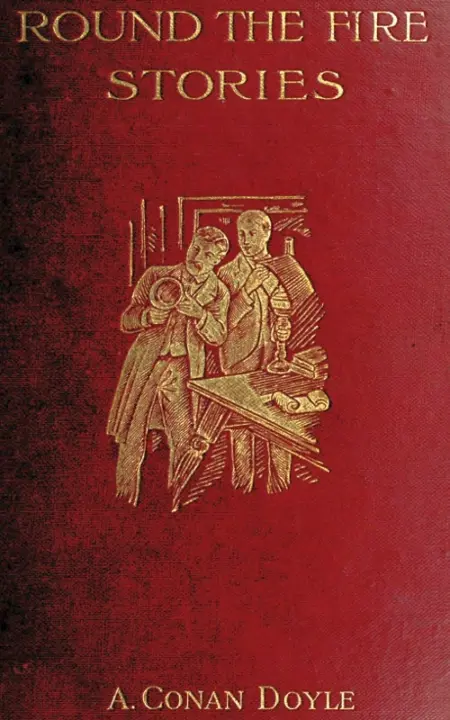
"Round the Fire Stories" by Arthur Conan Doyle is a collection of short stories written in the early 20th century. This anthology features tales that blend the grotesque and the terrible, effectively crafted for sharing on a chilly evening around a fire. The stories delve into various aspects of human experience and curiosity, hinting at macabre events and mysterious legacies. The opening of "Round the Fire Stories" introduces us to the character Lionel Dacre, a wealthy and eccentric collector of occult literature residing in Paris. A visit to his home leads to a curious examination of a leather funnel with a mysterious past, linked to the dark practices of historical torture. Dacre proposes an experiment involving the funnel, suggesting a connection to dreams and past horrors. The narrative sets up an air of suspense and reveals Dacre's intent to unearth the object’s intriguing story through a shared experience with the narrator, paving the way for a chilling exploration of history and the unknown.
Introduction adapted from the source catalogue; source summaries may be automatically generated.
Free to read · English · 103,913 words · No account needed
MAKE TIME FOR A GOOD BOOK
On by default. Untick to stop anonymous reading totals. Each page counts after 10 seconds in view. How this works.
Anonymous counting is on unless you have switched it off.
He had shown us in turn his mummies, his papyri, his rare scarabs, his inscriptions, his Jewish relics, and his duplication of the famous seven-branched candlestick of the Temple, which was brought to Rome by Titus, and which is supposed by some to be lying at this instant in the bed of the Tiber. Then he approached a case which stood in the very centre of the hall, and he looked down through the glass with reverence in his attitude and manner.
“This is no novelty to an expert like yourself, Mr. Mortimer,” said he; “but I daresay that your friend, Mr. Jackson, will be interested to see it.”
Leaning over the case I saw an object, some five inches square, which consisted of twelve precious stones in a framework of gold, with golden hooks at two of the corners. The stones were all varying in sort and colour, but they were of the same size. Their shapes, arrangement, and gradation of tint made me think of a box of water-colour paints. Each stone had some hieroglyphic scratched upon its surface.
“You have heard, Mr. Jackson, of the urim and thummim?”
I had heard the term, but my idea of its meaning was exceedingly vague.
“The urim and thummim was a name given to the jewelled plate which lay upon the breast of the high priest of the Jews. They had a very special feeling of reverence for it—something of the feeling which an ancient Roman might have for the Sibylline books in the Capitol. There are, as you see, twelve magnificent stones, inscribed with mystical characters. Counting from the left-hand top corner, the stones are carnelian, peridot, emerald, ruby, lapis lazuli, onyx, sapphire, agate, amethyst, topaz, beryl, and jasper.”
I was amazed at the variety and beauty of the stones.
“Has the breastplate any particular history?” I asked.
“It is of great age and of immense value,” said Professor Andreas. “Without being able to make an absolute assertion, we have many reasons to think that it is possible that it may be the original urim and thummim of Solomon’s Temple. There is certainly nothing so fine in any collection in Europe. My friend, Captain Wilson here, is a practical authority upon precious stones, and he would tell you how pure these are.”
Captain Wilson, a man with a dark, hard, incisive face, was standing beside his fiancée at the other side of the case.
“Yes,” said he, curtly, “I have never seen finer stones.”
“And the gold-work is also worthy of attention. The ancients excelled in ——”—he was apparently about to indicate the setting of the stones, when Captain Wilson interrupted him.
Your reading position is saved on this browser. Take it to another device with a library code. Reading pages adapt to text, rather than matching a printed edition.
Arthur Conan Doyle
Arthur Conan Doyle
Arthur Conan Doyle
Arthur Conan Doyle
BEHIND THE BOOK
This eBook is for the use of anyone anywhere in the United States and most other parts of the world at no cost and with almost no restrictions whatsoever. You may copy it, give it away or re-use it under the terms of the Project Gutenberg License included with this eBook or online at www.gutenberg.org. If you are not located in the United States, you will have to check the laws of the country where you are located before using this eBook. Read the source licence.
The original source file, including credits and licence, is retained by this library. Request an original-format copy at no charge. Please include the book title and Project Gutenberg identifier #54109.
KEEP YOUR CURIOSITY GOING
Coulson Kernahan

Maurice Baring
Frances Wright
Cécile Tormay

Frederic Jesup Stimson

W. H. P. (William Henry Pope) Jarvis


