
Life of Edwin Forrest, the American Tragedian. Volume 2 (of 2)
William Rounseville Alger & Horatio, Jr. Alger
THE CLASSIC COLLECTION · 1869
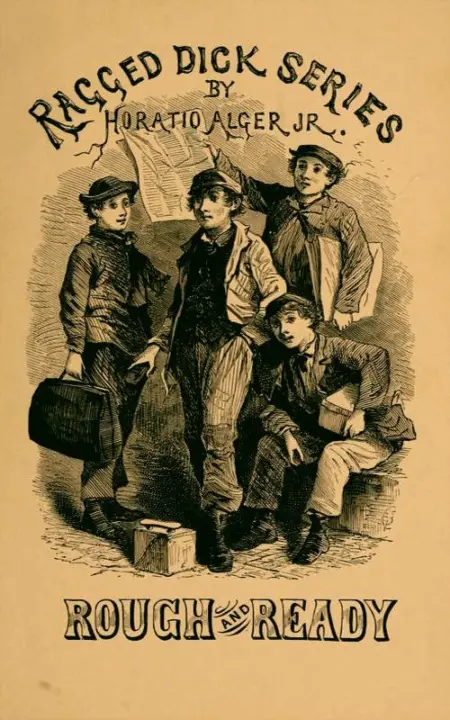
"Rough and Ready; Or, Life Among the New York Newsboys" by Horatio Alger Jr. is a novel written in the late 19th century. The story focuses on the life of a young newsboy named Rufus, nicknamed "Rough and Ready," who navigates the challenges of poverty in New York City while supporting himself and his younger sister, Rose. The narrative promises to explore themes of resilience, morality, and the struggles of underprivileged youth, as well as the importance of personal values in the face of adversity. At the start of the novel, we are introduced to Rufus as he sells newspapers on the busy streets of New York, demonstrating his quick wit and business savvy amidst the bustling environment. Through interactions with various customers, we learn about his circumstances, including his relationship with his disreputable stepfather, Martin, and his commitment to care for Rose after their mother's death. The opening chapters set the stage for Rufus's determination to provide a better life for his sister, showcasing his hardworking nature and the difficulties they face as they seek to escape the negative influences surrounding them.
Introduction adapted from the source catalogue; source summaries may be automatically generated.
Free to read · English · 49,263 words · No account needed
MAKE TIME FOR A GOOD BOOK
On by default. Untick to stop anonymous reading totals. Each page counts after 10 seconds in view. How this works.
Anonymous counting is on unless you have switched it off.
Rose accordingly followed her without hesitation, and when the Italian again stopped, the two little girls made a part of his audience. After going through his series of tunes, and gathering a small stock of pennies, the organ-grinder again started on his travels. Rose and Fanny, having no better amusement before them, still kept his company, and this continued for an hour or two.
By this time they had unconsciously got a considerable distance from home. There is no knowing how far they would have gone, had not the tambourine player detected Fanny in picking up a penny which had been thrown for the musicians. Fanny, supposing that she was not observed, slipped it into her pocket slily, intending to spend it for candy on her way home. But she was considerably alarmed when the girl, her dark face full of indignation, ran forward, and, seizing her by the arm, shook her, uttering the while an incoherent medley of Italian and English.
"What's the row? What has the little girl done?" asked a man in the
group.
"She one tief. She took penny, and put in her pocket," said the Italian girl, continuing to shake her.
Fanny protested with tears that she had not done it, but a boy near by testified that he had seen her do it. With shame and mortification, Fanny was obliged to produce the purloined penny, and give it to the monkey, who, in spite of her intended dishonesty, had the politeness to remove his hat, and make her a very ceremonious bow.
"I should think you'd be ashamed of yourselves," said a stout woman, addressing both little girls.
"I didn't take the penny," said Rose, resenting the imputation; "I
wouldn't steal for anything."
"She wanted me to take it," said Fanny, maliciously, "so that I could
buy some candy for her."
"That's a story," said Rose, indignantly; "I didn't know you meant to do it, till I saw you slip it into your pocket."
"I've no doubt one's as bad as the other," said the woman, with
commendable impartiality.
"Go 'way," said the tambourine girl; "you steal some more penny."
"Come away, Fanny," said Rose; "I'm ashamed to stay here any longer, and I should think you would be."
As circumstances made the neighborhood of the musicians rather unpleasant, Fanny condescended to adopt the suggestion of her companion.
"I guess I'll go home," she said. "I'm hungry, and ma'll give me some gingerbread. She won't give you any, for you're a bad girl."
"What are you?" retorted Rose.
"I'm a good girl."
"I never heard of a good girl's stealing," said Rose.
Your reading position is saved on this browser. Take it to another device with a library code. Reading pages adapt to text, rather than matching a printed edition.
William Rounseville Alger & Horatio, Jr. Alger

William Rounseville Alger & Horatio, Jr. Alger

Horatio, Jr. Alger

Horatio, Jr. Alger
BEHIND THE BOOK
This eBook is for the use of anyone anywhere in the United States and most other parts of the world at no cost and with almost no restrictions whatsoever. You may copy it, give it away or re-use it under the terms of the Project Gutenberg License included with this eBook or online at www.gutenberg.org. If you are not located in the United States, you will have to check the laws of the country where you are located before using this eBook. Read the source licence.
The original source file, including credits and licence, is retained by this library. Request an original-format copy at no charge. Please include the book title and Project Gutenberg identifier #55142.
KEEP YOUR CURIOSITY GOING
Coulson Kernahan

Maurice Baring
Frances Wright
Cécile Tormay

Frederic Jesup Stimson

W. H. P. (William Henry Pope) Jarvis