
Life of Edwin Forrest, the American Tragedian. Volume 2 (of 2)
William Rounseville Alger & Horatio, Jr. Alger
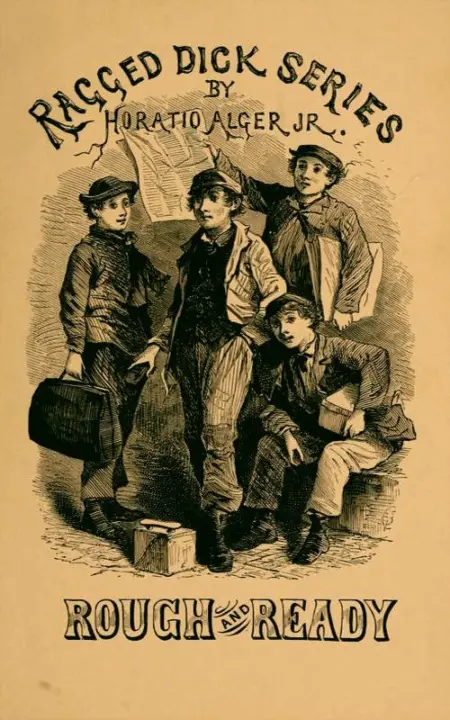
THE CLASSIC COLLECTION · 1869
"Rough and Ready; Or, Life Among the New York Newsboys" by Horatio Alger Jr. is a novel written in the late 19th century. The story focuses on the life of a young newsboy named Rufus, nicknamed "Rough and Ready," who navigates the challenges of poverty in New York City while supporting himself and his younger sister, Rose. The narrative promises to explore themes of resilience, morality, and the struggles of underprivileged youth, as well as the importance of personal values in the face of adversity. At the start of the novel, we are introduced to Rufus as he sells newspapers on the busy streets of New York, demonstrating his quick wit and business savvy amidst the bustling environment. Through interactions with various customers, we learn about his circumstances, including his relationship with his disreputable stepfather, Martin, and his commitment to care for Rose after their mother's death. The opening chapters set the stage for Rufus's determination to provide a better life for his sister, showcasing his hardworking nature and the difficulties they face as they seek to escape the negative influences surrounding them.
Introduction adapted from the source catalogue; source summaries may be automatically generated.
Free to read · English · 49,263 words · No account needed
MAKE TIME FOR A GOOD BOOK
On by default. Untick to stop anonymous reading totals. Each page counts after 10 seconds in view. How this works.
Anonymous counting is on unless you have switched it off.
"Now I like dogs best," said Rough and Ready.
"Most boys do, I believe," said the seamstress.
"But kittens are much prettier, Rufie," said Rose.
"They'll scratch, and dogs won't," said the newsboy; "but if you like a kitten, and Miss Manning is kind enough to get you one, I shall be glad to have her do so. But you seem to have forgotten all about my discovery."
"What is it, Rufie?"
Rough and Ready drew the pocket-book from his pocket, and displayed it.
"Where did you find it, Rufus?" asked Miss Manning.
"Is there much money in it, Rufie?" asked his sister.
"I don't know yet, I'll look and see, and afterwards I'll tell where I
found it."
He opened the wallet, and drew out a roll of bills. Spreading them open, he began to count. To his surprise they proved to be bills of a large denomination. There was one one-hundred-dollar bill, five twenties, six tens, and eight fives. He raised his eyes in surprise.
"Why, here are three hundred dollars," he said.
"Three hundred dollars!" exclaimed Rose, clapping her hands. "Why Rufie,
how rich you are!"
"But it isn't my money, Rose," he said. "You must remember that. I may
find the owner."
"Oh, I hope you won't," said the little girl, looking disappointed.
"But it isn't right to wish that, Rose," said Miss Manning. "Suppose you had lost the money, you would like to have it returned to you, would you not?"
"I suppose I should," said Rose; "but three hundred dollars would do us a great deal of good. You and Rufie wouldn't have to work so hard."
"As for me, hard work won't hurt me," said the newsboy. "I rather enjoy it, now that I don't have to give my wages to Mr. Martin to buy rum with."
"Have you seen him lately?"
"Not since the time I mentioned. But now I will tell you where I found
this money."
Hereupon the newsboy gave the account which is already known to the reader. It will, of course, be unnecessary to repeat it here. When he had finished speaking, Miss Manning asked, "Well, Rufus, what do you intend to do about the money?"
"I am going to ask Mr. O'Connor's advice about it to-night," said our hero. "Whatever he says I ought to do, I will do."
"Perhaps you won't find any owner, Rufie."
"We won't count our eggs before they are hatched," said Rufus, "and speaking of eggs, when are you going to give us some more for supper, Miss Manning? Those we had Monday were bully."
"We'll have them often, if you like them, Rufus," said the seamstress.
Your reading position is saved on this browser. Take it to another device with a library code. Reading pages adapt to text, rather than matching a printed edition.
William Rounseville Alger & Horatio, Jr. Alger

William Rounseville Alger & Horatio, Jr. Alger

Horatio, Jr. Alger

Horatio, Jr. Alger
BEHIND THE BOOK
This eBook is for the use of anyone anywhere in the United States and most other parts of the world at no cost and with almost no restrictions whatsoever. You may copy it, give it away or re-use it under the terms of the Project Gutenberg License included with this eBook or online at www.gutenberg.org. If you are not located in the United States, you will have to check the laws of the country where you are located before using this eBook. Read the source licence.
The original source file, including credits and licence, is retained by this library. Request an original-format copy at no charge. Please include the book title and Project Gutenberg identifier #55142.
KEEP YOUR CURIOSITY GOING
Coulson Kernahan

Maurice Baring
Frances Wright
Cécile Tormay

Frederic Jesup Stimson

W. H. P. (William Henry Pope) Jarvis