
Life of Edwin Forrest, the American Tragedian. Volume 2 (of 2)
William Rounseville Alger & Horatio, Jr. Alger
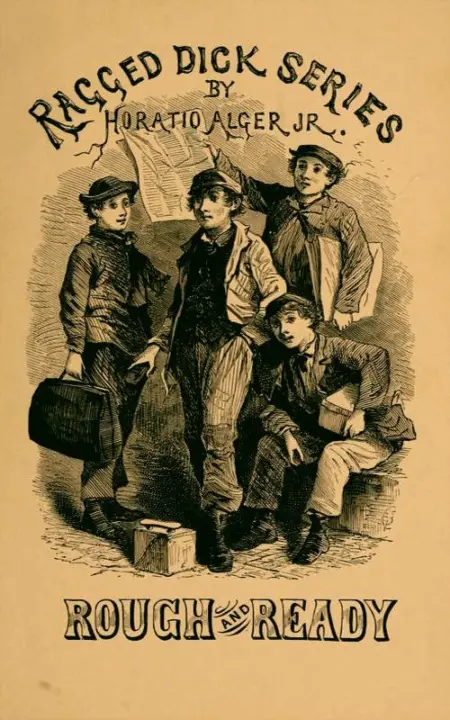
THE CLASSIC COLLECTION · 1869
"Rough and Ready; Or, Life Among the New York Newsboys" by Horatio Alger Jr. is a novel written in the late 19th century. The story focuses on the life of a young newsboy named Rufus, nicknamed "Rough and Ready," who navigates the challenges of poverty in New York City while supporting himself and his younger sister, Rose. The narrative promises to explore themes of resilience, morality, and the struggles of underprivileged youth, as well as the importance of personal values in the face of adversity. At the start of the novel, we are introduced to Rufus as he sells newspapers on the busy streets of New York, demonstrating his quick wit and business savvy amidst the bustling environment. Through interactions with various customers, we learn about his circumstances, including his relationship with his disreputable stepfather, Martin, and his commitment to care for Rose after their mother's death. The opening chapters set the stage for Rufus's determination to provide a better life for his sister, showcasing his hardworking nature and the difficulties they face as they seek to escape the negative influences surrounding them.
Introduction adapted from the source catalogue; source summaries may be automatically generated.
Free to read · English · 49,263 words · No account needed
MAKE TIME FOR A GOOD BOOK
On by default. Untick to stop anonymous reading totals. Each page counts after 10 seconds in view. How this works.
Anonymous counting is on unless you have switched it off.
"I have to obey orders," said the conductor. "I don't make the
regulations myself."
"If you will allow me," said a lady opposite, "I will pay your fare,
sir."
"Thank you, ma'am," said Martin. "I'll accept your kind offer, though I wouldn't need to be beholden to anybody, if it hadn't been for my loss. It's pretty hard on a poor man," he added, complainingly.
"Will you accept a trifle towards making up your loss?" said an old gentleman, who had more benevolence than penetration.
"Thank you, sir," said James Martin, accepting the two-dollar bill which was tendered him, without feeling the least delicacy in so doing.
"You're very kind. I wouldn't take it if I hadn't been so unfortunate."
"You're quite welcome," said the old gentleman, kindly. "You'd better report your loss to the police."
"So I shall, as soon as I return to-night."
James Martin looked round among the other passengers, hoping that some one else might be induced to follow the example of the charitable old gentle man. But he was disappointed. There was some thing about his appearance, which was not exactly engaging or attractive, and his red nose inspired suspicions that his habits were not quite what they ought to have been. In fact, there was more than one passenger who had serious doubts as to the reality of his loss.
When the cars reached the entrance of Fourth Avenue, Martin descended,
and walked up the street.
"Well," he said, chuckling, as he drew out the bill from his pocket, "I'm in luck. I'd like to meet plenty as soft-headed as that old chap that gave it to me. He swallowed down my story, as if it was gospel. I'll try it again some time when I'm hard up."
Martin began to consider whether, having so large a sum on hand, he had not better give up the idea of working till the next day; but the desire to find himself in a position in which he could regain Rose prevailed over his sluggishness, and he decided to keep on.
He had not far to walk. He soon came in sight of a row of wooden houses which were being erected, and, looking about him, he saw the man he had met in the streets of New York only a day or two before.
"Hallo, Martin!" he called out, seeing the new arrival; "have you come
over to help us?"
"Do you need any help?" asked Martin.
"Badly. One of my men is sick, and I am shorthanded."
"What do you give?"
"Two dollars a day."
Wages are higher now, but this was before the war.
"Come, what do you say?"
Your reading position is saved on this browser. Take it to another device with a library code. Reading pages adapt to text, rather than matching a printed edition.
William Rounseville Alger & Horatio, Jr. Alger

William Rounseville Alger & Horatio, Jr. Alger

Horatio, Jr. Alger

Horatio, Jr. Alger
BEHIND THE BOOK
This eBook is for the use of anyone anywhere in the United States and most other parts of the world at no cost and with almost no restrictions whatsoever. You may copy it, give it away or re-use it under the terms of the Project Gutenberg License included with this eBook or online at www.gutenberg.org. If you are not located in the United States, you will have to check the laws of the country where you are located before using this eBook. Read the source licence.
The original source file, including credits and licence, is retained by this library. Request an original-format copy at no charge. Please include the book title and Project Gutenberg identifier #55142.
KEEP YOUR CURIOSITY GOING
Coulson Kernahan

Maurice Baring
Frances Wright
Cécile Tormay

Frederic Jesup Stimson

W. H. P. (William Henry Pope) Jarvis