
Life of Edwin Forrest, the American Tragedian. Volume 2 (of 2)
William Rounseville Alger & Horatio, Jr. Alger
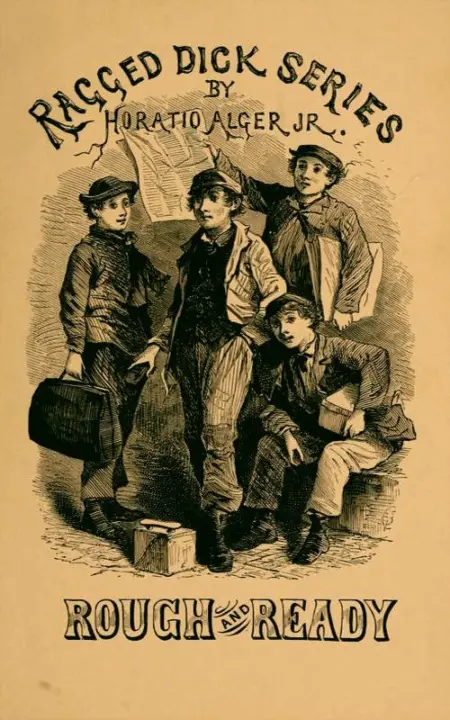
THE CLASSIC COLLECTION · 1869
"Rough and Ready; Or, Life Among the New York Newsboys" by Horatio Alger Jr. is a novel written in the late 19th century. The story focuses on the life of a young newsboy named Rufus, nicknamed "Rough and Ready," who navigates the challenges of poverty in New York City while supporting himself and his younger sister, Rose. The narrative promises to explore themes of resilience, morality, and the struggles of underprivileged youth, as well as the importance of personal values in the face of adversity. At the start of the novel, we are introduced to Rufus as he sells newspapers on the busy streets of New York, demonstrating his quick wit and business savvy amidst the bustling environment. Through interactions with various customers, we learn about his circumstances, including his relationship with his disreputable stepfather, Martin, and his commitment to care for Rose after their mother's death. The opening chapters set the stage for Rufus's determination to provide a better life for his sister, showcasing his hardworking nature and the difficulties they face as they seek to escape the negative influences surrounding them.
Introduction adapted from the source catalogue; source summaries may be automatically generated.
Free to read · English · 49,263 words · No account needed
MAKE TIME FOR A GOOD BOOK
On by default. Untick to stop anonymous reading totals. Each page counts after 10 seconds in view. How this works.
Anonymous counting is on unless you have switched it off.
"There, I know'd I'd mislaid 'em," she said, in a tone of
disappointment. "Can you read, boy?"
"More or less," said Rough and Ready. "What is it you wanted?"
"Why, you see I live to Danbury when I'm at home, and I heerd tell that Roxanna Jane Pinkham was married, and I want to know ef it's true. Maybe you'll find it in the marriages."
"All right, ma'am," said Rough and Ready, glancing over the paper till he came to the list of marriages.
"Is this it, ma'am?" asked the newsboy, reading, "In Danbury, Miss Roxanna Jane Pinkham to Pompey Smith, a very respectable colored man from New York."
"Massy sakes!" ejaculated the old lady. "Has Roxanna married a nigger? Well, she must have been put to't for a husband. Thank you, boy. I'd buy your paper, but I only wanted to know for certain if Roxanna was married. That does beat me,—her marryin' a colored person!"
"That's a profitable customer," thought the newsboy. "I guess she won't find that marriage in any of the other papers. This one has got it exclusive."
Immediately upon her return, the old lady spread the news of Roxanna Pinkham's strange marriage, and wrote comments upon it to her daughter in Danbury. When the report was indignantly denied by the lady most interested, and she threatened to sue the old lady for circulating a slanderous report, the latter stoutly asserted that she heard it read from a New York paper, and she had no doubt there was something in it, or it wouldn't have got into print.
This trick was hardly justifiable in the newsboy; but he was often troubled by people who wanted to look at his papers, but were not willing to buy them, and he repaid himself by some imaginary news of a startling description.
After disposing of his last paper, he procured a fresh supply, and was engaged in selling these, when, on looking up, he saw advancing towards him James Martin, his stepfather.
Before chronicling the incidents of the interview between them, we must go back to the time of Martin's awaking in the room in Leonard Street.
He remembered, at once, the visit of the landlord's agent the day previous, and felt that the time for action had arrived. He knew that the scanty furniture in the room was liable to seizure for rent, and this he resolved the landlord should not get hold of. Accordingly, dressing hastily, he went round to Baxter Street, and accosted the proprietor of a general second-hand establishment, with whom he had previously had some dealings.
"I've got some furniture to sell," he said. "Do you want to buy?"
Your reading position is saved on this browser. Take it to another device with a library code. Reading pages adapt to text, rather than matching a printed edition.
William Rounseville Alger & Horatio, Jr. Alger

William Rounseville Alger & Horatio, Jr. Alger

Horatio, Jr. Alger

Horatio, Jr. Alger
BEHIND THE BOOK
This eBook is for the use of anyone anywhere in the United States and most other parts of the world at no cost and with almost no restrictions whatsoever. You may copy it, give it away or re-use it under the terms of the Project Gutenberg License included with this eBook or online at www.gutenberg.org. If you are not located in the United States, you will have to check the laws of the country where you are located before using this eBook. Read the source licence.
The original source file, including credits and licence, is retained by this library. Request an original-format copy at no charge. Please include the book title and Project Gutenberg identifier #55142.
KEEP YOUR CURIOSITY GOING
Coulson Kernahan

Maurice Baring
Frances Wright
Cécile Tormay

Frederic Jesup Stimson

W. H. P. (William Henry Pope) Jarvis