
Life of Edwin Forrest, the American Tragedian. Volume 2 (of 2)
William Rounseville Alger & Horatio, Jr. Alger
THE CLASSIC COLLECTION · 1869
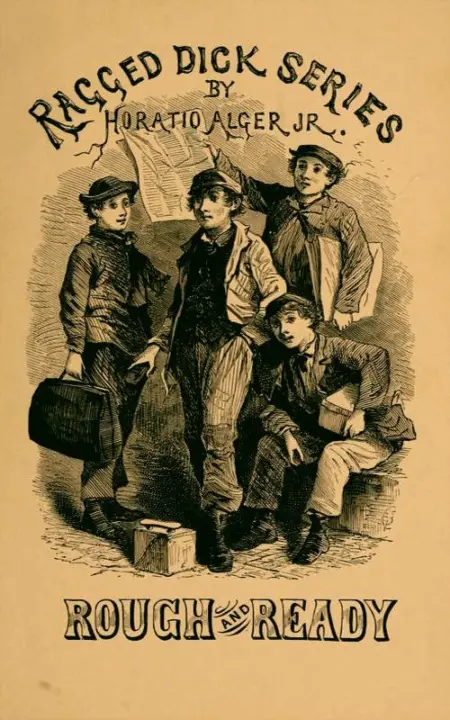
"Rough and Ready; Or, Life Among the New York Newsboys" by Horatio Alger Jr. is a novel written in the late 19th century. The story focuses on the life of a young newsboy named Rufus, nicknamed "Rough and Ready," who navigates the challenges of poverty in New York City while supporting himself and his younger sister, Rose. The narrative promises to explore themes of resilience, morality, and the struggles of underprivileged youth, as well as the importance of personal values in the face of adversity. At the start of the novel, we are introduced to Rufus as he sells newspapers on the busy streets of New York, demonstrating his quick wit and business savvy amidst the bustling environment. Through interactions with various customers, we learn about his circumstances, including his relationship with his disreputable stepfather, Martin, and his commitment to care for Rose after their mother's death. The opening chapters set the stage for Rufus's determination to provide a better life for his sister, showcasing his hardworking nature and the difficulties they face as they seek to escape the negative influences surrounding them.
Introduction adapted from the source catalogue; source summaries may be automatically generated.
Free to read · English · 49,263 words · No account needed
MAKE TIME FOR A GOOD BOOK
On by default. Untick to stop anonymous reading totals. Each page counts after 10 seconds in view. How this works.
Anonymous counting is on unless you have switched it off.
Rose drew back alarmed at this rough language, and for a moment kept silent, hardly daring to renew her appeal. But a look at James Martin's threatening face compelled her to continue, and again she made the appeal.
This time it was a lady she addressed,—mild and pleasant,—who paused a moment, and spoke gently.
"Is your mother quite sick, my dear?" she asked, in a voice of
compassion.
"Yes, ma'am," answered Rose, faintly, ashamed of the falsehood she was
uttering.
"Have you any brothers and sisters?"
"One brother," answered Rose, glad that here at least she could tell the
truth.
"Here's something for you," said the lady, placing twenty-five cents in the child's outstretched palm.
All the passengers had now passed through the portal, and she had some
respite.
James Martin crossed the street, and, coming up to her, asked, "How much
did you get?"
Rose opened her hand.
"Thirty-five cents in five minutes," he said, elated. "Come, little gal, you're gettin' on finely. I shouldn't wonder if you'd take three or four dollars by two o'clock. We'll go home then."
"But I don't like to beg," said Rose.
"Don't let me hear none of that," said Martin, angrily. "You're lazy, that's what's the matter. You've got to earn your livin', there's no two ways about that, and this is the easiest way to do it. There aint no work about beggin'."
Since Martin was mean enough to live on the money begged by a little girl, it isn't likely that he would understand the delicate scrupulousness which made Rose ashamed of soliciting charity.
"I'll take the money," said her stepfather, "and you can get some more when the next boat comes in. I'm goin' away a few minutes," he proceeded; "but you must stay here just where you are, and keep on just as if I was here. I won't be gone long. If I find you haven't done nothing when I come back, look out for yourself."
James Martin had reflected that the thirty-five cents would be sufficient to get him a drink and a couple of cigars, and it was to obtain these that he went away. He found it rather dull work, standing on the sidewalk and watching Rose, and he thought that by inspiring her with a little wholesome fear, she would go on just as well in his absence. Still it might be as well to encourage her a little.
"If you're a good gal," he proceeded, in a changed tone, "and get a lot of money, I'll buy you some candy when we go home."
Your reading position is saved on this browser. Take it to another device with a library code. Reading pages adapt to text, rather than matching a printed edition.
William Rounseville Alger & Horatio, Jr. Alger

William Rounseville Alger & Horatio, Jr. Alger

Horatio, Jr. Alger

Horatio, Jr. Alger
BEHIND THE BOOK
This eBook is for the use of anyone anywhere in the United States and most other parts of the world at no cost and with almost no restrictions whatsoever. You may copy it, give it away or re-use it under the terms of the Project Gutenberg License included with this eBook or online at www.gutenberg.org. If you are not located in the United States, you will have to check the laws of the country where you are located before using this eBook. Read the source licence.
The original source file, including credits and licence, is retained by this library. Request an original-format copy at no charge. Please include the book title and Project Gutenberg identifier #55142.
KEEP YOUR CURIOSITY GOING
Coulson Kernahan

Maurice Baring
Frances Wright
Cécile Tormay

Frederic Jesup Stimson

W. H. P. (William Henry Pope) Jarvis