
Life of Edwin Forrest, the American Tragedian. Volume 2 (of 2)
William Rounseville Alger & Horatio, Jr. Alger
THE CLASSIC COLLECTION · 1869
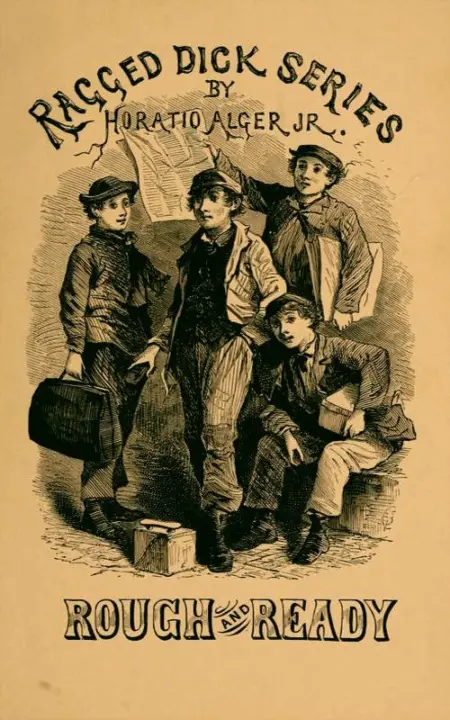
"Rough and Ready; Or, Life Among the New York Newsboys" by Horatio Alger Jr. is a novel written in the late 19th century. The story focuses on the life of a young newsboy named Rufus, nicknamed "Rough and Ready," who navigates the challenges of poverty in New York City while supporting himself and his younger sister, Rose. The narrative promises to explore themes of resilience, morality, and the struggles of underprivileged youth, as well as the importance of personal values in the face of adversity. At the start of the novel, we are introduced to Rufus as he sells newspapers on the busy streets of New York, demonstrating his quick wit and business savvy amidst the bustling environment. Through interactions with various customers, we learn about his circumstances, including his relationship with his disreputable stepfather, Martin, and his commitment to care for Rose after their mother's death. The opening chapters set the stage for Rufus's determination to provide a better life for his sister, showcasing his hardworking nature and the difficulties they face as they seek to escape the negative influences surrounding them.
Introduction adapted from the source catalogue; source summaries may be automatically generated.
Free to read · English · 49,263 words · No account needed
MAKE TIME FOR A GOOD BOOK
On by default. Untick to stop anonymous reading totals. Each page counts after 10 seconds in view. How this works.
Anonymous counting is on unless you have switched it off.
"Yes," said Rose, shuddering. She privately made up her mind that she should die if this threat were carried out, and the very thought of it made her turn pale.
"Don't you want some pie, Rose?" asked Fanny, with her mouth full.
"Yes," said Rose, "I should like some."
"Well, you can't have any," said Fanny, maliciously. "Can she, ma?"
"Of course not. She don't deserve any," said the mother. "Pie is too good for wicked girls. Here, you Rose, here's something for you to do, to keep you out of mischief. Sit down to the table here, and shell these beans. Don't you want to help, Fanny?"
"No, I don't," said Fanny, decidedly. "She can do 'em alone."
A tin-pan half full of bean-pods was placed on the table, and Rose was ordered to be "spry," and not to waste her time. Fanny, having finished her pie, began to tease the cat, which employment she found much more satisfactory than helping Rose.
That night Mrs. Waters presented her bill to Mr. Martin for a week's board in advance for himself and Rose. The fact that he had apparently given up working made her a little doubtful whether he would prove good pay. She determined to ask payment in advance, and thus guard against all risk of loss.
"Mr. Martin," she said, "here's my bill for your board, and the little girl's. I'm rather short of money, and have got some bills to pay, and I should feel particularly obliged if you could pay me now."
Mr. Martin took the bill, and looked at it.
"It's seven dollars," said Mrs. Waters. "I can't afford to take any less. Beef's two cents a pound higher, and potatoes is rising every day. You can't say it's unreasonable."
"It's all right, Mrs. Waters," said Martin, slipping it into his vest-pocket. "It's all right. I'll attend to it in a day or two."
"Can't you pay me to-day?" persisted the landlady. "I've got my rent to pay to-morrow, and it'll take all I can get to pay it."
"Can you change a fifty-dollar bill?" asked Martin.
"I can get it changed."
"I guess I'll get it changed myself," said Martin. "I'm goin' out on
business."
"I don't believe he's got so much money," thought Mrs. Waters, suspiciously, and it is needless to say that she was quite right in her suspicions. The exact amount of Mr. Martin's cash in hand was a dollar and thirty-seven cents, and his entire wardrobe and the sum of his earthly possessions would not probably have brought over fifteen dollars.
Your reading position is saved on this browser. Take it to another device with a library code. Reading pages adapt to text, rather than matching a printed edition.
William Rounseville Alger & Horatio, Jr. Alger

William Rounseville Alger & Horatio, Jr. Alger

Horatio, Jr. Alger

Horatio, Jr. Alger
BEHIND THE BOOK
This eBook is for the use of anyone anywhere in the United States and most other parts of the world at no cost and with almost no restrictions whatsoever. You may copy it, give it away or re-use it under the terms of the Project Gutenberg License included with this eBook or online at www.gutenberg.org. If you are not located in the United States, you will have to check the laws of the country where you are located before using this eBook. Read the source licence.
The original source file, including credits and licence, is retained by this library. Request an original-format copy at no charge. Please include the book title and Project Gutenberg identifier #55142.
KEEP YOUR CURIOSITY GOING
Coulson Kernahan

Maurice Baring
Frances Wright
Cécile Tormay

Frederic Jesup Stimson

W. H. P. (William Henry Pope) Jarvis