
Life of Edwin Forrest, the American Tragedian. Volume 2 (of 2)
William Rounseville Alger & Horatio, Jr. Alger
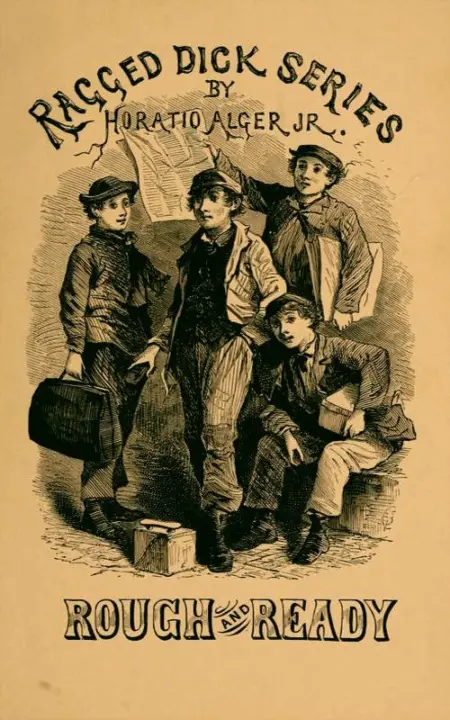
THE CLASSIC COLLECTION · 1869
"Rough and Ready; Or, Life Among the New York Newsboys" by Horatio Alger Jr. is a novel written in the late 19th century. The story focuses on the life of a young newsboy named Rufus, nicknamed "Rough and Ready," who navigates the challenges of poverty in New York City while supporting himself and his younger sister, Rose. The narrative promises to explore themes of resilience, morality, and the struggles of underprivileged youth, as well as the importance of personal values in the face of adversity. At the start of the novel, we are introduced to Rufus as he sells newspapers on the busy streets of New York, demonstrating his quick wit and business savvy amidst the bustling environment. Through interactions with various customers, we learn about his circumstances, including his relationship with his disreputable stepfather, Martin, and his commitment to care for Rose after their mother's death. The opening chapters set the stage for Rufus's determination to provide a better life for his sister, showcasing his hardworking nature and the difficulties they face as they seek to escape the negative influences surrounding them.
Introduction adapted from the source catalogue; source summaries may be automatically generated.
Free to read · English · 49,263 words · No account needed
MAKE TIME FOR A GOOD BOOK
On by default. Untick to stop anonymous reading totals. Each page counts after 10 seconds in view. How this works.
Anonymous counting is on unless you have switched it off.
"Do you think that would be a good plan?" asked his father, smiling.
"Yes, I could earn money, you know."
"Not much, I think. I suppose, if I agree to that arrangement, you will promise to pay all your expenses out of your earnings."
"Yes, I guess I could," said Walter, hesitating, "I can learn the
business of Rufus."
"I don't think you'd like it very well," said our hero, amused.
"Don't you like it?"
"I don't think I should like to sell papers all my life."
"What are you going to do when you are a man?"
"I can't tell yet."
"By the way, Rufus, I should be glad to have you call at my counting-room, No. —— Wall Street, this morning."
"Thank you, sir," said Rufus; "but I should prefer to call to-morrow. This morning, I am going over to Brooklyn to see if I can recover my sister."
"To-morrow will answer just as well. Don't fail to come, however, I wish to have a talk with you about your prospects."
"I will not fail to come," answered the newsboy.
Rufus did not find it so embarrassing as he anticipated at the breakfast table. His young neighbor, Walter, plied him with questions, many of which amused him, and occasionally his sister Carrie, on the opposite side of the table, joined in. Mrs. Turner asked him questions about his little sister, and sympathized with him when he described the plot by which she had been taken from him.
"Do you know Latin?" inquired Walter.
"No," said Rufus.
"I don't see what's the use of studying it, for my part. I never expect
to talk Latin."
"I don't think you ever will," said his father; "judging from your school report, your success has not been very brilliant in that study, so far."
"I know one Latin sentence, anyway," said Walter, complacently.
"What is it?"
"Sum stultus."
"I regret to hear it," said his father, in a tone of amusement.
"Why?" asked Walter, surprised.
"Do you understand the meaning of the words you have just used?"
"Yes, sir."
"Well, what is it?"
"They mean, 'I am good.'"
"Indeed,—I had an idea that their meaning was quite different. Suppose you look out stultus in your dictionary."
"I am sure I am right," said Walter, confidently. "I will prove it to
you."
He got his dictionary, and looked for the word. He looked a little
abashed when he found it.
"Well," said his father, "what does it mean?"
"I am a fool," returned Walter.
At this there was a laugh at Walter's expense. Breakfast was now over, and they rose from the table.
Your reading position is saved on this browser. Take it to another device with a library code. Reading pages adapt to text, rather than matching a printed edition.
William Rounseville Alger & Horatio, Jr. Alger

William Rounseville Alger & Horatio, Jr. Alger

Horatio, Jr. Alger

Horatio, Jr. Alger
BEHIND THE BOOK
This eBook is for the use of anyone anywhere in the United States and most other parts of the world at no cost and with almost no restrictions whatsoever. You may copy it, give it away or re-use it under the terms of the Project Gutenberg License included with this eBook or online at www.gutenberg.org. If you are not located in the United States, you will have to check the laws of the country where you are located before using this eBook. Read the source licence.
The original source file, including credits and licence, is retained by this library. Request an original-format copy at no charge. Please include the book title and Project Gutenberg identifier #55142.
KEEP YOUR CURIOSITY GOING
Coulson Kernahan

Maurice Baring
Frances Wright
Cécile Tormay

Frederic Jesup Stimson

W. H. P. (William Henry Pope) Jarvis