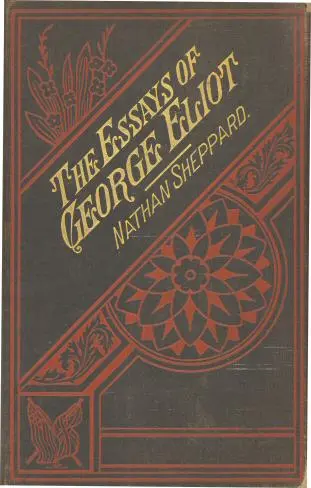
The Essays of “George Eliot” Complete
George Eliot
THE CLASSIC COLLECTION · 1863
"Romola" by George Eliot is a historical novel written between 1862 and 1863. Set in 1490s Florence during the Italian Renaissance, it follows the scholarly Romola de' Bardi and her marriage to Tito Melema, a charismatic Greek scholar with dangerous secrets. As political upheaval sweeps through Florence under Savonarola's religious fervor, Romola must navigate betrayal, moral awakening, and the collision between personal loyalty and civic duty in a city torn by war, famine, and spiritual revolution.
Introduction adapted from the source catalogue; source summaries may be automatically generated.
Free to read · English · 229,822 words · No account needed
MAKE TIME FOR A GOOD BOOK
On by default. Untick to stop anonymous reading totals. Each page counts after 10 seconds in view. How this works.
Anonymous counting is on unless you have switched it off.
Much good had come to Florence since the dim time of struggle between the old patron and the new: some quarrelling and bloodshed, doubtless, between Guelf and Ghibelline, between Black and White, between orthodox sons of the Church and heretic Paterini; some floods, famine, and pestilence; but still much wealth and glory. Florence had achieved conquests over walled cities once mightier than itself, and especially over hated Pisa, whose marble buildings were too high and beautiful, whose masts were too much honoured on Greek and Italian coasts. The name of Florence had been growing prouder and prouder in all the courts of Europe, nay, in Africa itself, on the strength of purest gold coinage, finest dyes and textures, pre-eminent scholarship and poetic genius, and wits of the most serviceable sort for statesmanship and banking: it was a name so omnipresent that a Pope with a turn for epigram had called Florentines “the fifth element.” And for this high destiny, though it might partly depend on the stars and Madonna dell’ Impruneta, and certainly depended on other higher Powers less often named, the praise was greatly due to San Giovanni, whose image was on the fair gold florins.
Therefore it was fitting that the day of San Giovanni—that ancient Church festival already venerable in the days of Saint Augustine—should be a day of peculiar rejoicing to Florence, and should be ushered in by a vigil duly kept in strict old Florentine fashion, with much dancing, with much street jesting, and perhaps with not a little stone-throwing and window-breaking, but emphatically with certain street sights such as could only be provided by a city which held in its service a clever Cecca, engineer and architect, valuable alike in sieges and in shows. By the help of Cecca, the very saints, surrounded with their almond-shaped glory, and floating on clouds with their joyous companionship of winged cherubs, even as they may be seen to this day in the pictures of Perugino, seemed, on the eve of San Giovanni, to have brought their piece of the heavens down into the narrow streets, and to pass slowly through them; and, more wonderful still, saints of gigantic size, with attendant angels, might be seen, not seated, but moving in a slow mysterious manner along the streets, like a procession of colossal figures come down from the high domes and tribunes of the churches. The clouds were made of good woven stuff, the saints and cherubs were unglorified mortals supported by firm bars, and those mysterious giants were really men of very steady brain, balancing themselves on stilts, and enlarged, like Greek tragedians, by huge masks and stuffed shoulders; but he was a miserably unimaginative Florentine who thought only of that—nay, somewhat impious, for in the images of sacred things was there not some of the virtue of sacred things themselves? And if, after that, there came a company of merry black demons well armed with claws and thongs, and other implements of sport, ready to perform impromptu farces of bastinadoing and clothes-tearing, why, that was the demons’ way of keeping a vigil, and they, too, might have descended from the domes and the tribunes. The Tuscan mind slipped from the devout to the burlesque, as readily as water round an angle; and the saints had already had their turn, had gone their way, and made their due pause before the gates of San Giovanni, to do him honour on the eve of his festa. And on the morrow, the great day thus ushered in, it was fitting that the tributary symbols paid to Florence by all its dependent cities, districts, and villages, whether conquered, protected, or of immemorial possession, should be offered at the shrine of San Giovanni in the old octagonal church, once the cathedral and now the baptistery, where every Florentine had had the sign of the Cross made with the anointing chrism on his brow; that all the city, from the white-haired man to the stripling, and from the matron to the lisping child, should be clothed in its best to do honour to the great day, and see the great sight; and that again, when the sun was sloping and the streets were cool, there should be the glorious race or Corso, when the unsaddled horses, clothed in rich trappings, should run right across the city, from the Porta al Prato on the north-west, through the Mercato Vecchio, to the Porta Santa Croce on the south-east, where the richest of Palii, or velvet and brocade banners with silk linings and fringe of gold, such as became a city that half-clothed the well-dressed world, were mounted on a triumphal car awaiting the winner or winner’s owner.
Your reading position is saved on this browser. Take it to another device with a library code. Reading pages adapt to text, rather than matching a printed edition.
George Eliot
George Eliot

George Eliot & Elizabeth Barrett Browning & Robert Browning & Percy Bysshe Shelley
George Eliot
BEHIND THE BOOK
This eBook is for the use of anyone anywhere in the United States and most other parts of the world at no cost and with almost no restrictions whatsoever. You may copy it, give it away or re-use it under the terms of the Project Gutenberg License included with this eBook or online at www.gutenberg.org. If you are not located in the United States, you will have to check the laws of the country where you are located before using this eBook. Read the source licence.
The original source file, including credits and licence, is retained by this library. Request an original-format copy at no charge. Please include the book title and Project Gutenberg identifier #24020.
KEEP YOUR CURIOSITY GOING
Cécile Tormay

Moritz Busch
Coulson Kernahan
John L. Ransom

Maurice Baring
Frances Wright