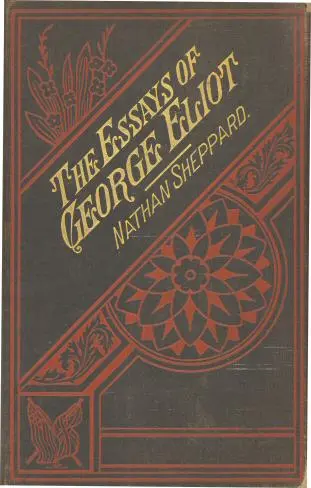
The Essays of “George Eliot” Complete
George Eliot
THE CLASSIC COLLECTION · 1863
"Romola" by George Eliot is a historical novel written between 1862 and 1863. Set in 1490s Florence during the Italian Renaissance, it follows the scholarly Romola de' Bardi and her marriage to Tito Melema, a charismatic Greek scholar with dangerous secrets. As political upheaval sweeps through Florence under Savonarola's religious fervor, Romola must navigate betrayal, moral awakening, and the collision between personal loyalty and civic duty in a city torn by war, famine, and spiritual revolution.
Introduction adapted from the source catalogue; source summaries may be automatically generated.
Free to read · English · 229,822 words · No account needed
MAKE TIME FOR A GOOD BOOK
On by default. Untick to stop anonymous reading totals. Each page counts after 10 seconds in view. How this works.
Anonymous counting is on unless you have switched it off.
“I do not deny it,” said Tito, blandly. “But if it turns out that Fra Francesco is mistaken, he will have been burned for the wrong side, and the Church has never reckoned such victims to be martyrs. We must suspend our judgment until the trial has really taken place.”
“It is true, Messer Segretario,” said the shopkeeper, with subdued impatience. “But will you favour us by interpreting the Latin?”
“Assuredly,” said Tito. “It does but express the conclusions or doctrines which the Frate specially teaches, and which the trial by fire is to prove true or false. They are doubtless familiar to you. First, that Florence—”
“Let us have the Latin bit by bit, and then tell us what it means,” said the shoemaker, who had been a frequent hearer of Fra Girolamo.
“Willingly,” said Tito, smiling. “You will then judge if I give you the
right meaning.”
“Yes, yes; that’s fair,” said Goro.
“Ecclesia Dei indiget renovatione; that is, the Church of God needs purifying or regenerating.”
“It is true,” said several voices at once.
“That means, the priests ought to lead better lives; there needs no miracle to prove that. That’s what the Frate has always been saying,” said the shoemaker.
“Flagellabitur,” Tito went on. “That is, it will be scourged. Renovabitur: it will be purified. Florentia quoque post flagellam renovabitur et prosperabitur: Florence also, after the scourging, shall be purified and shall prosper.”
“That means we are to get Pisa again,” said the shopkeeper.
“And get the wool from England as we used to do, I should hope,” said an elderly man, in an old-fashioned berretta, who had been silent till now. “There’s been scourging enough with the sinking of the trade.”
At this moment, a tall personage, surmounted by a red feather, issued from the door of the convent, and exchanged an indifferent glance with Tito; who, tossing his becchetto carelessly over his left shoulder, turned to his reading again, while the bystanders, with more timidity than respect, shrank to make a passage for Messer Dolfo Spini.
“Infideles convertentur ad Christum,” Tito went on. “That is, the infidels shall be converted to Christ.”
“Those are the Turks and the Moors. Well, I’ve nothing to say against that,” said the shopkeeper, dispassionately.
“Haec autem omnia erunt temporibus nostris: and all these things shall happen in our times.”
“Why, what use would they be else?” said Goro.
“Excommunicato nuper lata contra Reverendum Patrem nostrum Fratrem Hieronymum nulla est: the excommunication lately pronounced against our reverend father, Fra Girolamo, is null. Non observantes eam non peccant: those who disregard it are not committing a sin.”
Your reading position is saved on this browser. Take it to another device with a library code. Reading pages adapt to text, rather than matching a printed edition.
George Eliot
George Eliot

George Eliot & Elizabeth Barrett Browning & Robert Browning & Percy Bysshe Shelley
George Eliot
BEHIND THE BOOK
This eBook is for the use of anyone anywhere in the United States and most other parts of the world at no cost and with almost no restrictions whatsoever. You may copy it, give it away or re-use it under the terms of the Project Gutenberg License included with this eBook or online at www.gutenberg.org. If you are not located in the United States, you will have to check the laws of the country where you are located before using this eBook. Read the source licence.
The original source file, including credits and licence, is retained by this library. Request an original-format copy at no charge. Please include the book title and Project Gutenberg identifier #24020.
KEEP YOUR CURIOSITY GOING
Cécile Tormay

Moritz Busch
Coulson Kernahan
John L. Ransom

Maurice Baring
Frances Wright