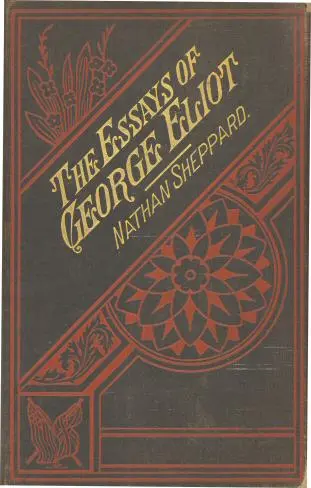
The Essays of “George Eliot” Complete
George Eliot
THE CLASSIC COLLECTION · 1863
"Romola" by George Eliot is a historical novel written between 1862 and 1863. Set in 1490s Florence during the Italian Renaissance, it follows the scholarly Romola de' Bardi and her marriage to Tito Melema, a charismatic Greek scholar with dangerous secrets. As political upheaval sweeps through Florence under Savonarola's religious fervor, Romola must navigate betrayal, moral awakening, and the collision between personal loyalty and civic duty in a city torn by war, famine, and spiritual revolution.
Introduction adapted from the source catalogue; source summaries may be automatically generated.
Free to read · English · 229,822 words · No account needed
MAKE TIME FOR A GOOD BOOK
On by default. Untick to stop anonymous reading totals. Each page counts after 10 seconds in view. How this works.
Anonymous counting is on unless you have switched it off.
“Yes, my little Tessa,” he said, caressingly, “you must go back to the Madre; but you must not tell her you are married—you must keep that a secret from everybody; else some very great harm would happen to me, and you would never see me again.”
She looked up at him with fear in her face.
“You must go back and feed your goats and mules, and do just as you have always done before, and say no word to any one about me.”
The corners of her mouth fell a little.
“And then, perhaps, I shall come and take care of you again when you want me, as I did before. But you must do just what I tell you, else you will not see me again.”
“Yes, I will, I will,” she said, in a loud whisper, frightened at that
blank prospect.
They were silent a little while; and then Tessa, looking at her hand,
said—
“The Madre wears a betrothal ring. She went to church and had it put on, and then after that, another day, she was married. And so did the cousin Nannina. But then she married Gollo,” added the poor little thing, entangled in the difficult comparison between her own case and others within her experience.
“But you must not wear a betrothal ring, my Tessa, because no one must know you are married,” said Tito, feeling some insistence necessary. “And the buona fortuna that I gave you did just as well for betrothal. Some people are betrothed with rings and some are not.”
“Yes, it is true, they would see the ring,” said Tessa, trying to convince herself that a thing she would like very much was really not good for her.
They were now near the entrance of the church again, and she remembered her cocoons which were still in Tito’s hand.
“Ah, you must give me the boto,” she said; “and we must go in, and I must take it to the Padre, and I must tell the rest of my beads, because I was too tired before.”
“Yes, you must go in, Tessa; but I will not go in. I must leave you now,” said Tito, too feverish and weary to re-enter that stifling heat, and feeling that this was the least difficult way of parting with her.
“And not come back? Oh, where do you go?” Tessa’s mind had never formed an image of his whereabout or his doings when she did not see him: he had vanished, and her thought, instead of following him, had stayed in the same spot where he was with her.
Your reading position is saved on this browser. Take it to another device with a library code. Reading pages adapt to text, rather than matching a printed edition.
George Eliot
George Eliot

George Eliot & Elizabeth Barrett Browning & Robert Browning & Percy Bysshe Shelley
George Eliot
BEHIND THE BOOK
This eBook is for the use of anyone anywhere in the United States and most other parts of the world at no cost and with almost no restrictions whatsoever. You may copy it, give it away or re-use it under the terms of the Project Gutenberg License included with this eBook or online at www.gutenberg.org. If you are not located in the United States, you will have to check the laws of the country where you are located before using this eBook. Read the source licence.
The original source file, including credits and licence, is retained by this library. Request an original-format copy at no charge. Please include the book title and Project Gutenberg identifier #24020.
KEEP YOUR CURIOSITY GOING
Cécile Tormay

Moritz Busch
Coulson Kernahan
John L. Ransom

Maurice Baring
Frances Wright