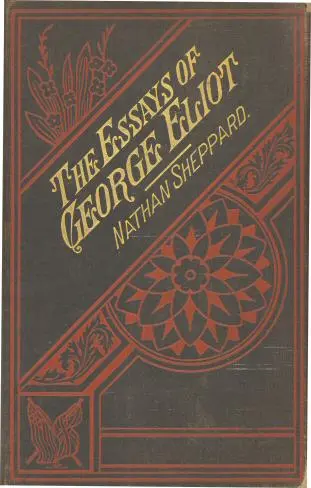
The Essays of “George Eliot” Complete
George Eliot
THE CLASSIC COLLECTION · 1863
"Romola" by George Eliot is a historical novel written between 1862 and 1863. Set in 1490s Florence during the Italian Renaissance, it follows the scholarly Romola de' Bardi and her marriage to Tito Melema, a charismatic Greek scholar with dangerous secrets. As political upheaval sweeps through Florence under Savonarola's religious fervor, Romola must navigate betrayal, moral awakening, and the collision between personal loyalty and civic duty in a city torn by war, famine, and spiritual revolution.
Introduction adapted from the source catalogue; source summaries may be automatically generated.
Free to read · English · 229,822 words · No account needed
MAKE TIME FOR A GOOD BOOK
On by default. Untick to stop anonymous reading totals. Each page counts after 10 seconds in view. How this works.
Anonymous counting is on unless you have switched it off.
“Stop, cousin!” said Bardo, in his imperious tone, for he had a remark to make, and only desperate measures could arrest the rattling lengthiness of Monna Brigida’s discourse. But now she gave a little start, pursed up her mouth, and looked at him with round eyes.
“Francesco Valori is not altogether wrong,” Bardo went on. “Bernardo, indeed, rates him not highly, and is rather of opinion that he christens private grudges by the name of public zeal; though I must admit that my good Bernardo is too slow of belief in that unalloyed patriotism which was found in all its lustre amongst the ancients. But it is true, Tito, that our manners have degenerated somewhat from that noble frugality which, as has been well seen in the public acts of our citizens, is the parent of true magnificence. For men, as I hear, will now spend on the transient show of a Giostra sums which would suffice to found a library, and confer a lasting possession on mankind. Still, I conceive, it remains true of us Florentines that we have more of that magnanimous sobriety which abhors a trivial lavishness that it may be grandly open-handed on grand occasions, than can be found in any other city of Italy; for I understand that the Neapolitan and Milanese courtiers laugh at the scarcity of our plate, and think scorn of our great families for borrowing from each other that furniture of the table at their entertainments. But in the vain laughter of folly wisdom hears half its applause.”
“Laughter, indeed!” burst forth Monna Brigida again, the moment, Bardo paused. “If anybody wanted to hear laughter at the wedding to-day they were disappointed, for when young Niccolò Macchiavelli tried to make a joke, and told stories out of Franco Sacchetti’s book, how it was no use for the Signoria to make rules for us women, because we were cleverer than all the painters, and architects, and doctors of logic in the world, for we could make black look white, and yellow look pink, and crooked look straight, and, if anything was forbidden, we could find a new name for it—Holy Virgin! the Piagnoni looked more dismal than before, and somebody said Sacchetti’s book was wicked. Well, I don’t read it—they can’t accuse me of reading anything. Save me from going to a wedding again, if that’s to be the fashion; for all of us who were not Piagnoni were as comfortable as wet chickens. I was never caught in a worse trap but once before, and that was when I went to hear their precious Frate last Quaresima in San Lorenzo. Perhaps I never told you about it, Messer Tito?—it almost freezes my blood when I think of it. How he rated us poor women! and the men, too, to tell the truth, but I didn’t mind that so much. He called us cows, and lumps of flesh, and wantons, and mischief-makers—and I could just bear that, for there were plenty others more fleshy and spiteful than I was, though every now and then his voice shook the very bench under me like a trumpet; but then he came to the false hair, and, O misericordia! he made a picture—I see it now—of a young woman lying a pale corpse, and us light-minded widows—of course he meant me as well as the rest, for I had my plaits on, for if one is getting old, one doesn’t want to look as ugly as the Befana,[1]—us widows rushing up to the corpse, like bare-pated vultures as we were, and cutting off its young dead hair to deck our old heads with. Oh, the dreams I had after that! And then he cried, and wrung his hands at us, and I cried too. And to go home, and to take off my jewels, this very clasp, and everything, and to make them into a packet, fù tutt’uno; and I was within a hair of sending them to the Good Men of Saint Martin to give to the poor, but, by heaven’s mercy, I bethought me of going first to my confessor, Fra Cristoforo, at Santa Croce, and he told me how it was all the work of the devil, this preaching and prophesying of their Fra Girolamo, and the Dominicans were trying to turn the world upside down, and I was never to go and hear him again, else I must do penance for it; for the great preachers Fra Mariano and Fra Menico had shown how Fra Girolamo preached lies—and that was true, for I heard them both in the Duomo—and how the Pope’s dream of San Francesco propping up the Church with his arms was being fulfilled still, and the Dominicans were beginning to pull it down. Well and good: I went away con Dio, and made myself easy. I am not going to be frightened by a Frate Predicatore again. And all I say is, I wish it hadn’t been the Dominicans that poor Dino joined years ago, for then I should have been glad when I heard them say he was come back—”
Your reading position is saved on this browser. Take it to another device with a library code. Reading pages adapt to text, rather than matching a printed edition.
George Eliot
George Eliot

George Eliot & Elizabeth Barrett Browning & Robert Browning & Percy Bysshe Shelley
George Eliot
BEHIND THE BOOK
This eBook is for the use of anyone anywhere in the United States and most other parts of the world at no cost and with almost no restrictions whatsoever. You may copy it, give it away or re-use it under the terms of the Project Gutenberg License included with this eBook or online at www.gutenberg.org. If you are not located in the United States, you will have to check the laws of the country where you are located before using this eBook. Read the source licence.
The original source file, including credits and licence, is retained by this library. Request an original-format copy at no charge. Please include the book title and Project Gutenberg identifier #24020.
KEEP YOUR CURIOSITY GOING
Cécile Tormay

Moritz Busch
Coulson Kernahan
John L. Ransom

Maurice Baring
Frances Wright