THE CLASSIC COLLECTION✦A dead man’s diaryCLASSIC FREE BOOKS
A dead man’s diary
Coulson Kernahan
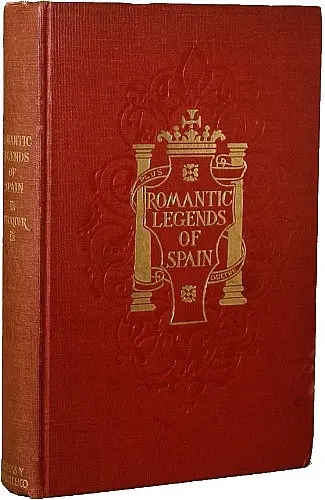
THE CLASSIC COLLECTION · 1909
"Romantic Legends of Spain" by Gustavo Adolfo Bécquer is a collection of short stories written in the late 19th century. The tales blend elements of folklore, romance, and the supernatural, exploring the rich traditions and legends of Spanish culture. Through intricate narratives, the author delves into themes of love, loss, and the mystical, often featuring enchanting characters that evoke the spirit of bygone eras. The opening of the collection introduces readers to the poignant story of Master Pérez, the blind organist at a convent in Seville who is dedicated to his craft and beloved by the townsfolk. As Christmas Eve approaches, he is determined to play the Midnight Mass despite his ailing health, illustrating his deep connection to both music and faith. His miraculous performance in the church, which draws tears from the audience, becomes an emotional crescendo that leads to his passing, leaving the townspeople to grapple with the loss of their cherished musician. This initial tale sets the tone for the collection, blending reverence for tradition with the haunting beauty of Bécquer's prose.
Introduction adapted from the source catalogue; source summaries may be automatically generated.
Free to read · English · 89,207 words · No account needed
MAKE TIME FOR A GOOD BOOK
On by default. Untick to stop anonymous reading totals. Each page counts after 10 seconds in view. How this works.
Anonymous counting is on unless you have switched it off.
It would seem to have been the unwonted sense of an assured income that gave him courage to undertake the support of a wife, for in this year 1861 his constant friend Correa obtained for him a position on the staff of a new Madrid daily, El Contemporáneo, a journal into whose labors he threw himself with a zest far beyond his strength and which he came to love with a touching enthusiasm. “El Contemporáneo is not for me a newspaper like any other; its columns are yourselves, my friends, my comrades in hope or disappointment, in failure or triumph, in joy or bitterness.” It was in El Contemporáneo that many of his legends appeared. But even as he thus became more and more closely identified with the life of Madrid, homesickness grew upon him for his own Andalusia “with her golden days and luminous, transparent nights,”--for his own Seville, “with her Giralda of lace-work mirrored in the trembling Guadalquivir, ... with her barred windows and her serenades, her iron door-screens and her night watchmen that chant the hour, her shrines and her stories, her brawls and her music, her tranquil nights and fiery afternoons, her rosy dawns and azure twilights,--Seville, with all the traditions that twenty centuries have heaped upon her brow, with all the pageantry and festal beauty of her southern nature, with all the poetry that imagination lends to a beloved memory.”
He re-visited Seville, if The Tavern of the Cats can be taken as testimony, at about this time, and may so have renewed intercourse with his family, for in 1862 his next older brother, Valeriano, who, following in their father’s path, had entered on a promising career as a painter of Andalusian types, came to him in Madrid. Valeriano, too, was of frail physique; he, too, had been unhappy in his marriage; yet the brothers affectionately joined such forces as they had and set up, with the little children, a makeshift for a home. But in a year or two some wasting illness, apparently the early stages of consumption, forced the poet to leave “the Court” and seek renewal of health in the mountain valley of Veruela. During this sojourn he gathered several legends of the Moncayo, that precipitous granite wall--known to Martial as the haunt of Æolus--which bars Old Castile from Aragon and divides the basin of the Douro, the river of Soria, from that of the Ebro, the river of Saragossa. To Becquer its snowy crests looked “like the waves of a motionless, gigantic sea.” But the main literary result of that retirement is found in the series of eight exquisite letters, From My Cell, the high-water mark of Becquer’s prose, sent back to El Contemporáneo. In these he gives a vivid, humorous account of his journey, by rail to Tudela, by diligence to Tarazona, and by mule up the Moncayo to Veruela, in whose walled and towered old Cistercian abbey he found an austere refuge. He had his Shakespeare with him and his Byron, but the event of the day, in the earlier weeks of his banishment, was the arrival of the mounted postman with El Contemporáneo. He could not wait for it in the Gothic cloisters, but would wander halfway down the poplar avenue to the Black Cross of Veruela and, seated at its foot on one of the marble steps, would wait sometimes the afternoon long listening for the far-off beat of the horse’s hoofs. The journal came to him like a personal greeting from the life he had left behind. He loved even the odor of the damp paper and the printer’s ink, an odor that brought back to him “the incessant pounding and creaking of the presses” and all the eager activity of those hurrying nights in which the words “came palpitating from the pen.” But with sunset the feverish memories of Madrid fell from him and his thoughts took on the serenity of faith, “the faith in something grander, in a coming, unknown destiny beyond this life, the faith in eternity.” Again he found himself dreaming of death, but not now of a poet’s cherished grave beside the Guadalquivir, not now of a great patriot’s tomb in some sublime cathedral, but of a mound in a village burial-plot, forgotten under nettles, thistles and grass. Long tormented by insomnia, it seemed sweet to him to slumber in such untroubled peace, “wrapt in a light cloak of earth,” without having over him “even the weight of a sepulchral stone.” As the mountain air brought strength, he began to ramble over the Moncayo, sketching and gathering up traditions, while through El Contemporáneo he passionately urged the claims of the past, and proposed the state organization of archæological expeditions in groups made up of an artist, an architect and a man of letters, to explore the provinces for their hidden, perishing traces of that bygone Spain of Roman, Visigoth, Moor, mailed knight and saintly vision. Bent, as ever, on doing his part in this unprized service, he wrote out, in the quiet and leisure that had been so seldom his, masterly descriptions of the market-place of Tarazona, and of the peasant-women of the Amazonian hamlet of Añón. In the sixth letter he narrates, with a pen almost unendurably graphic, the recent doing to death of a reputed hereditary witch, a wretched old woman whom the superstitious Aragonese peasants had, in very truth, hunted to a peak of the Moncayo off which, bleeding from stones and knives, she had been thrust down the precipice. In the seventh and eighth letters he goes on to relate, in his most attractive manner, two local legends of witchcraft,--one of the necromancer who built in a night the castle of Trasmoz, and one of the pious priest who exorcised the witches that had come, in course of time, to make its ruined tower their tryst, only to have his work undone by the girlish vanity of his niece. She tampered with the holy water and restored to the witches the freedom of the castle in return for their kind offices in scrambling down her chimney, gray cats, black cats, all manner of cats, the night before a festival, and stitching up for her such fascinating finery that she forthwith won a husband.
Your reading position is saved on this browser. Take it to another device with a library code. Reading pages adapt to text, rather than matching a printed edition.
BEHIND THE BOOK
This eBook is for the use of anyone anywhere in the United States and most other parts of the world at no cost and with almost no restrictions whatsoever. You may copy it, give it away or re-use it under the terms of the Project Gutenberg License included with this eBook or online at www.gutenberg.org. If you are not located in the United States, you will have to check the laws of the country where you are located before using this eBook. Read the source licence.
The original source file, including credits and licence, is retained by this library. Request an original-format copy at no charge. Please include the book title and Project Gutenberg identifier #50044.
KEEP YOUR CURIOSITY GOING
Coulson Kernahan

Maurice Baring
Frances Wright
Cécile Tormay
Francis Greenleaf Allinson & Anne C. E. (Anne Crosby Emery) Allinson

Frederic Jesup Stimson