THE CLASSIC COLLECTION✦A dead man’s diaryCLASSIC FREE BOOKS
A dead man’s diary
Coulson Kernahan
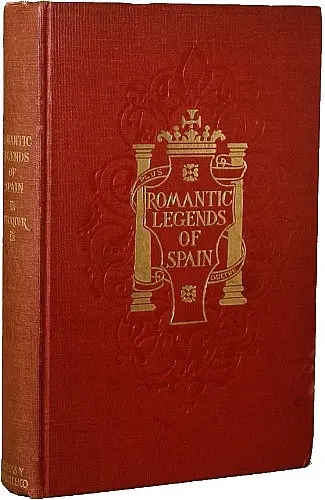
THE CLASSIC COLLECTION · 1909
"Romantic Legends of Spain" by Gustavo Adolfo Bécquer is a collection of short stories written in the late 19th century. The tales blend elements of folklore, romance, and the supernatural, exploring the rich traditions and legends of Spanish culture. Through intricate narratives, the author delves into themes of love, loss, and the mystical, often featuring enchanting characters that evoke the spirit of bygone eras. The opening of the collection introduces readers to the poignant story of Master Pérez, the blind organist at a convent in Seville who is dedicated to his craft and beloved by the townsfolk. As Christmas Eve approaches, he is determined to play the Midnight Mass despite his ailing health, illustrating his deep connection to both music and faith. His miraculous performance in the church, which draws tears from the audience, becomes an emotional crescendo that leads to his passing, leaving the townspeople to grapple with the loss of their cherished musician. This initial tale sets the tone for the collection, blending reverence for tradition with the haunting beauty of Bécquer's prose.
Introduction adapted from the source catalogue; source summaries may be automatically generated.
Free to read · English · 89,207 words · No account needed
MAKE TIME FOR A GOOD BOOK
On by default. Untick to stop anonymous reading totals. Each page counts after 10 seconds in view. How this works.
Anonymous counting is on unless you have switched it off.
I am black and comely; my lips are glowing;
I am passion; my heart is hot;
The rapture of life in my veins is flowing.
For me thou callest?--I call thee not.
Pale is my forehead and gold my tresses;
Endless comforts are locked in me,
Treasure of hearthside tendernesses.
’Tis I whom thou seekest?--Nay, not thee.
I am a dream, afar, forbidden.
Vague as the mist on the mountain-brow,
A bodiless glory, haunting, hidden;
I cannot love thee.--Oh, come! come thou!
Becquer himself was wont to ascribe the premature death of poets, that breaking of the harp while yet the golden chords have yielded but their least of melodies, to a restless fulness of life, the imprisoned vapor that bursts the vessel. This appears with pathetic emphasis in the Introduction that he wrote, not long before his death, for a projected volume of tales and fantasies. He felt that he must rid his fevered brain of their importunity, but he had begun to give expression to only one, The Woman of Stone, when death broke the magic pen. The story remains a fragment,[5] not passing beyond its opening pages of rich artistic description, nor can its course be clearly conjectured even though in The Kiss, and in the closing passages of his Literary Letters to a Woman, his imagination hovers about the theme. He left, like Hawthorne, many tantalizing titles that suggest the greatness of our loss. That drama on “The Brothers of Sorrow,” that poem on the discovery of America, those Andalusian novels on “The Last Minstrel,” “To Live or Not to Live,” those Toledo legends on “The Foundress of Convents,” “El Cristo de la Vega,” “The Angel Musicians,” those fantasies on “Light and Snow,” “The Diana of the Indies,” “The Life of the Dead,”--these are but a few of the conceptions that teemed in his mind but found no outlet to the world. It seemed to his friends, who knew the man and had listened to his marvellous talk, that the scanty handful of tales they could collect from newspapers here and there made so inadequate a showing as almost to misrepresent his powers. Yet however thwarted and wronged by circumstance this harvest of his imagination may be, it deserves attention if only for its finer and less obvious qualities. Becquer charges himself with a melancholy temperament, and seldom, in fact, do we find in these pages the blither humor playing in The Set of Emeralds; but the occasional morbidness of his tone is due rather, it would seem, to illness and its consequent despondency than to any native quality of his thought. He deals too much in the horrible for modern taste, but he cannot claim, like Baudelaire, to have “invented a new shudder.” Tales grounded in folk-lore are bound to contain elements of superstitious terror, and the affinity of these legends in that respect is rather with German balladry and the earlier romanticism in general than with the genius of Poe. Becquer’s truer kinship is with Hawthorne, whose outer faculty of close and minute observation is his as well as the inner preoccupation with mystery and symbol. All the senses of this young Spaniard seem to have been of the finest, his exquisite hearing entering into these tales as effectively as his keen sight; but he is most himself in presence of the dim, the fugitive, the impalpable. His mind was essentially mystical. His religion was not without its human side. In brooding on the inequalities of the mortal lot, he finds comfort in the reflection: “God, though invisible, yet holds a hand outreached to lift a little the burden that presses on the poor.” But faith in him was of the very fibre of imagination. He even lent a certain sympathetic credence to the mediæval legends of the Church, at least when the spell of Toledo was upon him. “Outside the place that guards their memory,” he says, “far from the precincts which still preserve their traces, and where we seem yet to breathe the atmosphere of the ages that gave them being, traditions lose their poetic mystery, their inexplicable hold upon the soul. At a distance we question, we analyze, we doubt; but there faith, like a secret revelation, illuminates the spirit, and we believe.” In a letter from Veruela to a lady of his acquaintance, a letter relating a brief but lovely legend[6] of an appearance of the Virgin, he asserts: “Only the hand of faith can touch the delicate flowers of tradition.” “God,” he elsewhere says, “is the glowing, eternal centre of all beauty.”
Your reading position is saved on this browser. Take it to another device with a library code. Reading pages adapt to text, rather than matching a printed edition.
BEHIND THE BOOK
This eBook is for the use of anyone anywhere in the United States and most other parts of the world at no cost and with almost no restrictions whatsoever. You may copy it, give it away or re-use it under the terms of the Project Gutenberg License included with this eBook or online at www.gutenberg.org. If you are not located in the United States, you will have to check the laws of the country where you are located before using this eBook. Read the source licence.
The original source file, including credits and licence, is retained by this library. Request an original-format copy at no charge. Please include the book title and Project Gutenberg identifier #50044.
KEEP YOUR CURIOSITY GOING
Coulson Kernahan

Maurice Baring
Frances Wright
Cécile Tormay
Francis Greenleaf Allinson & Anne C. E. (Anne Crosby Emery) Allinson

Frederic Jesup Stimson