THE CLASSIC COLLECTION✦Excursion to the Orkney IslandsCLASSIC FREE BOOKS
Excursion to the Orkney Islands
Jacob Abbott
THE CLASSIC COLLECTION · 1855
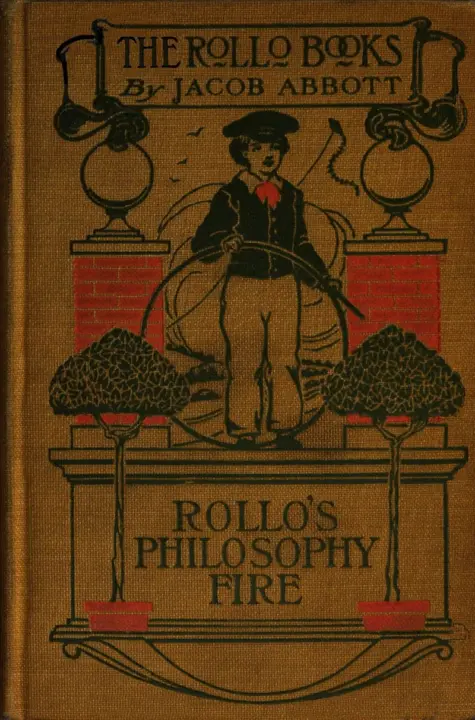
"Rollo's Philosophy [Fire]" by Jacob Abbott is a children's educational book written in the mid-19th century. It is part of the Rollo series, which aims to engage young readers in philosophical and scientific concepts through the adventures of its young protagonist, Rollo. The book focuses on the nature of fire and combustion, presenting Rollo's explorations and discussions with characters like his father and Jonas. At the start of the book, Rollo is introduced waiting for Jonas while observing fireflies, and his curiosity about fire leads him into a series of discussions about combustion and how fires are maintained. Through a detailed exchange with Jonas about covering coals to encourage slow combustion, readers are gradually introduced to the principles of how fires work and the science behind making charcoal. The opening sets the stage for Rollo's inquisitive nature and his eagerness to learn, as he ponders the nature of various substances and their reactions, laying the groundwork for a fun yet enlightening exploration of fire.
Introduction adapted from the source catalogue; source summaries may be automatically generated.
Free to read · English · 34,619 words · No account needed
MAKE TIME FOR A GOOD BOOK
On by default. Untick to stop anonymous reading totals. Each page counts after 10 seconds in view. How this works.
Anonymous counting is on unless you have switched it off.
“That makes me think of something Jonas said, which I was going to ask you,” said Rollo. “He said that, in books, burning was always called combustion, and I told him I meant to ask you why they couldn’t as well call it burning.”
“I don’t think that Jonas said exactly that,” said his father.
“Yes, sir, he did,” replied Rollo; “at least, I understood him so.”
“It is true, no doubt,” added his father, “that, in philosophical books, philosophical terms are very often used, instead of the common language which we ordinarily employ.”
“Why are they, father?” said Rollo. “I think the common words are a great deal easier to understand.”
“Yes,” said his father, “but they are not precise in their signification. They are vague and ambiguous, and so philosophers, when they wish to speak accurately, employ other terms, which have an exact signification.”
Rollo looked perplexed. He did not understand at all what his father meant. In the meantime, his mother had brought a fresh bundle of lamp-lighters from the closet, and had lighted her lamp with one of them, and was just going away. As she was going out, however, she said to her husband,—
“Please to wait a minute, until I come back, for I should like to hear what you are going to say.”
“Well,” said he; “and you, Rollo, may come and sit down by me, and I will explain it to you when mother comes back.”
So Rollo came and took a seat on the sofa by the side of his father,
saying,—
“Father, I wish you would have a bottle of spirits of turpentine for us to light our lamps by.”
“It is not of much advantage in a family,” said his father, “where the lamps are lighted in various parts of the house, and only a few in all to be lighted. But where there are a great many, it is quite a saving of time to have a little spirits of turpentine to tip the wicks with. In an illumination they always touch the wicks so, and by that means they can light up suddenly.”
“But, father, why will the wick light any quicker?”
Your reading position is saved on this browser. Take it to another device with a library code. Reading pages adapt to text, rather than matching a printed edition.
Jacob Abbott

Jacob Abbott

Jacob Abbott

Jacob Abbott
BEHIND THE BOOK
This eBook is for the use of anyone anywhere in the United States and most other parts of the world at no cost and with almost no restrictions whatsoever. You may copy it, give it away or re-use it under the terms of the Project Gutenberg License included with this eBook or online at www.gutenberg.org. If you are not located in the United States, you will have to check the laws of the country where you are located before using this eBook. Read the source licence.
The original source file, including credits and licence, is retained by this library. Request an original-format copy at no charge. Please include the book title and Project Gutenberg identifier #62726.
KEEP YOUR CURIOSITY GOING
Coulson Kernahan

Maurice Baring
Frances Wright
Cécile Tormay

Frederic Jesup Stimson

W. H. P. (William Henry Pope) Jarvis