THE CLASSIC COLLECTION✦Excursion to the Orkney IslandsCLASSIC FREE BOOKS
Excursion to the Orkney Islands
Jacob Abbott
THE CLASSIC COLLECTION · 1855
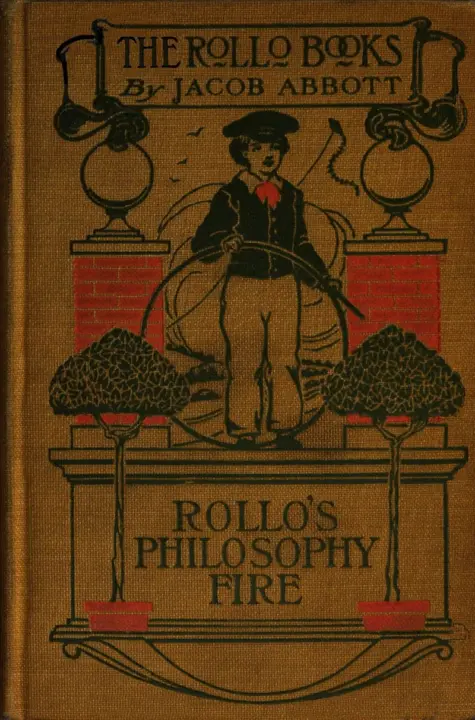
"Rollo's Philosophy [Fire]" by Jacob Abbott is a children's educational book written in the mid-19th century. It is part of the Rollo series, which aims to engage young readers in philosophical and scientific concepts through the adventures of its young protagonist, Rollo. The book focuses on the nature of fire and combustion, presenting Rollo's explorations and discussions with characters like his father and Jonas. At the start of the book, Rollo is introduced waiting for Jonas while observing fireflies, and his curiosity about fire leads him into a series of discussions about combustion and how fires are maintained. Through a detailed exchange with Jonas about covering coals to encourage slow combustion, readers are gradually introduced to the principles of how fires work and the science behind making charcoal. The opening sets the stage for Rollo's inquisitive nature and his eagerness to learn, as he ponders the nature of various substances and their reactions, laying the groundwork for a fun yet enlightening exploration of fire.
Introduction adapted from the source catalogue; source summaries may be automatically generated.
Free to read · English · 34,619 words · No account needed
MAKE TIME FOR A GOOD BOOK
On by default. Untick to stop anonymous reading totals. Each page counts after 10 seconds in view. How this works.
Anonymous counting is on unless you have switched it off.
“Why, the tea-kettle loses its heat by radiation principally, and the heater supplies it by conduction, and so one restores what is lost by the other.”
“I don’t understand it, exactly,” said Rollo.
“Well,” said his father, “I’ll explain it to you presently, alter we have taken our seats at the table.”
Accordingly, when they were all seated at the table, Rollo asked his father about the operation of the heater and the tea-kettle.
“Well,” replied his father, “I will explain it to you. It is a very good apparatus to illustrate the subject. The tea-kettle is a radiator, and the heater is a conductor, and so they show both modes of conveying heat.
“For,” continued his father, “as the sides of the tea-kettle do not come in contact with any thing but the air, they do not conduct away the heat much; for the air does not take heat easily by conduction. But the tea-kettle radiates heat continually. If you put your hand near it, you will feel the heat passing off into the air all around.”
Here Rollo, who was seated not very far from the tea-kettle, put out his hand towards it to feel the radiation.
“The tea-kettle would conduct away the heat very fast, if there was any thing touching it all around, which would take heat easily by conduction.”
“How fast?” said Rollo.
“Why, if you were to put your hands to it, clasping it all around, the heat would be conducted very fast into your hand, and you would be burned. Your hands would receive the heat readily by conduction, but the air does not.
“And the tea-kettle,” continued his father, “does not radiate the heat very fast, because it is a bad radiator. It is made so on purpose.”
“What do you mean by a bad radiator, father?” asked Rollo.
“Why, all white, and bright, and polished surfaces radiate very little,—and all dark, and dull, and rough surfaces radiate very fast. So the bright surfaces are called bad radiators, and those that are of dark color and dull, are called good radiators. A bright tea-pot, made of metal, is a bad radiator, and that makes a good tea-pot.”
Rollo laughed.
“Its being so bright prevents its radiating the heat of the water within it very fast away, and so the water keeps hot longer. But a stove pipe, which is of dark color, and not polished, is a good radiator. They make them so on purpose. A stove pipe made of some bright metal would look a great deal better, but it would not warm the room so well.”
Your reading position is saved on this browser. Take it to another device with a library code. Reading pages adapt to text, rather than matching a printed edition.
Jacob Abbott

Jacob Abbott

Jacob Abbott

Jacob Abbott
BEHIND THE BOOK
This eBook is for the use of anyone anywhere in the United States and most other parts of the world at no cost and with almost no restrictions whatsoever. You may copy it, give it away or re-use it under the terms of the Project Gutenberg License included with this eBook or online at www.gutenberg.org. If you are not located in the United States, you will have to check the laws of the country where you are located before using this eBook. Read the source licence.
The original source file, including credits and licence, is retained by this library. Request an original-format copy at no charge. Please include the book title and Project Gutenberg identifier #62726.
KEEP YOUR CURIOSITY GOING
Coulson Kernahan

Maurice Baring
Frances Wright
Cécile Tormay

Frederic Jesup Stimson

W. H. P. (William Henry Pope) Jarvis