THE CLASSIC COLLECTION✦Excursion to the Orkney IslandsCLASSIC FREE BOOKS
Excursion to the Orkney Islands
Jacob Abbott
THE CLASSIC COLLECTION · 1855
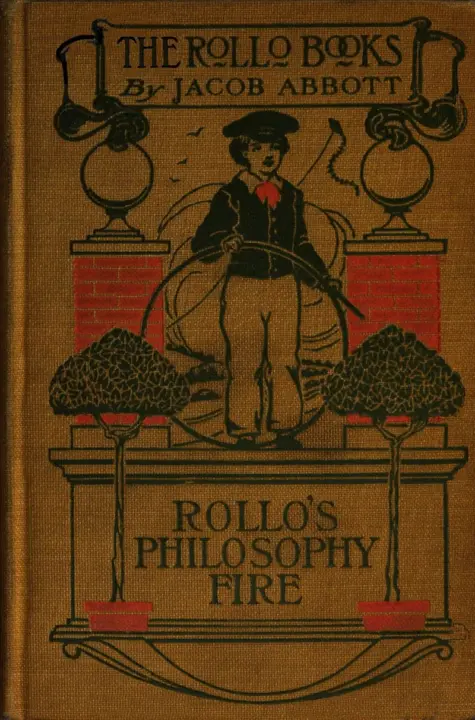
"Rollo's Philosophy [Fire]" by Jacob Abbott is a children's educational book written in the mid-19th century. It is part of the Rollo series, which aims to engage young readers in philosophical and scientific concepts through the adventures of its young protagonist, Rollo. The book focuses on the nature of fire and combustion, presenting Rollo's explorations and discussions with characters like his father and Jonas. At the start of the book, Rollo is introduced waiting for Jonas while observing fireflies, and his curiosity about fire leads him into a series of discussions about combustion and how fires are maintained. Through a detailed exchange with Jonas about covering coals to encourage slow combustion, readers are gradually introduced to the principles of how fires work and the science behind making charcoal. The opening sets the stage for Rollo's inquisitive nature and his eagerness to learn, as he ponders the nature of various substances and their reactions, laying the groundwork for a fun yet enlightening exploration of fire.
Introduction adapted from the source catalogue; source summaries may be automatically generated.
Free to read · English · 34,619 words · No account needed
MAKE TIME FOR A GOOD BOOK
On by default. Untick to stop anonymous reading totals. Each page counts after 10 seconds in view. How this works.
Anonymous counting is on unless you have switched it off.
“It looks like salt,” said Rollo.
“Yes,” rejoined Jonas, “and tastes a little like salt.”
Rollo and James both wanted to taste a little of the saltpetre, and they did. In the mean time, Jonas had poured some of it into the mortar, and was grinding it up with his pestle; and, when Rollo asked him where saltpetre came from, and what it was for, Jonas said he did not know any thing at all about it, and went on pounding and grinding with his pestle.
Dorothy now brought out another jar, containing sulphur; and as soon as Jonas had finished pulverizing his saltpetre, and had put it all into its cup, he poured out some of the sulphur into the third cup. The jars and the mortar were now put away, and Jonas got two sheets of wrapping-paper, and put upon the table, for he said he thought it probable that they might want some, in trying the powder.
“I expect your father will want a pair of scales, too,” said Jonas.
“What for?” asked Rollo.
“To weigh out the materials,” replied Jonas. “I don’t know what the proportions are; but I suppose that they must be mixed in right proportions.”
“What are the right proportions?” asked Rollo.
“I don’t know,” said Jonas, “but I suppose your father will know.”
“Well,” said Rollo, “I’ll go and call him.”
So Rollo went in, and told his father that they were all ready. He found his father at the library looking at a large book.
“Come, father,” said Rollo.
“Seventy-five parts of saltpetre,” said his father, reading out of his great book, and appearing not to pay any attention to what Rollo said,—“seventy-five parts of saltpetre, eleven and a half of sulphur, and thirteen and a half of charcoal. Seventy-five to eleven, that is, about seven to one. Say, six times as much saltpetre as of each of the other two. That will be near enough.”
“Come, father,” said Rollo again; “we’re all ready.”
“Yes,” said his father, “I’ll come.”
Rollo returned into the kitchen, and his father followed him. His mother came, too, for she wanted to see them make the gunpowder. Jonas asked Mr. Holiday if he should want a pair of scales.
“No,” said he, “we can guess at the proportions near enough. We can’t expect to make very good gunpowder.”
“Why not, sir?” said Rollo; “the things are all good that we are going
to make it of.”
“Very likely,” said his father; “but we cannot make them fine enough,—nor mix them intimately.”
“Why, father,” said Rollo, “Jonas has made them very fine indeed.”
Your reading position is saved on this browser. Take it to another device with a library code. Reading pages adapt to text, rather than matching a printed edition.
Jacob Abbott

Jacob Abbott

Jacob Abbott

Jacob Abbott
BEHIND THE BOOK
This eBook is for the use of anyone anywhere in the United States and most other parts of the world at no cost and with almost no restrictions whatsoever. You may copy it, give it away or re-use it under the terms of the Project Gutenberg License included with this eBook or online at www.gutenberg.org. If you are not located in the United States, you will have to check the laws of the country where you are located before using this eBook. Read the source licence.
The original source file, including credits and licence, is retained by this library. Request an original-format copy at no charge. Please include the book title and Project Gutenberg identifier #62726.
KEEP YOUR CURIOSITY GOING
Coulson Kernahan

Maurice Baring
Frances Wright
Cécile Tormay

Frederic Jesup Stimson

W. H. P. (William Henry Pope) Jarvis