THE CLASSIC COLLECTION✦Excursion to the Orkney IslandsCLASSIC FREE BOOKS
Excursion to the Orkney Islands
Jacob Abbott
THE CLASSIC COLLECTION · 1855
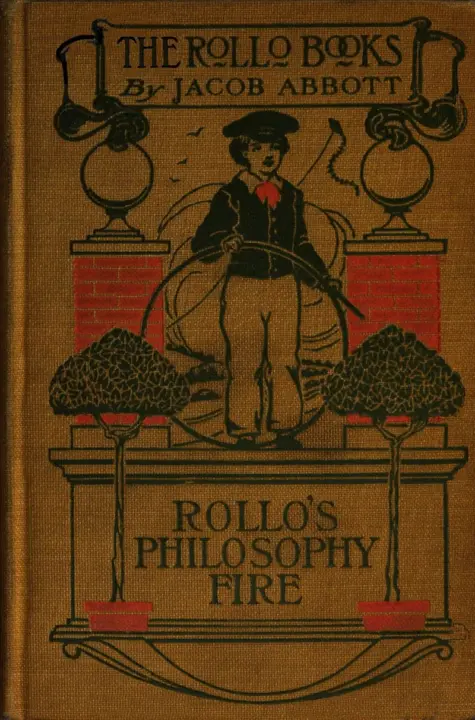
"Rollo's Philosophy [Fire]" by Jacob Abbott is a children's educational book written in the mid-19th century. It is part of the Rollo series, which aims to engage young readers in philosophical and scientific concepts through the adventures of its young protagonist, Rollo. The book focuses on the nature of fire and combustion, presenting Rollo's explorations and discussions with characters like his father and Jonas. At the start of the book, Rollo is introduced waiting for Jonas while observing fireflies, and his curiosity about fire leads him into a series of discussions about combustion and how fires are maintained. Through a detailed exchange with Jonas about covering coals to encourage slow combustion, readers are gradually introduced to the principles of how fires work and the science behind making charcoal. The opening sets the stage for Rollo's inquisitive nature and his eagerness to learn, as he ponders the nature of various substances and their reactions, laying the groundwork for a fun yet enlightening exploration of fire.
Introduction adapted from the source catalogue; source summaries may be automatically generated.
Free to read · English · 34,619 words · No account needed
MAKE TIME FOR A GOOD BOOK
On by default. Untick to stop anonymous reading totals. Each page counts after 10 seconds in view. How this works.
Anonymous counting is on unless you have switched it off.
“There is alcohol,” said Mr. Holiday, “which takes fire very easily, but it burns with a very pale and light flame. Oil must be heated much hotter before it will burn; but, when it does burn, it gives a large and bright flame; so that oil is good for lamps, it gives so much light when it burns.
“Spirits of turpentine,” continued Mr. Holiday, “inflames easily, and burns brightly too. So does phosphorus.”
“What is phosphorus?” said Rollo.
“Why, it is a substance that burns very easily. It looks like wax, but it burns very easily, and with a very bright flame indeed. It takes fire before it is as hot as boiling water.”
“I wish I had some phosphorus,” said Rollo.
“They keep it at the apothecaries, sometimes,” said his father.
“I wish you’d buy a little, father,” said Rollo, “and bring it home, and let me see it burn. Does it cost much?”
“I don’t know,” said his father, “how much it costs. Only it is troublesome to keep it. It must be kept under water.”
“Why, sir?” said Rollo.
“To keep it from taking fire. Even the sun shining upon it would heat it hot enough to set it on fire.”
“O father!” said Rollo.
“Yes,” said his father; “and so, for safety, they make it in the shape of sticks, and keep it in a phial filled with water.”
“Well, father,” said Rollo, “I wish you would get a little in a phial, and let me put a piece of it upon a paper in the sun, and let me see it catch fire.”
“I’ll think of it,” said his father, “next time I go into town. But phosphorus, you see, is certainly very inflammable, because it takes fire very easily, and burns brightly too. But I don’t know which would be said to be most inflammable, sulphur or resin; for instance, sulphur inflames the quickest, but resin will make altogether the greatest blaze.”
“I should think the resin,” said Rollo.
“We can’t tell by reasoning about it,” said his father; “it depends on the usage of the word. We will go into the other room, and look in the dictionary.”
So saying, they all went into the parlor again, and looked into the dictionary, to learn the precise meaning of the word, inflammable. The definition given was, “easily kindled into a flame.”
“Then,” said Mr. Holiday, “if this definition is correct, the sulphur and the alcohol are most inflammable, because they are most easily kindled.”
Just then the clock struck, and Rollo’s mother said,—
“Why, Rollo, it is half an hour past your bedtime.”
Your reading position is saved on this browser. Take it to another device with a library code. Reading pages adapt to text, rather than matching a printed edition.
Jacob Abbott

Jacob Abbott

Jacob Abbott

Jacob Abbott
BEHIND THE BOOK
This eBook is for the use of anyone anywhere in the United States and most other parts of the world at no cost and with almost no restrictions whatsoever. You may copy it, give it away or re-use it under the terms of the Project Gutenberg License included with this eBook or online at www.gutenberg.org. If you are not located in the United States, you will have to check the laws of the country where you are located before using this eBook. Read the source licence.
The original source file, including credits and licence, is retained by this library. Request an original-format copy at no charge. Please include the book title and Project Gutenberg identifier #62726.
KEEP YOUR CURIOSITY GOING
Coulson Kernahan

Maurice Baring
Frances Wright
Cécile Tormay

Frederic Jesup Stimson

W. H. P. (William Henry Pope) Jarvis