THE CLASSIC COLLECTION✦Excursion to the Orkney IslandsCLASSIC FREE BOOKS
Excursion to the Orkney Islands
Jacob Abbott
THE CLASSIC COLLECTION · 1855
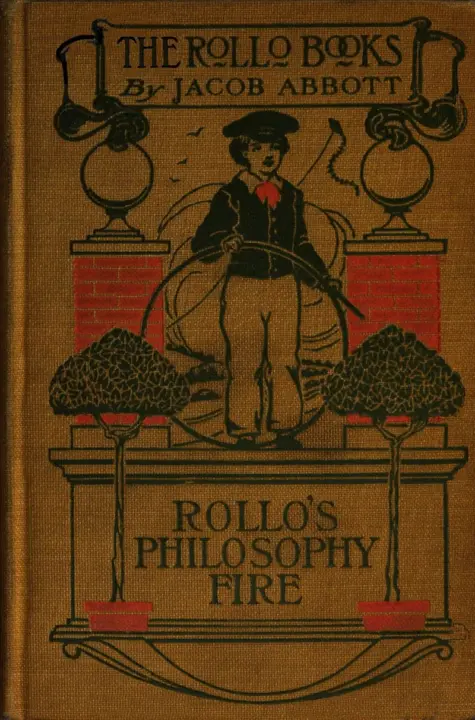
"Rollo's Philosophy [Fire]" by Jacob Abbott is a children's educational book written in the mid-19th century. It is part of the Rollo series, which aims to engage young readers in philosophical and scientific concepts through the adventures of its young protagonist, Rollo. The book focuses on the nature of fire and combustion, presenting Rollo's explorations and discussions with characters like his father and Jonas. At the start of the book, Rollo is introduced waiting for Jonas while observing fireflies, and his curiosity about fire leads him into a series of discussions about combustion and how fires are maintained. Through a detailed exchange with Jonas about covering coals to encourage slow combustion, readers are gradually introduced to the principles of how fires work and the science behind making charcoal. The opening sets the stage for Rollo's inquisitive nature and his eagerness to learn, as he ponders the nature of various substances and their reactions, laying the groundwork for a fun yet enlightening exploration of fire.
Introduction adapted from the source catalogue; source summaries may be automatically generated.
Free to read · English · 34,619 words · No account needed
MAKE TIME FOR A GOOD BOOK
On by default. Untick to stop anonymous reading totals. Each page counts after 10 seconds in view. How this works.
Anonymous counting is on unless you have switched it off.
“No,” said his father, “I cannot actually try such an experiment as that. I could not get such a bar very conveniently; and, if I had the bar and all the substances, I could not heat the bar exactly equally. It could not be done very well, except in a chemical laboratory. But it would be a very pretty experiment, if it could be performed.”
“Is there a very great difference,” said Rollo’s mother, “in the degree of heat necessary to set fire to these different things?”
“Yes,” said Mr. Holiday, “I believe the difference is very great. Phosphorus inflames below the heat of boiling water, but it takes almost a red heat to set wood on fire. And iron will not take fire till it is white hot.”
“Iron?” said Rollo, with surprise.
“Yes,” said his father, “iron will take fire and burn as well as wood, if you heat it hot enough.”
“I never knew that,” said Rollo.
“The ends of the tongs and of the andirons do not burn,” said his father, “simply because the fire is never hot enough to set such a large piece of iron on fire. But if we heat the end of a bar of iron very hot indeed in a furnace, it will take fire and burn; and so, if we take a very minute piece of iron, as big as the point of a pin, a common fire would be sufficient to heat that hot enough to set it on fire.”
“Well, father,” said Rollo, “let us try it.”
“If we had some iron filings, we might sprinkle them in the fire, or even in the flame of a lamp, and they would burn.”
“I wish I had some filings,” said Rollo.
“Yes,” said his father, “they burn beautifully.”
“How can I get some?” asked Rollo.
“You can get some at a blacksmith’s shop,” said his father. “The filings commonly accumulate behind the vice, and you can get plenty of them there. The next time you go by a blacksmith’s shop, you had better go in and ask him to give you some.”
“Well,” said Rollo, “so I will.”
“And now do you understand,” said his father, “why it is that you can light a lamp more easily when there is a little spirits of turpentine on the wick?”
“Yes, sir,” said Rollo. “The spirits of turpentine need not get so hot before it catches fire, and so you don’t have to hold the lamp-lighter so long, and burn your fingers.”
“Will oil always take fire when it gets to a certain degree of heat?” asked Rollo’s mother.
“Yes,” said his father, “I suppose so.”
Your reading position is saved on this browser. Take it to another device with a library code. Reading pages adapt to text, rather than matching a printed edition.
Jacob Abbott

Jacob Abbott

Jacob Abbott

Jacob Abbott
BEHIND THE BOOK
This eBook is for the use of anyone anywhere in the United States and most other parts of the world at no cost and with almost no restrictions whatsoever. You may copy it, give it away or re-use it under the terms of the Project Gutenberg License included with this eBook or online at www.gutenberg.org. If you are not located in the United States, you will have to check the laws of the country where you are located before using this eBook. Read the source licence.
The original source file, including credits and licence, is retained by this library. Request an original-format copy at no charge. Please include the book title and Project Gutenberg identifier #62726.
KEEP YOUR CURIOSITY GOING
Coulson Kernahan

Maurice Baring
Frances Wright
Cécile Tormay

Frederic Jesup Stimson

W. H. P. (William Henry Pope) Jarvis