The Later Renaissance
David Hannay
THE CLASSIC COLLECTION · 1891
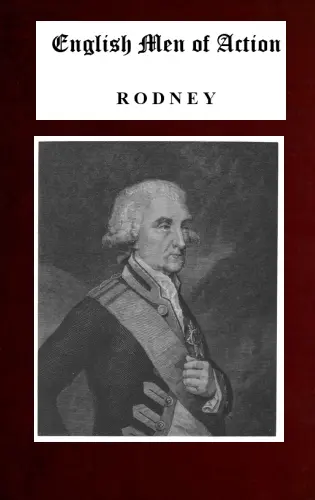
"Rodney" by David Hannay is a historical account written in the late 19th century. The book explores the life and legacy of George Brydges Rodney, a prominent English admiral who played a crucial role in establishing British naval dominance during the Age of Sail. Through his early experiences, career, and significant naval battles, the narrative delves into both Rodney's personal life and the broader context of maritime warfare of the time. At the start of the book, the author introduces George Brydges Rodney's lineage and family background, highlighting the stability of the Rodney family in Somersetshire while setting the stage for his eventual rise in the naval ranks. Rodney's early life is chronicled, from his humble beginnings through his entry into the navy as a young boy and the rigors of maritime service during a period of relative peace in England. The opening portion establishes the groundwork for understanding Rodney's character, his experiences at sea, and the realities of naval life in the 18th century.
Introduction adapted from the source catalogue; source summaries may be automatically generated.
Free to read · English · 65,719 words · No account needed
MAKE TIME FOR A GOOD BOOK
On by default. Untick to stop anonymous reading totals. Each page counts after 10 seconds in view. How this works.
Anonymous counting is on unless you have switched it off.
The days immediately following the battle were spent in hard work. Although he had missed victory Rodney was not beaten, and determined to show the Frenchmen as much. He therefore resolutely kept the sea, and barred their road to Fort Royal. The Sandwich was so battered that for twenty-four hours she was in danger of sinking. Rodney shifted his flag to the Montague. The damage was repaired at sea. As the French, who are driven to some straits to find victories at sea, have claimed April 17th as one, we may pardonably remind them that quiescence on the part of their admiral seems to show they were as badly mauled as we were. On the 20th, three days after the battle, the French reappeared to the north, but on finding the English waiting for them, made off at once. Guichen took his ships northward to the Dutch, and then neutral, island of St. Eustatius, where he was able to refit, which does not look like the conduct of an officer who felt conscious of superiority. After cruising for a few days longer in sight of Martinique, to the no small disturbance of the French colonists, Rodney, seeing that Guichen had retreated, went south himself to Santa Lucia, leaving frigates to watch Fort Royal. At Choque Bay he was able to get fresh water, to land his sick and wounded, and to complete his repairs.
On May 6th the look-out frigates reported that the French had reappeared; this time to the eastward of Martinique. Rodney at once put to sea with nineteen line-of-battle ships and two of fifty guns, turning to the windward of Santa Lucia by the north to meet the Frenchman. He had now an opportunity of doing what he told his wife greatly needed to be done--namely, of teaching his captains to be officers. “Every captain in this fleet,” he once said to Gilbert Blane, “thinks himself fit to be Prime Minister of Great Britain.” The Admiral was resolved to show them that they should not disobey, or show a want of promptitude in obeying, the orders of George Brydges Rodney. He set resolutely to work to bring them to a proper degree of smartness. While he was manœuvring in front of Guichen the days were passed in tacking in succession or tacking together, in wearing in succession or together, in forming column and forming line. Whenever a ship was out of her station her signal was made, and she was publicly rebuked without regard to the seniority of her captain, or to the fact that she carried an admiral’s flag. Rodney even threatened to hoist his flag in a frigate in order to observe the line from a distance the better. It is easy to understand that such schooling was disagreeable to old captains who thought themselves masters of their profession. Rodney’s second in command, Sir Hyde Parker, a thorough seaman and solid fighter of the old stamp, was wrought by it into a state of sullen fury. When he returned to England a few months later he was with difficulty restrained by Sandwich from rushing into a pamphleteering attack on his late commander. For the present, however, there was nothing for it but obedience. At the end of a few days the lesson had been taught, and the English squadron manœuvred with the precision of Frederick’s grenadiers. Rodney might have found a more excellent way. If he had had more of the kindly good-fellowship of Nelson, if he had been wont to talk things over and explain his ideas to his captains, to get the wild ducks out after dinner and work out problems, it might have been better for his glory. But this was not Rodney’s way. He lived apart from his captains, whom he generally regarded as his social inferiors--neither asking for their friendship nor giving them his--asking only for that implicit obedience which he was ready to render to his own official superiors. As a natural consequence he got obedience, but he won none of that loyal devotion which bound Collingwood, or Hallowell, or Hoste to Nelson. His relations to his subordinates were always strained. They knew that he expected them to act only on his order, therefore they would do just what they were ordered and nothing more. He could never shut up his signal-book as Nelson could, with the confidence that he had instilled his spirit into his captains and could trust them to act in it. On Rodney’s part, however, it is only fair to remember that the relations of Nelson to his captains were exceptional, and would not have been possible unless he had been absolutely sure of their spirit of discipline. In the American War the bonds of discipline required to be tightened, and Rodney did well to tighten them. To say that he could not temper command by good-fellowship, that he could order but could not inspire, is to say that he had not the genial temperament of the very greatest stamp of leader, of a Nelson or of a Gustavus Adolphus, to whom, king as he was, all soldiers were brothers, who knew that his personal influence would give him all the superiority he wanted. To that race Rodney did not belong.
Your reading position is saved on this browser. Take it to another device with a library code. Reading pages adapt to text, rather than matching a printed edition.
David Hannay
David Hannay
BEHIND THE BOOK
This eBook is for the use of anyone anywhere in the United States and most other parts of the world at no cost and with almost no restrictions whatsoever. You may copy it, give it away or re-use it under the terms of the Project Gutenberg License included with this eBook or online at www.gutenberg.org. If you are not located in the United States, you will have to check the laws of the country where you are located before using this eBook. Read the source licence.
The original source file, including credits and licence, is retained by this library. Request an original-format copy at no charge. Please include the book title and Project Gutenberg identifier #52155.
KEEP YOUR CURIOSITY GOING
Cécile Tormay

Moritz Busch
John L. Ransom
Frances Wright
Cécile Tormay

Mabel Potter Daggett