The Later Renaissance
David Hannay
THE CLASSIC COLLECTION · 1891
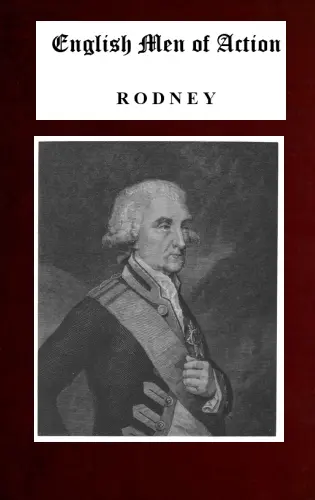
"Rodney" by David Hannay is a historical account written in the late 19th century. The book explores the life and legacy of George Brydges Rodney, a prominent English admiral who played a crucial role in establishing British naval dominance during the Age of Sail. Through his early experiences, career, and significant naval battles, the narrative delves into both Rodney's personal life and the broader context of maritime warfare of the time. At the start of the book, the author introduces George Brydges Rodney's lineage and family background, highlighting the stability of the Rodney family in Somersetshire while setting the stage for his eventual rise in the naval ranks. Rodney's early life is chronicled, from his humble beginnings through his entry into the navy as a young boy and the rigors of maritime service during a period of relative peace in England. The opening portion establishes the groundwork for understanding Rodney's character, his experiences at sea, and the realities of naval life in the 18th century.
Introduction adapted from the source catalogue; source summaries may be automatically generated.
Free to read · English · 65,719 words · No account needed
MAKE TIME FOR A GOOD BOOK
On by default. Untick to stop anonymous reading totals. Each page counts after 10 seconds in view. How this works.
Anonymous counting is on unless you have switched it off.
In 1768 Rodney stood, and was elected, for Northampton. The same arts that gained a power, must maintain it. It was necessary for him to keep that position in the House which had hitherto been so useful. But times had changed. He could no longer be “chosen member for Okehampton” by Newcastle, whose day was over--who indeed died in this very year. The King had set himself resolutely to fight the Whig oligarchy with its own weapons, and was doing it with success. Rodney took his place with the King’s friends, and did it this time at his own expense. The fight for Northampton was very severe, which, given the time and place, means that it was very costly. It gave Rodney his seat in the House, but it hung a load of debt round his neck from which he did not shake himself free for years. Nor was electioneering the only “method of evacuation” to which he had recourse, and perhaps it was not even the most effectual. He lived in the great and “fast” society of his time, which may safely be taken to be only another way of saying that he gambled. Between the one form of extravagance and the other he certainly impoverished himself.
In 1771 he was appointed to a command, and again sailed to the West Indies. The dispute about the Falkland Islands seemed likely in that time to lead to another war with Spain. If it had done so, the West Indian command would in all probability have made good the damage done to Rodney’s fortune by his seven years on shore. Money was now very important to him, and as has been already said, he made a claim to be allowed to retain his governorship while in command at sea. With the help of the double salary he might have been able to free himself from his liabilities. But the request was refused, and he sailed for his station, which was on this occasion Jamaica, and not the Leeward Islands. Here again disappointment awaited him. The quarrel with Spain blew over, and there was no war. In the early days of his command Rodney caused His Majesty’s ministers some considerable anxiety. Just after his arrival on the station there had arisen one of those periodical squabbles with the Spanish guardacostas which had been the fertile cause of quarrels and bloodshed in the West Indies. An English tender which was found “prowling with hostile keel,” as Mr. Bright would have said, too close to the Spanish main, was arrested by the Spanish cruisers. It doubtless appeared ominous to the officers of the Catholic king, who must have been perfectly well aware of the nature of the relations of the two countries at the time, that an armed English ship should have been just there just then. Rodney took a high tone, protested fiercely, and sent a line-of-battle-ship to look into Carracas. Technically he was in the right, but his superiors at home were far from pleased at his promptitude. There was no wish in England--not at least among those who were responsible for the government of the country--for a war with Spain. When, therefore, it was known that war-ships had been sent on a mission of remonstrance, and almost of menace, into a Spanish port, ministers who knew what a trick the cannon had of “going off by themselves” in the West Indies were greatly displeased. The Ministry suspected their Admiral of an intention to bring on a quarrel if he could. Rodney was sharply rebuked for sending a subordinate officer to a place where a little want of tact and temper might so easily produce a collision. Sandwich even took very strong measures. In a letter which is a model of official reprimand he told Rodney quite plainly that if he thought a war in the West Indies would do him any good he was greatly mistaken. If war should unfortunately break out, said the Minister, it would be necessary to send out strong reinforcements, and in that case a superior officer would be sent in command. Rodney could be trusted to know what that meant. It was manifestly calculated that he had no wish to repeat his experience in 1762. How far the suspicions of the Ministry were founded no one can say. Probably they were not altogether baseless. No doubt Rodney, like other Englishmen in the West Indies, did long to give the Spaniards a lesson. Sandwich, measuring the corn of others by his own bushel, may have thought that an officer whom he must have known to be embarrassed in his affairs would risk much for the chance of a stroke at a Spanish port or the capture of a treasure-ship. Here, again, he was certainly not altogether wrong. Rodney’s need of, and desire for, place and money in those years was great, and was quite frankly avowed. He was, however, far too capable a man not to know that too much may be risked even for the greatest prize. To fall into disgrace at headquarters would be ruin. When therefore he distinctly understood what the Ministry wanted he conformed precisely to their wishes, and was soon rewarded by being told that the King was pleased with him.
Your reading position is saved on this browser. Take it to another device with a library code. Reading pages adapt to text, rather than matching a printed edition.
David Hannay
David Hannay
BEHIND THE BOOK
This eBook is for the use of anyone anywhere in the United States and most other parts of the world at no cost and with almost no restrictions whatsoever. You may copy it, give it away or re-use it under the terms of the Project Gutenberg License included with this eBook or online at www.gutenberg.org. If you are not located in the United States, you will have to check the laws of the country where you are located before using this eBook. Read the source licence.
The original source file, including credits and licence, is retained by this library. Request an original-format copy at no charge. Please include the book title and Project Gutenberg identifier #52155.
KEEP YOUR CURIOSITY GOING
Cécile Tormay

Moritz Busch
John L. Ransom
Frances Wright
Cécile Tormay

Mabel Potter Daggett