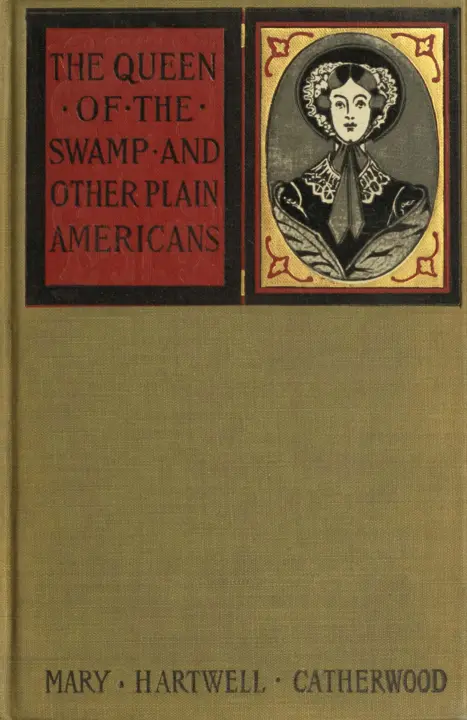
The Queen of the Swamp, and other plain Americans
Mary Hartwell Catherwood
THE CLASSIC COLLECTION · 1882
"Rocky Fork" by Mary Hartwell Catherwood is a novel written in the late 19th century. Set among the hills and hollows of central Ohio, it follows spirited Melissa “Bluebell” Garde as she navigates schooldays, community customs, and the dangers and delights of a rural settlement with her little sister Rocco, their physician father, and visiting Aunt Melissa. Expect tender domestic moments, lively classroom scenes, industrial backdrops, and occasional frontier hazards, all filtered through a child’s keen eye. The opening of the novel follows Bluebell on her path to the log schoolhouse under kindly Mr. Pitzer, where a polished outsider, Mr. Runnels, sweeps in to launch a “geography school” with map-chanting that captivates the district. After a noon of trading treats and games, Bluebell rides with her father to the chapel meeting; the night turns urgent when a furnace worker is injured, and the pair brave the perilous Narrows on their sure-footed mare, Ballie. Next day a refined relative, Miss Melissa Calder, arrives with gifts (including a wax doll that briefly stirs Rocco’s jealousy), then visits the school, offers remarks, and joins the girls’ swing at noon. The section closes on a simmering quarrel over a prized thumb-paper and a heated spelling match as a storm gathers, sketching the community’s rhythms, childhood rivalries, and the mix of learning and danger that shape Bluebell’s world.
Introduction adapted from the source catalogue; source summaries may be automatically generated.
Free to read · English · 53,847 words · No account needed
MAKE TIME FOR A GOOD BOOK
On by default. Untick to stop anonymous reading totals. Each page counts after 10 seconds in view. How this works.
Anonymous counting is on unless you have switched it off.
“And I am sure you will not regret the change in--as to--I mean from a financial point of view, for all our friends are prepossessed in your favor already.”
“As to that,” said the young man, “I’ll have to prove myself able to do something, as I did at the Rocky Fork.”
“Yes; and I am sure you will indeed.”
“Papa, how is Liza?”
The doctor started, and looked queerly at his little girl.
He said, however, “She’s quite well.”
“I am learning to play the piano.”
His little girl made this announcement with the exact accent and expression of Miss Libbie Biggar.
“Are you?”
“Yes, sir.”
He rubbed a finger across his forehead and looked at Miss Melissa. The
delicate lady smiled.
“Don’t you think she has improved very much?”
“Ye-es,” said the doctor, “certainly.”
He looked at his little girl.
“You may entertain your father awhile if he will excuse me, Melissa,” said Miss Calder, putting Rocco down. “I want to have a few changes made about tea. And if you want to go to your room, Maurice, Melissa knows where it is.”
So Aunt Melissa went out, and Bluebell longed so much to tangle and squeeze Roxana that she was fain at least to draw her seat beside Miss Calder’s vacant arm-chair, into which the baby had mounted on all-fours and wiggled about into a sitting posture.
“Are you glad to see B’uebell, Rocco?”
“Uh--uuh,” responded Roxana, still trying to take her bearings in these
strange waters.
“You mustn’t say that--it isn’t polite,” said Bluebell, shaking her
head.
Father’s square, serious face set itself to study her. His clothes looked plain compared to the clothes she had seen gentlemen wear in Sharon. They really had a woodsman look. But who could see father’s resolute chin over his black neckcloth and not instinctively love him? His little girl did not state the matter in these words. Her impressions were instantaneous and languageless. The baby did look so funny, too. Bluebell wished one of her new dresses was small enough for the little sister. It was only that she did not want them to be behind herself in advantages.
“Have you been real well, papa?”
“That isn’t polite,” said father slowly.
His little girl turned red. She was beginning to think his steady look meant disapproval, after all, when she had tried so hard to learn deportment.
“What! To ask if you have been well?”
“To call me ‘papa’ when you know I want to be called ‘father.’”
Bluebell’s face and ears tingled.
Your reading position is saved on this browser. Take it to another device with a library code. Reading pages adapt to text, rather than matching a printed edition.
Mary Hartwell Catherwood
Mary Hartwell Catherwood

Mary Hartwell Catherwood
Mary Hartwell Catherwood
BEHIND THE BOOK
This eBook is for the use of anyone anywhere in the United States and most other parts of the world at no cost and with almost no restrictions whatsoever. You may copy it, give it away or re-use it under the terms of the Project Gutenberg License included with this eBook or online at www.gutenberg.org. If you are not located in the United States, you will have to check the laws of the country where you are located before using this eBook. Read the source licence.
The original source file, including credits and licence, is retained by this library. Request an original-format copy at no charge. Please include the book title and Project Gutenberg identifier #76984.
KEEP YOUR CURIOSITY GOING
Coulson Kernahan

Maurice Baring
Frances Wright
Cécile Tormay

Frederic Jesup Stimson

W. H. P. (William Henry Pope) Jarvis