THE CLASSIC COLLECTION✦An outlaw’s diary: the CommuneCLASSIC FREE BOOKS
An outlaw’s diary: the Commune
Cécile Tormay
THE CLASSIC COLLECTION · 1899
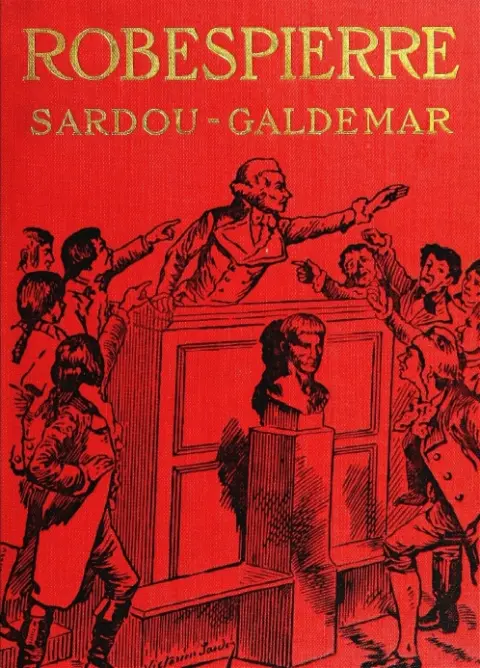
"Robespierre" by Ange Galdemar is a historical novel written in the late 19th century. The book is based on Victorien Sardou's play and explores the complex life of Maximilien Robespierre, a leading figure of the French Revolution. It delves into themes of power, ambition, and personal sacrifice amid the tumultuous backdrop of revolutionary France, focusing on characters such as Robespierre himself, Monsieur de Pontivy, and Clarisse. The opening of "Robespierre" introduces readers to the Hôtel de Pontivy, where we meet Monsieur de Pontivy as he searches for a lost document important for a secret debate in Parliament. Here, the reader is introduced to his daughter Clarisse, who navigates a sheltered life and shares a complicated relationship with both her father and Robespierre, her father's secretary. The tension rises as it becomes apparent that their lives are entwined through shared ambitions and the unacknowledged consequences of their interactions. The initial chapter sets the stage for the unfolding drama, hinting at themes of love, betrayal, and the heavy burdens of honor and reputation that will develop as the story progresses.
Introduction adapted from the source catalogue; source summaries may be automatically generated.
Free to read · English · 71,073 words · No account needed
MAKE TIME FOR A GOOD BOOK
On by default. Untick to stop anonymous reading totals. Each page counts after 10 seconds in view. How this works.
Anonymous counting is on unless you have switched it off.
"And if I have no accomplice, you will find some, I'll be bound!" cried Olivier ironically. "But you shall not have my name!"
Lebas, having finished the letters, came forward, and Robespierre gave him a questioning glance. The letters, he said, revealed nothing in particular. They had been written two or three years ago, and bore no address or signatures of importance. Two signed Marie Thérèse were apparently from a young girl, the prisoner's sister or fiancée.
"Then the medallion belongs to her," put in Victoire; "M.T. are the
initials on it."
But these letters revealed nothing, nor did three others signed "Your mother," couched in terms of endearment and advice. The style was most certainly that of an aristocrat. Only one letter--dated 1791--gave a slight indication, a very vague one.
Robespierre pricked up his ears--
"And the contents of that letter?" he asked.
Lebas scanned it once more. It was dated 1791, from a country place in one of the suburbs of Paris, and addressed to the young man, then a student, by his grandfather, who seemed also to be his godfather, for he says: "I shall expect you to-morrow evening, for my fête and yours, the Feast of St. Olivier."
"Is Olivier, then, his name?" inquired Robespierre, looking at the
young man.
But Lebas continued reading. "The valet, my dear child, will not
fetch you this time. At fifteen a lad ought to be able to travel
alone."
"The letter being dated May, 1791, the young man must be now
nineteen," Lebas observed.
"Nineteen! yes, just nineteen!" repeated Robespierre, as if a thought had struck him. "Go on! Go on? What comes next?"
Lebas continued: "My travelling-coach will wait for you in the Rue des Lions, before the door of the hotel."
"There can be only one Rue des Lions in Paris, the Rue des Lions-Saint-Paul?" interposed Robespierre, more and more impressed, and still looking intently at the youth.
"Just so!" Lebas answered.
"Go on with the letter! Go on!"
Lebas resumed his reading: "Benoit..."
"The concierge!" interrupted Robespierre, scarcely able to hide his
emotion.
Lebas went on: "Benoit will open the shutters of the little room leading out of my study to the garden. In a bookcase, the one surmounted by the busts of Cicero and Socrates, you will find just within your reach, and will bring to me, volumes x. and xi. of a set of folios bound in red morocco, with the title..."
"Arrêts du Parlement!" exclaimed Robespierre, to the general surprise, carried beyond himself by the revelation which had suddenly burst upon him.
Olivier looked at him, in bewilderment.
Your reading position is saved on this browser. Take it to another device with a library code. Reading pages adapt to text, rather than matching a printed edition.
BEHIND THE BOOK
This eBook is for the use of anyone anywhere in the United States and most other parts of the world at no cost and with almost no restrictions whatsoever. You may copy it, give it away or re-use it under the terms of the Project Gutenberg License included with this eBook or online at www.gutenberg.org. If you are not located in the United States, you will have to check the laws of the country where you are located before using this eBook. Read the source licence.
The original source file, including credits and licence, is retained by this library. Request an original-format copy at no charge. Please include the book title and Project Gutenberg identifier #71538.
KEEP YOUR CURIOSITY GOING
Cécile Tormay

Moritz Busch
Coulson Kernahan
John L. Ransom

Maurice Baring
Frances Wright