THE CLASSIC COLLECTION✦An outlaw’s diary: the CommuneCLASSIC FREE BOOKS
An outlaw’s diary: the Commune
Cécile Tormay
THE CLASSIC COLLECTION · 1899
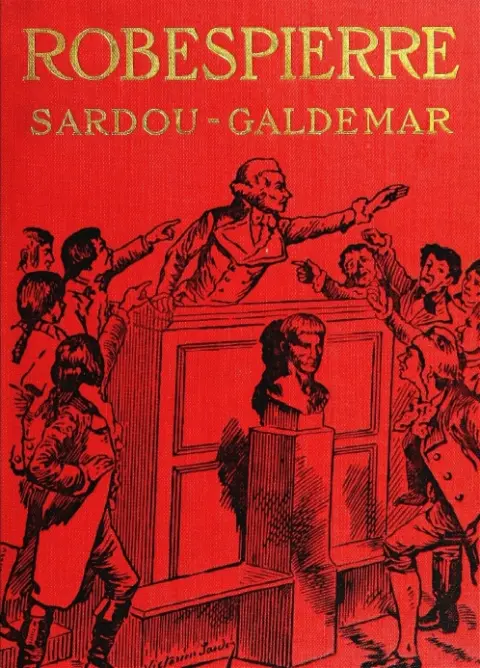
"Robespierre" by Ange Galdemar is a historical novel written in the late 19th century. The book is based on Victorien Sardou's play and explores the complex life of Maximilien Robespierre, a leading figure of the French Revolution. It delves into themes of power, ambition, and personal sacrifice amid the tumultuous backdrop of revolutionary France, focusing on characters such as Robespierre himself, Monsieur de Pontivy, and Clarisse. The opening of "Robespierre" introduces readers to the Hôtel de Pontivy, where we meet Monsieur de Pontivy as he searches for a lost document important for a secret debate in Parliament. Here, the reader is introduced to his daughter Clarisse, who navigates a sheltered life and shares a complicated relationship with both her father and Robespierre, her father's secretary. The tension rises as it becomes apparent that their lives are entwined through shared ambitions and the unacknowledged consequences of their interactions. The initial chapter sets the stage for the unfolding drama, hinting at themes of love, betrayal, and the heavy burdens of honor and reputation that will develop as the story progresses.
Introduction adapted from the source catalogue; source summaries may be automatically generated.
Free to read · English · 71,073 words · No account needed
MAKE TIME FOR A GOOD BOOK
On by default. Untick to stop anonymous reading totals. Each page counts after 10 seconds in view. How this works.
Anonymous counting is on unless you have switched it off.
"To-morrow, children, you shall have duck, duck and turnips!" said Madame Duplay, much gratified, as she set to work to carve the fowl, giving Robespierre the white meat, which he took mechanically, deep in thought. Lebas told them that he had seen Fouquier-Tinville, the Public Prosecutor, who was returning from the Bastille, where he had been to inspect the new installation.
"Ah, yes! the guillotine!" interposed mother Duplay, continuing to carve. "But it didn't work to-day, did it?"
"It will not work to-morrow either," said Robespierre, "but the day
after to-morrow ..."
"Will you allude to it in your discourse, bon ami?"
"Yes, towards the end; for it is well that the aristocrats should know that we are not disarming."
"Decidedly," chimed in Duplay, "that would be too stupid."
Robespierre, warmed by the tone of the conversation, recovered his
appetite.
"At all events," he said, "the fête to-morrow will be a warning for every one; for the aristocrats, as well as for many a Judas of the party."
He stopped to express his appreciation of the fowl, sending up his
plate for more.
"A leg, or a wing?" asked mother Duplay, delighted.
Robespierre suddenly turned round. He had heard a noise.
"I am sure the front door has just been opened," he said.
Simon Duplay took out a match to light a lamp, and young Maurice rose, looking out into the dark.
"It's true," he said; "it's a woman with a large parcel."
"Our dresses, surely!" exclaimed Cornélie, who had been somewhat
morose and silent until then.
"Yes, our dresses," cried Madame Lebas and Victoire expectantly.
It was, after all, only the dresses, which the dressmaker had at last brought. The enormous box was handled by them eagerly; they wished to open it there and then. However, Victoire, prudently fearing to soil the contents, carried it into the dining-room, followed by her sisters.
The conversation was resumed with lively interest by the light of the lamp just lit, and opinions were freely expressed that as Royalty had her fêtes, the world would now see what a Republican fête could be like. It would be truly national, imposing, and symbolical.
The young women had not yet returned.
"Hullo! you children! what are you doing there?" called out old
Duplay.
"Here we are! Here we are!" answered Victoire, appearing that moment on the threshold of the dining-room in a pretty white dress, coquettishly pushing back her hair, disordered by her hasty toilet.
"Doesn't it suit me?" she said. "Oh! don't look at my hair; it isn't arranged," and she ran down the steps followed by Madame Lebas and Cornélie, also arrayed in their new finery.
Your reading position is saved on this browser. Take it to another device with a library code. Reading pages adapt to text, rather than matching a printed edition.
BEHIND THE BOOK
This eBook is for the use of anyone anywhere in the United States and most other parts of the world at no cost and with almost no restrictions whatsoever. You may copy it, give it away or re-use it under the terms of the Project Gutenberg License included with this eBook or online at www.gutenberg.org. If you are not located in the United States, you will have to check the laws of the country where you are located before using this eBook. Read the source licence.
The original source file, including credits and licence, is retained by this library. Request an original-format copy at no charge. Please include the book title and Project Gutenberg identifier #71538.
KEEP YOUR CURIOSITY GOING
Cécile Tormay

Moritz Busch
Coulson Kernahan
John L. Ransom

Maurice Baring
Frances Wright