THE CLASSIC COLLECTION✦An outlaw’s diary: the CommuneCLASSIC FREE BOOKS
An outlaw’s diary: the Commune
Cécile Tormay
THE CLASSIC COLLECTION · 1899
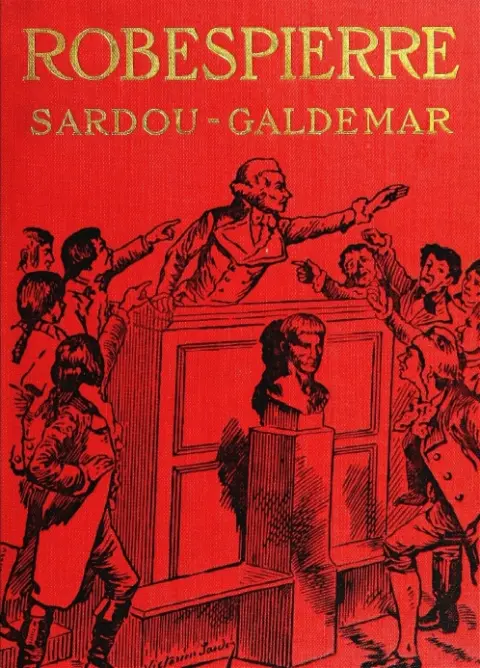
"Robespierre" by Ange Galdemar is a historical novel written in the late 19th century. The book is based on Victorien Sardou's play and explores the complex life of Maximilien Robespierre, a leading figure of the French Revolution. It delves into themes of power, ambition, and personal sacrifice amid the tumultuous backdrop of revolutionary France, focusing on characters such as Robespierre himself, Monsieur de Pontivy, and Clarisse. The opening of "Robespierre" introduces readers to the Hôtel de Pontivy, where we meet Monsieur de Pontivy as he searches for a lost document important for a secret debate in Parliament. Here, the reader is introduced to his daughter Clarisse, who navigates a sheltered life and shares a complicated relationship with both her father and Robespierre, her father's secretary. The tension rises as it becomes apparent that their lives are entwined through shared ambitions and the unacknowledged consequences of their interactions. The initial chapter sets the stage for the unfolding drama, hinting at themes of love, betrayal, and the heavy burdens of honor and reputation that will develop as the story progresses.
Introduction adapted from the source catalogue; source summaries may be automatically generated.
Free to read · English · 71,073 words · No account needed
MAKE TIME FOR A GOOD BOOK
On by default. Untick to stop anonymous reading totals. Each page counts after 10 seconds in view. How this works.
Anonymous counting is on unless you have switched it off.
Olivier bowed courteously, and as Madame de Choiseul, struck by the distinguished air of the young workman, held out her hand, Olivier took it in his and kissed it. In this high-born company all the grace of his early education came back to him.
The marquise smiled and turned to Clarisse.
"Behold a son who betrays his mother! Your name is not Durand. You belong to us. I had thought as much."
And as Clarisse was about to reply, she added: "Hush! I am not
asking your secrets."
She then assured the young man that his mother was right: the concierge Haly, though rough, was rather kind than otherwise, letting visitors enter, and even bring in provisions, sweets, and linen.
"And above all," she added, "he does us the great favour of letting us walk about and disport ourselves here until night time."
She then pointed out to Olivier the various games in which the men
and children took part.
"As you see," she added, "they take full advantage of the permission."
Clarisse, well pleased with the tone of the conversation, tried to
retain the marquise.
"Tell him, madame, how you pass your evenings."
"What! Have you not yet told him?" asked the marquise, who had been a silent spectator of the meeting between the mother and her son.
"You must not forget that I only arrived yesterday," said Clarisse. "I know nothing myself but what I have heard."
"Ah, true!" said Madame de Choiseul, who with a mother's heart now understood Clarisse's kindly motive.
At once she pointed out to Olivier the windows of one of the
buildings.
"That is what we call our drawing-room--a large apartment in which we gather in the evening. There we play at guessing riddles, charades, and bouts-rimés. Some read verses, or recite to us, and we even have music. Look! Do you see that gentleman seated over there under an arch, turning the pages of an album? That is the Baron de Wyrbach, who plays some charming airs every evening on his viola d'amoré. He exhausts his ingenuity to find something new for us."
Olivier listened in astonishment, beginning to be really reassured.
"You see," continued the marquise, "we might imagine ourselves still
at Versailles."
Then she added with a sad smile--
"And so we are in one sense, for all that remains of Versailles is
now in prison."
And she mentioned many names, singling out among the prisoners those who belonged to the old Court: the Prince and Princess de Saint-Maurice, the Chevalier de Pons, and the Count d'Armaille, whose nephew, young d'Hauteville, had been a page to Louis XVI.
Your reading position is saved on this browser. Take it to another device with a library code. Reading pages adapt to text, rather than matching a printed edition.
BEHIND THE BOOK
This eBook is for the use of anyone anywhere in the United States and most other parts of the world at no cost and with almost no restrictions whatsoever. You may copy it, give it away or re-use it under the terms of the Project Gutenberg License included with this eBook or online at www.gutenberg.org. If you are not located in the United States, you will have to check the laws of the country where you are located before using this eBook. Read the source licence.
The original source file, including credits and licence, is retained by this library. Request an original-format copy at no charge. Please include the book title and Project Gutenberg identifier #71538.
KEEP YOUR CURIOSITY GOING
Cécile Tormay

Moritz Busch
Coulson Kernahan
John L. Ransom

Maurice Baring
Frances Wright