THE CLASSIC COLLECTION✦An outlaw’s diary: the CommuneCLASSIC FREE BOOKS
An outlaw’s diary: the Commune
Cécile Tormay
THE CLASSIC COLLECTION · 1899
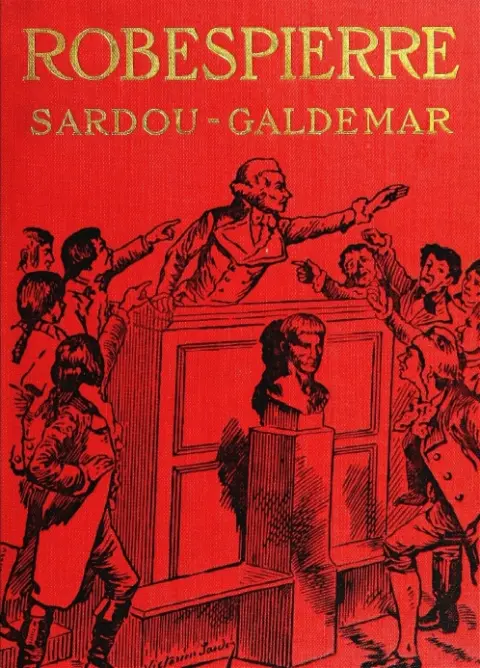
"Robespierre" by Ange Galdemar is a historical novel written in the late 19th century. The book is based on Victorien Sardou's play and explores the complex life of Maximilien Robespierre, a leading figure of the French Revolution. It delves into themes of power, ambition, and personal sacrifice amid the tumultuous backdrop of revolutionary France, focusing on characters such as Robespierre himself, Monsieur de Pontivy, and Clarisse. The opening of "Robespierre" introduces readers to the Hôtel de Pontivy, where we meet Monsieur de Pontivy as he searches for a lost document important for a secret debate in Parliament. Here, the reader is introduced to his daughter Clarisse, who navigates a sheltered life and shares a complicated relationship with both her father and Robespierre, her father's secretary. The tension rises as it becomes apparent that their lives are entwined through shared ambitions and the unacknowledged consequences of their interactions. The initial chapter sets the stage for the unfolding drama, hinting at themes of love, betrayal, and the heavy burdens of honor and reputation that will develop as the story progresses.
Introduction adapted from the source catalogue; source summaries may be automatically generated.
Free to read · English · 71,073 words · No account needed
MAKE TIME FOR A GOOD BOOK
On by default. Untick to stop anonymous reading totals. Each page counts after 10 seconds in view. How this works.
Anonymous counting is on unless you have switched it off.
Then Didier, who had just heard it from one of his agents on watch in the neighbourhood, told Robespierre of the interview between Clarisse and Vaughan at the place they were standing. He also described the hurried departure of Clarisse when Robespierre arrived, and how she had then flown, in all haste, to her house, a few steps off, and shut herself in.
This was too much for Robespierre, whose misgivings had been already
awakened.
"What! a third person, a stranger, was cognizant of my interview with the Englishman? Let that woman be arrested instantly," he exclaimed.
"But there are two of them," said Didier, "mother and daughter."
"Then have them both arrested! Arrest the three of them, for there
is also a son, I believe!"
"Yes, but he is not there at this moment," said Didier.
"Then arrest him when he returns!"
Didier gave the order to his companion, and returned to Robespierre.
"And where must they be taken?" he asked. "To what prison?"
"Where you like! Only see that they are arrested immediately. Now be quiet ... here come our friends!"
The tinkling of a bell was heard, and the crack of a whip. Then gay voices and bursts of laughter and merriment broke on the ear. A man made his appearance, who was lame and walked with the help of a stick, preceded by Blount, the dog gambolling round him in welcome. It was Duplay's nephew, Simon, the wooden-legged. While a volunteer in 1792, he had lost his left leg at the battle of Valmy, and now, disabled and pensioned off by the army commission, he acted as secretary to Robespierre. Simon advanced gaily, like a guide reaching his journey's end.
"Good morning, Maximilien! Have you been here long?"
Robespierre was about to equivocate and say that he had only just arrived, but he was spared the trouble of replying. Cries of "Good morning, Maximilien! Good morning, friend!" sounded across the hedge, a few steps from him. The whole Duplay family appeared in sight, all perched on a cart drawn by a lean, jaded beast. Old Duplay, in his shirt sleeves, his face all red and bathed in perspiration, led the horse by the bridle over the ruts of the road, while his son, Maurice, a boy of fifteen, ran about, his hair floating in the wind, waving the branch of a tree to beat away the flies. Behind the cart, pushing it forward by the wheels, was another man, neatly dressed. This was Lebas, Robespierre's colleague at the Convention and at the Committee of Public Safety, the husband of one of Duplay's daughters. In the cart were all the family: mother Duplay, seated on a stool, a solidly built woman, with arms bare to the elbow, holding the reins, and by her side, seated on a heap of provisions and crockery, were the three daughters, Elizabeth, the wife of Lebas; Victoire, the youngest, a fair-haired girl with beautiful eyes; and Eleonore, or Cornélie, for the Duplays had unearthed the name of a Roman matron to give her a character of antique grace in the sight of Robespierre, who, it was said, was going to marry her.
Your reading position is saved on this browser. Take it to another device with a library code. Reading pages adapt to text, rather than matching a printed edition.
BEHIND THE BOOK
This eBook is for the use of anyone anywhere in the United States and most other parts of the world at no cost and with almost no restrictions whatsoever. You may copy it, give it away or re-use it under the terms of the Project Gutenberg License included with this eBook or online at www.gutenberg.org. If you are not located in the United States, you will have to check the laws of the country where you are located before using this eBook. Read the source licence.
The original source file, including credits and licence, is retained by this library. Request an original-format copy at no charge. Please include the book title and Project Gutenberg identifier #71538.
KEEP YOUR CURIOSITY GOING
Cécile Tormay

Moritz Busch
Coulson Kernahan
John L. Ransom

Maurice Baring
Frances Wright