THE CLASSIC COLLECTION✦An outlaw’s diary: the CommuneCLASSIC FREE BOOKS
An outlaw’s diary: the Commune
Cécile Tormay
THE CLASSIC COLLECTION · 1899
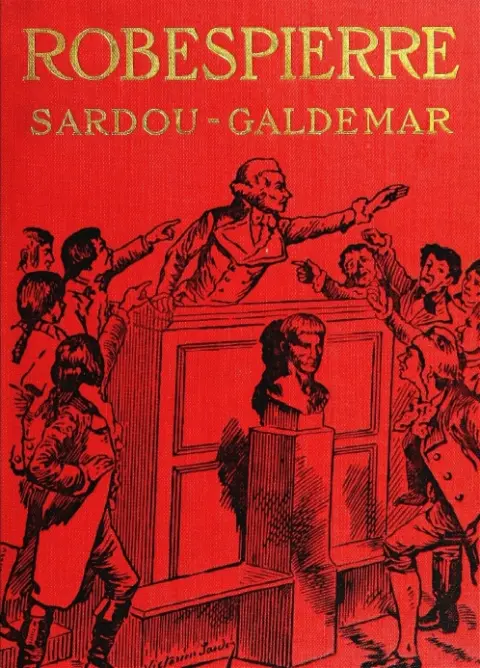
"Robespierre" by Ange Galdemar is a historical novel written in the late 19th century. The book is based on Victorien Sardou's play and explores the complex life of Maximilien Robespierre, a leading figure of the French Revolution. It delves into themes of power, ambition, and personal sacrifice amid the tumultuous backdrop of revolutionary France, focusing on characters such as Robespierre himself, Monsieur de Pontivy, and Clarisse. The opening of "Robespierre" introduces readers to the Hôtel de Pontivy, where we meet Monsieur de Pontivy as he searches for a lost document important for a secret debate in Parliament. Here, the reader is introduced to his daughter Clarisse, who navigates a sheltered life and shares a complicated relationship with both her father and Robespierre, her father's secretary. The tension rises as it becomes apparent that their lives are entwined through shared ambitions and the unacknowledged consequences of their interactions. The initial chapter sets the stage for the unfolding drama, hinting at themes of love, betrayal, and the heavy burdens of honor and reputation that will develop as the story progresses.
Introduction adapted from the source catalogue; source summaries may be automatically generated.
Free to read · English · 71,073 words · No account needed
MAKE TIME FOR A GOOD BOOK
On by default. Untick to stop anonymous reading totals. Each page counts after 10 seconds in view. How this works.
Anonymous counting is on unless you have switched it off.
For more than half an hour he went on thus, seeking the lost document, a lawyer's opinion recently received, which would assist him in elucidating a difficult point which was to be secretly debated the next day in Parliament, before judgment was delivered. He had thoughtlessly let his young secretary retire without asking him the whereabouts of this document, which he alone could find.
Monsieur de Pontivy had hastened to his study this evening directly dinner was over, to mature in solitude the arguments which were to triumph on the morrow, and of which he wished to make a short, concise summary before retiring to rest.
Having returned home sooner than usual that afternoon, the fancy had seized him to advance the dinner-hour, but learning that his daughter had not returned, he was obliged to forego his whim. This hour was rarely changed, the regulations of the house being rigorous to a degree, but Monsieur de Pontivy in the excess of his despotic authority was none the less displeased, being early himself, to find no one awaiting him. So when he heard the rumbling of the heavy coach which brought back Clarisse and her governess, Mademoiselle Jusseaume, he sought for a pretext to vent his ill-humour on them.
He had commenced to walk impatiently backwards and forwards the whole length of the room, casting hasty glances out of the window, wondering at the child's delay in coming to him, when the door opened and a head appeared in the doorway, fair, with pale, delicate features, large blue eyes, wide open to the day, in whose clear depths, half-hidden by the fresh candour of first youth, lay a tinge of melancholy.
It was Clarisse.
What an apparition, in such an austere and dreary place, that frail, white-robed form standing on the threshold, a tender smile of dawn in the dark room! She entered on tip-toe, approaching her father with greeting in her eyes and on her lips; he, continuing his walk, had his back towards her.
"Already here?" she asked, and her voice fell on the silence like an
angelus.
Monsieur de Pontivy turned abruptly.
"How is it that you enter without knocking?"
The smile died on the child's lips. She murmured, disconcerted and
abashed--
"I never used to knock, father, on entering your room."
"Then make it a point to do so in future. You are no longer a child; so learn to be discreet and to respect closed doors. A closed room, mademoiselle, is a sanctuary."
The young girl was accustomed to sermons, but had not expected one of that kind just then. She stood irresolute, hesitating whether to advance or retire.
"Must I go?" she hazarded, trembling.
Your reading position is saved on this browser. Take it to another device with a library code. Reading pages adapt to text, rather than matching a printed edition.
BEHIND THE BOOK
This eBook is for the use of anyone anywhere in the United States and most other parts of the world at no cost and with almost no restrictions whatsoever. You may copy it, give it away or re-use it under the terms of the Project Gutenberg License included with this eBook or online at www.gutenberg.org. If you are not located in the United States, you will have to check the laws of the country where you are located before using this eBook. Read the source licence.
The original source file, including credits and licence, is retained by this library. Request an original-format copy at no charge. Please include the book title and Project Gutenberg identifier #71538.
KEEP YOUR CURIOSITY GOING
Cécile Tormay

Moritz Busch
Coulson Kernahan
John L. Ransom

Maurice Baring
Frances Wright