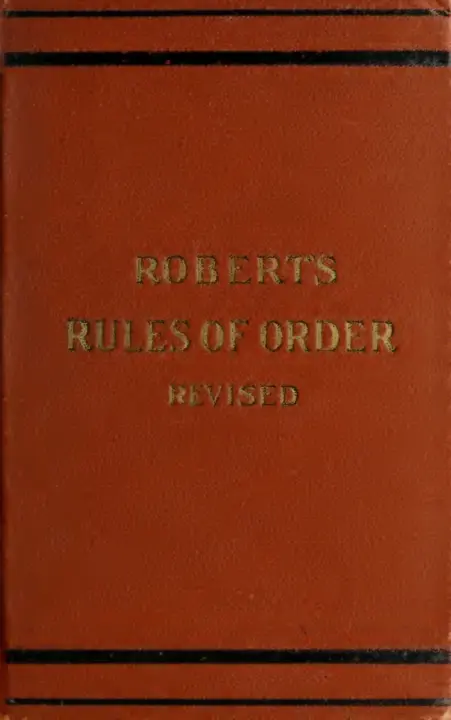
Robert’s rules of order revised
Henry M. (Henry Martyn) Robert
THE CLASSIC COLLECTION · 1876
"Robert's Rules of Order" by Henry M. Robert is a manual of parliamentary procedure first published in 1876. Created by a U.S. Army officer who witnessed chaotic meetings in San Francisco, it adapts congressional rules for voluntary organizations. The book has become the most widely used parliamentary guide in the United States, governing meetings for churches, nonprofits, school boards, and countless other groups. Robert published four editions before his death in 1923, creating a standard that brought order to democratic assemblies nationwide.
Introduction adapted from the source catalogue; source summaries may be automatically generated.
Free to read · English · 37,153 words · No account needed
MAKE TIME FOR A GOOD BOOK
On by default. Untick to stop anonymous reading totals. Each page counts after 10 seconds in view. How this works.
Anonymous counting is on unless you have switched it off.
The vast number of societies, political, literary, scientific, benevolent and religious, formed all over the land, though not legislative, are still deliberative in their character, and must have some system of conducting business, and some rules to govern their proceedings, and are necessarily subject to the common parliamentary law where it does not conflict with their own special rules. But as their knowledge of parliamentary law has been obtained from the usages in this country, rather than from the customs of Parliament, it has resulted that these societies have followed the customs of our own legislative bodies, and our people have thus been educated under a system of parliamentary law which is peculiar to this country, and yet so well established as to supersede the English parliamentary law as the common law of ordinary deliberative assemblies.
The practice of the National House of Representatives should have the same force in this country as the usages of the House of Commons have in England, in determining the general principles of the common parliamentary law of the land; but it does not follow that in every matter of detail the rules of Congress can be appealed to as the common law governing every deliberative assembly. In these matters of detail, the rules of each House of Congress are adapted to their own peculiar wants, and are of no force whatever in other assemblies.
But upon all great parliamentary questions, such as what motions can be made, what is their order of precedence, which can be debated, what is their effect, etc., the common law of the land is settled by the practice of the U. S. House of Representatives, and not by that of the English Parliament, the U. S. Senate, or any other body.
While in extreme cases there is no difficulty in deciding the question as to whether the practice of Congress determines the common parliamentary law, yet between these extremes there must necessarily be a large number of doubtful cases upon which there would be great difference of opinion, and to avoid the serious difficulties always arising from a lack of definiteness in the law, every deliberative assembly should imitate our legislative bodies in adopting Rules of Order for the conduct of their business.* [Where the practice of Congress differs from that of Parliament upon a material point, the common law of this country follows the practice of Congress. Thus in every American deliberative assembly having no rules for conducting business, the motion to adjourn would be decided to be undebatable, as in Congress, the English parliamentary law to the contrary notwithstanding; so if the Previous Question were negatived, the debate upon the subject would continue as in Congress, whereas in Parliament the subject would be immediately dismissed; so too the Previous Question could be moved when there was before the assembly a motion either to amend, to commit, or to postpone definitely or indefinitely, just as in Congress, notwithstanding that, according to English parliamentary law, the Previous Question could not be moved under such circumstances. When the rules of the two Houses of Congress conflict, the H. R. rules are of greater authority than those of the Senate in determining the parliamentary law of the country, just as the practice of the House of Commons, and not the House of Lords, determines the parliamentary law of England. For instance, though the Senate rules do not allow the motion for the Previous Question, and make the motion to postpone indefinitely take precedence of every other subsidiary motion [§ 7] except to lie on the table, yet the parliamentary law of the land follows the practice of the House of Representatives, in recognizing the Previous Question as a legitimate motion, and assigning to the very lowest rank the motion to postpone indefinitely. But in matters of detail, the rules of the House of Representatives are adapted to the peculiar wants of that body, and are of no authority in any other assembly. No one for instance would accept the following H. R. rules as common parliamentary law in this country: That the chairman, in case of disorderly conduct, would have the power to order the galleries to be cleared; that the ballot could not be used in electing the officers of an assembly; that any fifteen members would be authorized to compel the attendance of absent members and make them pay the expenses of the messengers sent after them; that all committees not appointed by the Chair would have to be appointed by ballot, and if the required number were not elected by a majority vote, then a second ballot must be taken in which a plurality of votes would prevail; that each member would be limited in debate upon any question, to one hour; that a day’s notice must be given of the introduction of a bill, and that before its passage it must be read three times, and that without the special order of the assembly it cannot be read twice the same day. These examples are sufficient to show the absurdity of the idea that the rules of Congress in all things determine the common parliamentary law.]
Your reading position is saved on this browser. Take it to another device with a library code. Reading pages adapt to text, rather than matching a printed edition.
Henry M. (Henry Martyn) Robert
BEHIND THE BOOK
This eBook is for the use of anyone anywhere in the United States and most other parts of the world at no cost and with almost no restrictions whatsoever. You may copy it, give it away or re-use it under the terms of the Project Gutenberg License included with this eBook or online at www.gutenberg.org. If you are not located in the United States, you will have to check the laws of the country where you are located before using this eBook. Read the source licence.
The original source file, including credits and licence, is retained by this library. Request an original-format copy at no charge. Please include the book title and Project Gutenberg identifier #9097.
KEEP YOUR CURIOSITY GOING

Charles G. (Charles Griffith) Ross
Hannah Webster Foster

Emily Lawless
Edwin Hamlin Carr

Charles De Lano Hine
Andrew Ure