READ · DISCOVER · ENJOYClassic literature · Always free
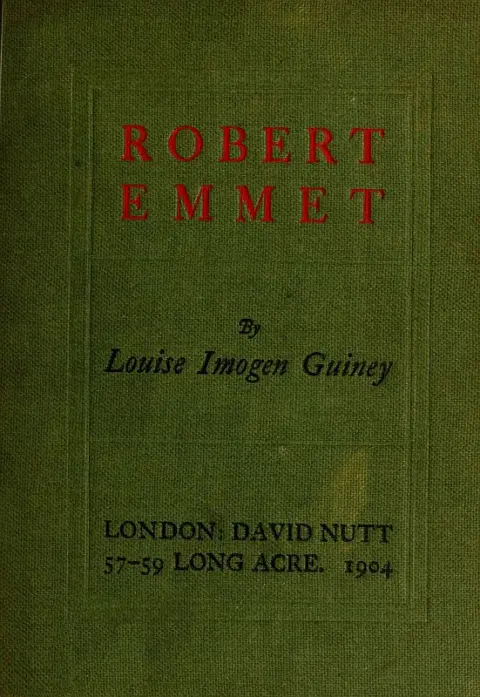
Robert Emmet: A Survey of His Rebellion and of His Romance — digital edition cover

THE CLASSIC COLLECTION · 1904

Robert Emmet: A Survey of His Rebellion and of His Romance

"Robert Emmet: A Survey of His Rebellion and of His Romance" by Louise Imogen Guiney is a historical account written in the early 20th century. The book delves into the life and legacy of Robert Emmet, a prominent figure in Irish history known for his role in the rebellion against British rule and his romantic affiliation with Sarah Curran. Through a blend of historical detail and narrative, the author captures Emmet's passionate ideals and the tragic consequences of his actions within the broader context of Irish nationalism. The opening of the text introduces Robert Emmet's family background, outlining the lineage of both the Emmets and Masons, emphasizing their distinguished heritage and intellectual prowess. It paints a picture of a young and gifted man whose moral fervor and artistic talents are entwined with a deep sense of duty toward Ireland. The narrative establishes Emmet as a pivotal character shaped by the political turbulence of his time, leading to his eventual involvement in the rebellion of 1803. It also highlights his complex and enduring relationship with Sarah Curran, setting the stage for a tale not only of political ambition but also of deep personal sacrifice and tragic love.

Introduction adapted from the source catalogue; source summaries may be automatically generated.

Start reading ↓

Free to read · English · 21,683 words · No account needed

MAKE TIME FOR A GOOD BOOK

Robert Emmet: A Survey of His Rebellion and of His Romance

On by default. Untick to stop anonymous reading totals. Each page counts after 10 seconds in view. How this works.

Anonymous counting is on unless you have switched it off.

Robert Emmet: A Survey of His Rebellion and of His Romance

Robert Emmet took lodgings under an assumed name in Butterfield Lane, in the suburb of Rathfarnham. His agents came to him by night and reported their progress. The record of all he had meant to do, drawn up with manly composure at the brink of the grave, may be read elsewhere. As has been noted, his plan for the capture of Dublin and the summoning of the patriotic Members of Parliament was clearly founded on an inspiring precedent, that of the Revolution of 1640 in Portugal, when but two-score clever and resolute men served to deliver the whole country from the yoke of Spain. But when the hour of Ireland’s destiny struck, every clock-wheel went wrong. If the failure were not so piteous, because of one’s interest in the doomed wizard and his suddenly disenchanted wand, it would be grotesque. Emmet had studied with enormous industry, and arranged with masterly precision, directing, among pikes and powder in his dingy depôts, each needful move and counter-move for a concerted rising; he thought it strange that in every conceivable way, major and minor, the whole scheme simultaneously miscarried.

If one could believe him as free as he believed himself, one might regret that he maintained too perfect a secrecy, and counted too much upon the elasticity of Irish impulse. He had been careful to avoid what he thought the error of the United Irishmen in establishing too many posts for revolutionary action, and confiding knowledge of preliminaries to innumerable persons all over the country, some of whom would be almost certain to play him false. He worked in the dark, with but a dozen friends at his elbow, spending his money freely but heedfully on manufacturing and storing weapons of war in Dublin. He looked towards a moment when a disaffected legion would arise at a summons, like the men from the heath in The Lady of the Lake: a legion which he could arm and command and weld, in one magic moment, for Ireland’s regeneration. He leaned overmuch, not on human goodness, but on human intelligence in making opportunity: and it failed him. He was like the purely literary playwright labouring with the average theatre audience; he was never in the least, for all his wit, cunning enough to deal scientifically with a corporation on whom hints, half-tones, adumbrations, are thrown away; the law of whose being is still to crave a presentation of the “undisputed thing in such a solemn way.” As drama through its processes, act after act, does well to assume that we are all blockheads, and then, as the case requires, to modify, so any flaming revolutionary genius would do well to trust nothing whatever to a moral inspiration only too likely to be non-existent. It is a terribly costly thing to be, as we say, equal to an emergency, before the emergency is quite ready to be equalled. And that was Emmet’s plight. A French fleet had been promised to begin military operations towards the end of August, but an unforeseen explosion in one of Emmet’s Dublin magazines led him to declare his toy war against the English Crown prematurely. The local volunteer troops were to be reinforced by others, well armed, from the outlying counties, at the firing of a rocket agreed upon; the Castle was to be seized as the chief move, and a Provisional Government, according to printed programme, set up. The time for assembling was hurriedly fixed for July 23, 1803, early in the evening. The gentlemen leaders and the trusty battalions failed to appear, kept away by mysterious quasi-authentic advices; appeared instead, as time wore on, many unknown, unprepossessing insurgents, the drunken refuse of the city taverns. The cramp-irons, the scaling-ladders, the blunderbusses, the fuses for the grenades, were not ready; signals had been delayed or suppressed; the prepared slow-matches were mixed in with others; treachery was at work and running like fire in oil under the eyes of one who could believe no ill of human kind. Beyond Dublin, the Wicklow men under Dwyer, an epic peasant figure, received no message; the Wexford men waited in vain for orders all night; the Kildare men, whom Emmet meant to head in person, actually reached the city, and left it again. They had met and talked with him, and were not satisfied with the number and quality of the weapons, chiefly primitive inventions of his own; and because Dublin confederates were not produced for inspection (such was Emmet’s caution where others were concerned), the canny farmers returned homewards, spreading the ill word along the roads that Dublin had refused to act. Each imaginable prospect grew darker than its alternative. But the curtain had to rise now, let results be what they might. About nine o’clock, Emmet being in such a state of speechless agitation as may be conceived, one Quigley rushed in with the false report that the Government soldiery were upon them. There was nothing to do but sally forth in the hope of augmented numbers, once the move was made. The poor “General,” in his green-and-white-and-gold uniform, at the head of some eighty insubordinates, took in the bitter situation at a glance: he foresaw how his holy insurrection would dwindle to a three-hours’ riot, how his dream, with all its costly architecture, was ending like snow in the gutter. Hardly had he set out on foot, with drawn sword, through the town, accompanied by the faithful Stafford and two or three associates, followed confusedly by the uncontrollable crowd, when an uproar rose from the rear; there was a sudden commotion which ended in wounds and death to a citizen and an officer; then the spirit of rowdyism, private pillage, and indiscriminate slaughter took the lead. While it ran high, Arthur Wolfe, Lord Kilwarden, Lord Chief-Justice, the one unfailingly humane and deservedly beloved judge in all Ireland, was killed. He was driving in from the country with his daughter and his nephew, the Rev. Richard Wolfe; finding the carriage stopped in Thomas Street, he put his grey head out at the window in the pleasant evening light, announcing the honoured name which, as he thought he knew, would be his passport through the maddest mob ever gathered. A muddle-brained creature, quite mistaken as to facts, and acting in revenge for a wrong never inflicted, unmercifully piked him: a fate paralleled only by the unpremeditated assassination in our own time of that other kindest heart, Lord Frederick Cavendish. It is significant that some in the ranks afterwards made separately in court the unasked declaration that had they been near enough, Lord Kilwarden’s life should have been saved at the expense of their own. Such, indeed, was the general feeling. It has been carelessly stated that Emmet was not far from the scene of the outrage, and arrived, in a fury, just too late to prevent the second horror, the stabbing to death of Mr. Wolfe; and that it was he who took the unfortunate Miss Wolfe, to whom no violence was offered, from the carriage. But records now show conclusively that (as he once said) he had withdrawn from that part of Dublin before the murders came to pass. He had addressed his followers in Francis Street, setting his face against useless bloodshed, and made for the mountains hard by, commanding those who retained any sense of discipline to go along with him. A quick retreat was the only sagacious course to follow in this gross witless turmoil, so contrary to his purpose: for his printed manifesto had expressly declared life and property were to be held sacred. His secret, up to this point, was practically safe, and his losses reparable. The “rebels” abroad that night were but diabolical changelings; he would break away with the few he could rely upon, nurse hope to life with the courage that never failed, and take his chances to fight again. He reached safety, unchallenged; Dwyer even then implored for leave to call out on the morrow his disappointed veterans for a new assay; but Emmet was firm. No lust of revenge on fate, no recoil from being thought, for one hot moment, a coward, could shake him from his shrewd and rational acceptance of present defeat. He had no personal ambition, no vicarious tax to pay it. Ireland could wait the truer hour. He seems never once to have bewailed aloud the miserable end of his own long minute study of military strategy, the foul check to aspirations founded in honour, and breathed upon by the dead of Salamis and Thermopylæ.

Your reading position is saved on this browser. Take it to another device with a library code. Reading pages adapt to text, rather than matching a printed edition.

More from this author

BEHIND THE WORDS

About Louise Imogen Guiney

Louise Imogen Guiney (1861–1920). Explore Hurrell Froude: Memoranda and Comments, Patrins To Which Is Added an Inquirendo Into the Wit & Other Good Parts of His Late Majesty King Charles the Second, “Monsieur Henri”: A Foot-Note to French History and other works in this collection. These books span history, essays & ideas, classic fiction.

Explore this author’s books →

THE READERS’ VERDICT

How did this story stay with you?

Not rated yet
Your rating for Robert Emmet: A Survey of His Rebellion and of His Romance

Be the first to share your verdict.

One rating per browser, which you can change or remove. A necessary browser identifier remembers your vote. How ratings work

A GOOD STORY DESERVES COMPANY

Pass this book along.

A great read is even better when it’s shared.

SEND A LITTLE INSPIRATION

Share this book

BEHIND THE BOOK

Edition & source details.

Title
Robert Emmet: A Survey of His Rebellion and of His Romance
Author
Louise Imogen Guiney
First publication (Open Library catalogue match)
1904
Digital edition publisher
Project Gutenberg
Gutenberg release date
2016-04-29
Language
English
Source edition imprint
Not stated in source catalogue
Source identifier
Project Gutenberg #51889
Contributors
No additional named contributors in source metadata

Public-domain source & licence

This eBook is for the use of anyone anywhere in the United States and most other parts of the world at no cost and with almost no restrictions whatsoever. You may copy it, give it away or re-use it under the terms of the Project Gutenberg License included with this eBook or online at www.gutenberg.org. If you are not located in the United States, you will have to check the laws of the country where you are located before using this eBook. Read the source licence.

Full source licence and obtaining an original copy

The original source file, including credits and licence, is retained by this library. Request an original-format copy at no charge. Please include the book title and Project Gutenberg identifier #51889.

the full Project Gutenberg License must appear
prominently whenever any copy of a Project Gutenberg work (any work
on which the phrase “Project Gutenberg” appears, or with which the
phrase “Project Gutenberg” is associated) is accessed, displayed,
performed, viewed, copied or distributed:

This eBook is for the use of anyone anywhere in the United States and most
other parts of the world at no cost and with almost no restrictions
whatsoever. You may copy it, give it away or re-use it under the terms
of the Project Gutenberg™ License included with this eBook or online
at www.gutenberg.org. If you
are not located in the United States, you will have to check the laws
of the country where you are located before using this eBook.

1.E.2. If an individual Project Gutenberg electronic work is
derived from texts not protected by U.S. copyright law (does not
contain a notice indicating that it is posted with permission of the
copyright holder), the work can be copied and distributed to anyone in
the United States without paying any fees or charges. If you are
redistributing or providing access to a work with the phrase “Project
Gutenberg” associated with or appearing on the work, you must comply
either with the requirements of paragraphs 1.E.1 through 1.E.7 or
obtain permission for the use of the work and the Project Gutenberg
trademark as set forth in paragraphs 1.E.8 or 1.E.9.

1.E.3. If an individual Project Gutenberg electronic work is posted
with the permission of the copyright holder, your use and distribution
must comply with both paragraphs 1.E.1 through 1.E.7 and any
additional terms imposed by the copyright holder. Additional terms
will be linked to the Project Gutenberg License for all works
posted with the permission of the copyright holder found at the
beginning of this work.

1.E.4. Do not unlink or detach or remove the full Project Gutenberg
License terms from this work, or any files containing a part of this
work or any other work associated with Project Gutenberg.

1.E.5. Do not copy, display, perform, distribute or redistribute this
electronic work, or any part of this electronic work, without
prominently displaying the sentence set forth in paragraph 1.E.1 with
active links or immediate access to the full terms of the Project
Gutenberg License.

1.E.6. You may convert to and distribute this work in any binary,
compressed, marked up, nonproprietary or proprietary form, including
any word processing or hypertext form. However, if you provide access
to or distribute copies of a Project Gutenberg work in a format
other than “Plain Vanilla ASCII” or other format used in the official
version posted on the official Project Gutenberg website
(www.gutenberg.org), you must, at no additional cost, fee or expense
to the user, provide a copy, a means of exporting a copy, or a means
of obtaining a copy upon request, of the work in its original “Plain
Vanilla ASCII” or other form. Any alternate format must include the
full Project Gutenberg License as specified in paragraph 1.E.1.

1.E.7. Do not charge a fee for access to, viewing, displaying,
performing, copying or distributing any Project Gutenberg works
unless you comply with paragraph 1.E.8 or 1.E.9.

1.E.8. You may charge a reasonable fee for copies of or providing
access to or distributing Project Gutenberg electronic works
provided that:

• You pay a royalty fee of 20% of the gross profits you derive from
the use of Project Gutenberg works calculated using the method
you already use to calculate your applicable taxes. The fee is owed
to the owner of the Project Gutenberg trademark, but he has
agreed to donate royalties under this paragraph to the Project
Gutenberg Literary Archive Foundation. Royalty payments must be paid
within 60 days following each date on which you prepare (or are
legally required to prepare) your periodic tax returns. Royalty
payments should be clearly marked as such and sent to the Project
Gutenberg Literary Archive Foundation at the address specified in
Section 4, “Information about donations to the Project Gutenberg
Literary Archive Foundation.”

• You provide a full refund of any money paid by a user who notifies
you in writing (or by e-mail) within 30 days of receipt that s/he
does not agree to the terms of the full Project Gutenberg™
License. You must require such a user to return or destroy all
copies of the works possessed in a physical medium and discontinue
all use of and all access to other copies of Project Gutenberg™
works.

• You provide, in accordance with paragraph 1.F.3, a full refund of
any money paid for a work or a replacement copy, if a defect in the
electronic work is discovered and reported to you within 90 days of
receipt of the work.

• You comply with all other terms of this agreement for free
distribution of Project Gutenberg™ works.


1.E.9. If you wish to charge a fee or distribute a Project
Gutenberg™ electronic work or group of works on different terms than
are set forth in this agreement, you must obtain permission in writing
from the Project Gutenberg Literary Archive Foundation, the manager of
the Project Gutenberg™ trademark. Contact the Foundation as set
forth in Section 3 below.

1.F.

1.F.1. Project Gutenberg volunteers and employees expend considerable
effort to identify, do copyright research on, transcribe and proofread
works not protected by U.S. copyright law in creating the Project
Gutenberg™ collection. Despite these efforts, Project Gutenberg™
electronic works, and the medium on which they may be stored, may
contain “Defects,” such as, but not limited to, incomplete, inaccurate
or corrupt data, transcription errors, a copyright or other
intellectual property infringement, a defective or damaged disk or
other medium, a computer virus, or computer codes that damage or
cannot be read by your equipment.

1.F.2. LIMITED WARRANTY, DISCLAIMER OF DAMAGES - Except for the “Right
of Replacement or Refund” described in paragraph 1.F.3, the Project
Gutenberg Literary Archive Foundation, the owner of the Project
Gutenberg™ trademark, and any other party distributing a Project
Gutenberg™ electronic work under this agreement, disclaim all
liability to you for damages, costs and expenses, including legal
fees. YOU AGREE THAT YOU HAVE NO REMEDIES FOR NEGLIGENCE, STRICT
LIABILITY, BREACH OF WARRANTY OR BREACH OF CONTRACT EXCEPT THOSE
PROVIDED IN PARAGRAPH 1.F.3. YOU AGREE THAT THE FOUNDATION, THE
TRADEMARK OWNER, AND ANY DISTRIBUTOR UNDER THIS AGREEMENT WILL NOT BE
LIABLE TO YOU FOR ACTUAL, DIRECT, INDIRECT, CONSEQUENTIAL, PUNITIVE OR
INCIDENTAL DAMAGES EVEN IF YOU GIVE NOTICE OF THE POSSIBILITY OF SUCH
DAMAGE.

1.F.3. LIMITED RIGHT OF REPLACEMENT OR REFUND - If you discover a
defect in this electronic work within 90 days of receiving it, you can
receive a refund of the money (if any) you paid for it by sending a
written explanation to the person you received the work from. If you
received the work on a physical medium, you must return the medium
with your written explanation. The person or entity that provided you
with the defective work may elect to provide a replacement copy in
lieu of a refund. If you received the work electronically, the person
or entity providing it to you may choose to give you a second
opportunity to receive the work electronically in lieu of a refund. If
the second copy is also defective, you may demand a refund in writing
without further opportunities to fix the problem.

1.F.4. Except for the limited right of replacement or refund set forth
in paragraph 1.F.3, this work is provided to you ‘AS-IS’, WITH NO
OTHER WARRANTIES OF ANY KIND, EXPRESS OR IMPLIED, INCLUDING BUT NOT
LIMITED TO WARRANTIES OF MERCHANTABILITY OR FITNESS FOR ANY PURPOSE.

1.F.5. Some states do not allow disclaimers of certain implied
warranties or the exclusion or limitation of certain types of
damages. If any disclaimer or limitation set forth in this agreement
violates the law of the state applicable to this agreement, the
agreement shall be interpreted to make the maximum disclaimer or
limitation permitted by the applicable state law. The invalidity or
unenforceability of any provision of this agreement shall not void the
remaining provisions.

1.F.6. INDEMNITY - You agree to indemnify and hold the Foundation, the
trademark owner, any agent or employee of the Foundation, anyone
providing copies of Project Gutenberg™ electronic works in
accordance with this agreement, and any volunteers associated with the
production, promotion and distribution of Project Gutenberg™
electronic works, harmless from all liability, costs and expenses,
including legal fees, that arise directly or indirectly from any of
the following which you do or cause to occur: (a) distribution of this
or any Project Gutenberg work, (b) alteration, modification, or
additions or deletions to any Project Gutenberg work, and (c) any
Defect you cause.

Section 2. Information about the Mission of Project Gutenberg

Project Gutenberg is synonymous with the free distribution of
electronic works in formats readable by the widest variety of
computers including obsolete, old, middle-aged and new computers. It
exists because of the efforts of hundreds of volunteers and donations
from people in all walks of life.

Volunteers and financial support to provide volunteers with the
assistance they need are critical to reaching Project Gutenberg’s
goals and ensuring that the Project Gutenberg collection will
remain freely available for generations to come. In 2001, the Project
Gutenberg Literary Archive Foundation was created to provide a secure
and permanent future for Project Gutenberg and future
generations. To learn more about the Project Gutenberg Literary
Archive Foundation and how your efforts and donations can help, see
Sections 3 and 4 and the Foundation information page at www.gutenberg.org.

Section 3. Information about the Project Gutenberg Literary Archive Foundation

The Project Gutenberg Literary Archive Foundation is a non-profit
501(c)(3) educational corporation organized under the laws of the
state of Mississippi and granted tax exempt status by the Internal
Revenue Service. The Foundation’s EIN or federal tax identification
number is 64-6221541. Contributions to the Project Gutenberg Literary
Archive Foundation are tax deductible to the full extent permitted by
U.S. federal laws and your state’s laws.

The Foundation’s business office is located at 41 Watchung Plaza #516,
Montclair NJ 07042, USA, +1 (862) 621-9288. Email contact links and up
to date contact information can be found at the Foundation’s website
and official page at www.gutenberg.org/contact

Section 4. Information about Donations to the Project Gutenberg
Literary Archive Foundation

Project Gutenberg™ depends upon and cannot survive without widespread
public support and donations to carry out its mission of
increasing the number of public domain and licensed works that can be
freely distributed in machine-readable form accessible by the widest
array of equipment including outdated equipment. Many small donations
($1 to $5,000) are particularly important to maintaining tax exempt
status with the IRS.

The Foundation is committed to complying with the laws regulating
charities and charitable donations in all 50 states of the United
States. Compliance requirements are not uniform and it takes a
considerable effort, much paperwork and many fees to meet and keep up
with these requirements. We do not solicit donations in locations
where we have not received written confirmation of compliance. To SEND
DONATIONS or determine the status of compliance for any particular state
visit www.gutenberg.org/donate.

While we cannot and do not solicit contributions from states where we
have not met the solicitation requirements, we know of no prohibition
against accepting unsolicited donations from donors in such states who
approach us with offers to donate.

International donations are gratefully accepted, but we cannot make
any statements concerning tax treatment of donations received from
outside the United States. U.S. laws alone swamp our small staff.

Please check the Project Gutenberg web pages for current donation
methods and addresses. Donations are accepted in a number of other
ways including checks, online payments and credit card donations. To
donate, please visit: www.gutenberg.org/donate.

Section 5. General Information About Project Gutenberg electronic works

Professor Michael S. Hart was the originator of the Project
Gutenberg concept of a library of electronic works that could be
freely shared with anyone. For forty years, he produced and
distributed Project Gutenberg eBooks with only a loose network of
volunteer support.

Project Gutenberg eBooks are often created from several printed
editions, all of which are confirmed as not protected by copyright in
the U.S. unless a copyright notice is included. Thus, we do not
necessarily keep eBooks in compliance with any particular paper
edition.

Most people start at our website which has the main PG search
facility: www.gutenberg.org.

This website includes information about Project Gutenberg,
including how to make donations to the Project Gutenberg Literary
Archive Foundation, how to help produce our new eBooks, and how to
subscribe to our email newsletter to hear about new eBooks.


KEEP YOUR CURIOSITY GOING

Your next chapter awaits.

Your privacy choices

Reading is always free. You can change these settings at any time.

Book banners link to our books on simonward.net. They do not use advertising cookies or tracking.

Privacy & cookie policy · Reading data and privacy controls