THE CLASSIC COLLECTION✦Hurrell Froude: Memoranda and CommentsCLASSIC FREE BOOKS
Hurrell Froude: Memoranda and Comments
Louise Imogen Guiney
THE CLASSIC COLLECTION · 1904
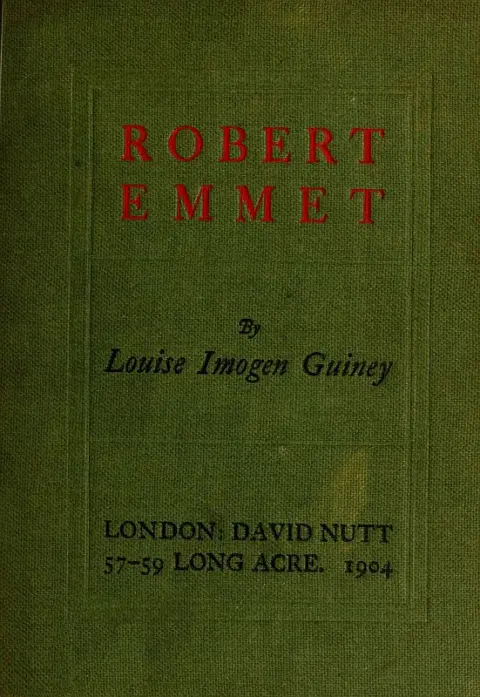
"Robert Emmet: A Survey of His Rebellion and of His Romance" by Louise Imogen Guiney is a historical account written in the early 20th century. The book delves into the life and legacy of Robert Emmet, a prominent figure in Irish history known for his role in the rebellion against British rule and his romantic affiliation with Sarah Curran. Through a blend of historical detail and narrative, the author captures Emmet's passionate ideals and the tragic consequences of his actions within the broader context of Irish nationalism. The opening of the text introduces Robert Emmet's family background, outlining the lineage of both the Emmets and Masons, emphasizing their distinguished heritage and intellectual prowess. It paints a picture of a young and gifted man whose moral fervor and artistic talents are entwined with a deep sense of duty toward Ireland. The narrative establishes Emmet as a pivotal character shaped by the political turbulence of his time, leading to his eventual involvement in the rebellion of 1803. It also highlights his complex and enduring relationship with Sarah Curran, setting the stage for a tale not only of political ambition but also of deep personal sacrifice and tragic love.
Introduction adapted from the source catalogue; source summaries may be automatically generated.
Free to read · English · 21,683 words · No account needed
MAKE TIME FOR A GOOD BOOK
On by default. Untick to stop anonymous reading totals. Each page counts after 10 seconds in view. How this works.
Anonymous counting is on unless you have switched it off.
Sarah Curran’s quiet annals are ungathered by any one hand, but the main outlines are henceforth discernible, and some celebrated writers have found them of interest. Washington Irving, in The Broken Heart, has given her an exquisite immortality; and the pathetic central incident of his narration is also the inspiration of Moore’s haunting song: She is far from the land. It was not, however, at the Rotunda in Dublin, but in a festal room in the friendly house where, after the death of her betrothed, she lived on in a dispirited convalescence, that she wandered away from the company, and sitting alone on the stair, began singing softly a plaintive air, “housed in a dream, at distance from the kind.” This happened at Woodhill, in Cork. Her voice seems to have been singularly beautiful: there was a general development of musical genius in her father’s family. The incident was reported at firsthand to Irving, as to Moore. To those who knew her story, the little forgetful act was poignant enough: for she was singing to the dead. In her sorrow, her deprivations, her entire withdrawal from the world, Miss Curran was blest with tender friends and champions. The poet just named, who was one of Robert Emmet’s early comrades, knew how admiration followed her like her shadow.
“And lovers are round her, sighing:
But coldly she turns from their gaze, and weeps,
For her heart in his grave is lying.”
Among those who looked with infinite sympathy and respect on the gentle girl moving like a soulless phantom in an unreal world, was a very young Englishman, barely her senior, a newly commissioned captain of Royal Engineers, a lineal descendant of Strafford, and full of Strafford’s strong singleness of heart. Henry Robert Sturgeon was third son of William Sturgeon, Esquire, and the Lady Henrietta Alicia Watson-Wentworth; grandson of the first, and nephew of the second Marquis of Rockingham. He conceived for Sarah Curran an instinctive affection, ardent and profound, and free from stain of self as Emmet’s own. It was as if Emmet, absented for ever, had breathed himself into another for the comfort and protection of the well-beloved. But the well-beloved would not be comforted nor protected: not though she knew, as she knew perfectly, both what her suitor’s worth was, and what were his fortune and standing in the great world; not though every member of the Penrose family, devoted to him, encouraged his hope; not though all of them, of their own accord, interceded with their ward and guest. In the Literary Souvenir for 1831, there is an agreeable paper of fifteen pages entitled Some Passages in the History of Sarah Curran, signed “M.” It has been conjectured that the writer was one of the Crawfords of Lismore, who had been very kind to Sarah when her mother’s flight broke up the Curran household. Whoever “M.” was, her devotion to her friend, of whose character and mental qualities she had the highest opinion, is conspicuous, and one may glean much information from what she has to tell us. Captain Sturgeon, she says in the slightly stilted Georgian phrases, was everything which is good. “Had not her heart been seared by early grief and disappointment, he could not have failed to have experienced the most flattering reception.” Sarah herself was entirely open with him: one would expect no less of her nobly sweet nature. “She pleaded his own cause for him by proving how little he deserved a divided affection;” but “the constancy and tenderness of her attachment to Emmet seem only to have rendered her the more interesting.” Two difficult years and more went by for Henry Sturgeon. He never wavered in his purpose: much as society sought after him, there was but one woman in the world to that patient and dedicated lover. Time was on their side. Sarah was gaining some measure of content and also of health, although she never definitely rallied from the heartbreak of 1803. It touched her at last that as she was, as she had told him so often that she was, with no life to live and nothing to give him, he prayed her still to become his wife, to lend him the one ultimate privilege of humblest service, from which otherwise he would be debarred. Some expectation of leaving the south of Ireland, or the actual arrival of orders from headquarters, seems to have lent a sudden heightened earnestness to his addresses; and Sarah, being pressed, gave her sad consent. They were married at Glanmire Church, near Woodhill, in the February of 1806.
Your reading position is saved on this browser. Take it to another device with a library code. Reading pages adapt to text, rather than matching a printed edition.
Louise Imogen Guiney
Louise Imogen Guiney
Louise Imogen Guiney

Louise Imogen Guiney
BEHIND THE BOOK
This eBook is for the use of anyone anywhere in the United States and most other parts of the world at no cost and with almost no restrictions whatsoever. You may copy it, give it away or re-use it under the terms of the Project Gutenberg License included with this eBook or online at www.gutenberg.org. If you are not located in the United States, you will have to check the laws of the country where you are located before using this eBook. Read the source licence.
The original source file, including credits and licence, is retained by this library. Request an original-format copy at no charge. Please include the book title and Project Gutenberg identifier #51889.
KEEP YOUR CURIOSITY GOING
Cécile Tormay

Moritz Busch
John L. Ransom
Frances Wright
Cécile Tormay

Mabel Potter Daggett