THE CLASSIC COLLECTION✦Hurrell Froude: Memoranda and CommentsCLASSIC FREE BOOKS
Hurrell Froude: Memoranda and Comments
Louise Imogen Guiney
THE CLASSIC COLLECTION · 1904
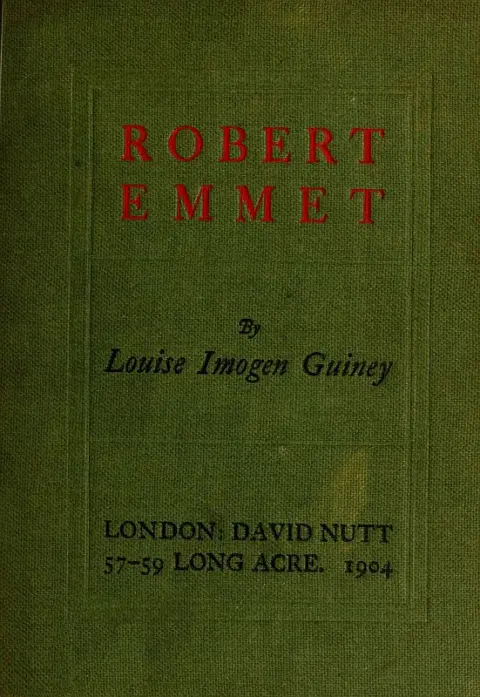
"Robert Emmet: A Survey of His Rebellion and of His Romance" by Louise Imogen Guiney is a historical account written in the early 20th century. The book delves into the life and legacy of Robert Emmet, a prominent figure in Irish history known for his role in the rebellion against British rule and his romantic affiliation with Sarah Curran. Through a blend of historical detail and narrative, the author captures Emmet's passionate ideals and the tragic consequences of his actions within the broader context of Irish nationalism. The opening of the text introduces Robert Emmet's family background, outlining the lineage of both the Emmets and Masons, emphasizing their distinguished heritage and intellectual prowess. It paints a picture of a young and gifted man whose moral fervor and artistic talents are entwined with a deep sense of duty toward Ireland. The narrative establishes Emmet as a pivotal character shaped by the political turbulence of his time, leading to his eventual involvement in the rebellion of 1803. It also highlights his complex and enduring relationship with Sarah Curran, setting the stage for a tale not only of political ambition but also of deep personal sacrifice and tragic love.
Introduction adapted from the source catalogue; source summaries may be automatically generated.
Free to read · English · 21,683 words · No account needed
MAKE TIME FOR A GOOD BOOK
On by default. Untick to stop anonymous reading totals. Each page counts after 10 seconds in view. How this works.
Anonymous counting is on unless you have switched it off.
Within a few days, towards the end of this month of August, Mr. Curran himself received a letter from Robert Emmet. It was neither signed nor dated, and opened abruptly, waiving all formalities, not from any hidden defiance, but from entire absorption in the mournful retrospect it called up. As we know from Lord Hardwicke’s communication, Emmet had retained Mr. Curran for his counsel, and it was thought fitting that the latter should decline the brief for the defence. Of course Mr. Curran threw it up; no man could have done otherwise. But his general turmoil, and the apparent motives of it, are not a particularly noble spectacle. The young prisoner, meanwhile, had something to say to him.
“I did not expect you to be my counsel. I nominated you, because not to have done so might have appeared remarkable. Had Mr. ——[1] been in town, I did not even wish to have seen you, but as he was not, I wrote to you to come to me at once. I know that I have done you very severe injury, much greater than I can atone for with my life; that atonement I did offer to make before the Privy Council by pleading guilty if those documents were suppressed.... My intention was not to leave the suppression of those documents to possibility, but to render it unnecessary for anyone to plead for me, by pleading guilty to the charge myself. The circumstances that I am now going to mention I do not state in my own justification. When I first addressed your daughter I expected that in another week my own fate would have been decided. I knew that in case of success many others would look on me differently from what they did at that moment; but I speak with sincerity when I say that I never was anxious for situation or distinction myself, and I did not wish to be united to one who was. I spoke to your daughter, neither expecting nor (under those circumstances) wishing that there should be a return of attachment, but wishing to judge of her dispositions, to know how far they might be not unfavourable or disengaged, and to know what foundation I might afterwards have to count on. I received no encouragement whatever. She told me she had no attachment for any person, nor did she seem likely to have any that could make her wish to quit you. I stayed away till the time had elapsed, when I found that the event to which I allude was to be postponed indefinitely. I returned, by a kind of infatuation, thinking that to myself only was I giving pleasure or pain. I perceived no progress of attachment on her part, nor anything in her conduct to distinguish me from a common acquaintance. Afterwards I had reason to suppose that [political] discoveries were made, and that I should be obliged to quit the kingdom immediately. I came to make a renunciation of any approach to friendship that might have been formed. On that very day she herself spoke to me to discontinue my visits; I told her it was my intention, and I mentioned the reason. I then for the first time found, when I was unfortunate, by the manner in which she was affected, that there was a return of affection, and that it was too late to retreat. My own apprehensions also I afterwards found were without cause; and I remained. There has been much culpability on my part in all this, but there has also been a great deal of that misfortune which seems uniformly to have accompanied me. That I have written to your daughter since an unfortunate event [the arrest], has taken place, was an additional breach of propriety for which I have suffered well; but I will candidly confess that I not only do not feel it to have been of the same extent, but that I consider it to have been unavoidable after what had passed. For though I shall not attempt to justify in the smallest degree my former conduct, yet, when an attachment was once formed between us (and a sincerer one never did exist), I feel that, peculiarly circumstanced as I then was, to have left her uncertain of my situation would neither have weaned her affections nor lessened her anxiety; and looking upon her as one whom, if I lived, I hoped to have had my partner for life, I did hold the removing of her anxiety above every other consideration. I would rather have the affections of your daughter in the back settlements of America, than the first situation this country could offer without them. I know not whether this will be any extenuation of my offence; I know not whether it will be any extenuation of it to know that if I had that situation in my power at this moment I would relinquish it to devote my life to her happiness; I know not whether success would have blotted out the recollection of what I have done; but I [do] know that a man with the coldness of death on him need not to be made to feel any other coldness, and that he may be spared any addition to the misery he feels, not for himself, but for those to whom he has left nothing but sorrow.”
Your reading position is saved on this browser. Take it to another device with a library code. Reading pages adapt to text, rather than matching a printed edition.
Louise Imogen Guiney
Louise Imogen Guiney
Louise Imogen Guiney

Louise Imogen Guiney
BEHIND THE BOOK
This eBook is for the use of anyone anywhere in the United States and most other parts of the world at no cost and with almost no restrictions whatsoever. You may copy it, give it away or re-use it under the terms of the Project Gutenberg License included with this eBook or online at www.gutenberg.org. If you are not located in the United States, you will have to check the laws of the country where you are located before using this eBook. Read the source licence.
The original source file, including credits and licence, is retained by this library. Request an original-format copy at no charge. Please include the book title and Project Gutenberg identifier #51889.
KEEP YOUR CURIOSITY GOING
Cécile Tormay

Moritz Busch
John L. Ransom
Frances Wright
Cécile Tormay

Mabel Potter Daggett