THE CLASSIC COLLECTION✦A dead man’s diaryCLASSIC FREE BOOKS
A dead man’s diary
Coulson Kernahan
THE CLASSIC COLLECTION · 1910
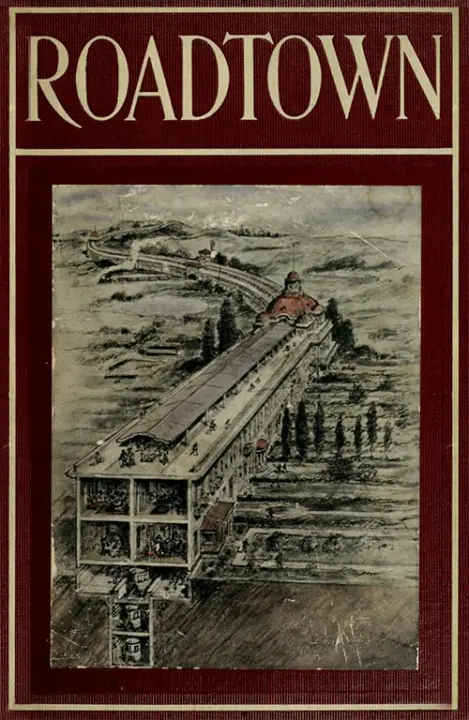
"Roadtown" by Edgar Chambless is a speculative fiction work written in the early 20th century. The book presents an innovative vision of a new type of society that combines housing and transportation in a linear, interconnected manner, aiming to eliminate the inefficiencies of urban living. The narrative focuses on the inventor and visionary Edgar Chambless, who seeks to create a utopia where individuals can thrive without the burdens of traditional city life. At the start of "Roadtown," the author introduces the protagonist's disillusionment with contemporary society following a financial crisis. As Chambless reflects on his life experiences while contemplating the nature of transportation and urban planning, he begins to conceptualize a revolutionary idea: a city designed in a straight line that integrates advanced transportation with living spaces. His vision includes features such as mechanized housekeeping and cooperative agricultural practices, alongside a streamlined system for distribution and utility. This opening sets the stage for a comprehensive exploration of how such a radical reimagining of urban life could address the challenges of modern civilization.
Introduction adapted from the source catalogue; source summaries may be automatically generated.
Free to read · English · 28,785 words · No account needed
MAKE TIME FOR A GOOD BOOK
On by default. Untick to stop anonymous reading totals. Each page counts after 10 seconds in view. How this works.
Anonymous counting is on unless you have switched it off.
The following calculations are based on the construction of two hundred and fifty (250) two-story houses in a continuous row. This also includes a continuous glass enclosed roof promenade 10 ft. wide and 8 ft. high. The estimate gives the complete construction of these buildings, including the tunnel for the proposed monorail road, also a central power plant, including kitchen, laundry and such other equipments as may be necessary for the proper maintenance of such an establishment. It further includes all mains, pipes, wires, so that when the plant is completed it would be ready to turn over to the occupant in a completely finished condition.
Each house will be equipped with hot water heat furnished from a central station; electric lights, electric power, telephone connected with central station, vacuum sweeping system, complete plumbing and water supply.
The calculations which are given herewith are fairly close and without doubt under proper management and accessible facilities for getting material the work can be done for the estimate given.
250 houses, 21´ wide × 20´ deep, with seven rooms well furnished as per illustration @ $1,800 each $450,000 Five coöperative centers, tower-like in effect 50,000 Wiring houses based on $50 per house 12,500 Heating, ” ” ” $150 ” ” 37,500 Plumbing, ” ” ” $125 ” ” 21,250 Laundry machinery 8,000 Cooking apparatus 12,000 Boiler plant and heating apparatus 40,000 Refrigerating plant 10,000 Electric plant and switchboard, telephone 40,000 Wiring, feeder mains, etc. 12,000 Brick Chimney 4,000 Sewerage system 20,000 Water supply and mains for irrigation and domestic use 40,000 Gas and vacuum producers and holders 10,000 ------- One mile of house--equipped $777,250
Cost per house--equipped $3,109
The principal fixed charges for labor, coal, interest on the investment
would be as follows:
Chief engineer $2,400 Two (2) assistant engineers, $80 per month, $960 each 1,920 Four (4) firemen, $60 per month, $240 each 2,880 Two (2) extra men, $50 per month 1,200 Chef, $75 per month 900 Three (3) cooks, $40 per month 1,440 Four (4) helpers, $20 per month 720 One (1) laundryman, $100 per month 1,200 Ten (10) women, $20 per month 2,400 ------ Total labor cost $15,060
Coal 4,000 Oil and waste 500 6% interest on $581,250[B] $34,375 7% ” ” 196,000[B] 14,550 48,852 ------ ------
Total expense for one year’s operation, interest and depreciation $68,385
[B] The lower rate of interest is charged upon the house and fixtures, the higher rate upon the plants and machinery.
Or each tenant’s rent for year to be $22.76 per month or $3.25 per room, exclusive of charge for food but inclusive of furniture, power, cooking, heat, light, water, vacuum sweeping, laundry and the delivery of all food, parcels, produce, etc.
The population could without doubt be increased by 500 to 1,000 houses more without any material increase in the principal items for labor, such as engineers, firemen and heads of departments. The only extra increase would be for help in these departments which would be governed by the amount of work required.
Using Autos
Four (4) electric autos for passengers and food $12,000 10% interest, depreciation and repairs $1,200 Six (6) men @ $75 per month 5,400 ------ $6,600
For 250 families $1.70 per month.
Your reading position is saved on this browser. Take it to another device with a library code. Reading pages adapt to text, rather than matching a printed edition.
BEHIND THE BOOK
This eBook is for the use of anyone anywhere in the United States and most other parts of the world at no cost and with almost no restrictions whatsoever. You may copy it, give it away or re-use it under the terms of the Project Gutenberg License included with this eBook or online at www.gutenberg.org. If you are not located in the United States, you will have to check the laws of the country where you are located before using this eBook. Read the source licence.
The original source file, including credits and licence, is retained by this library. Request an original-format copy at no charge. Please include the book title and Project Gutenberg identifier #58964.
KEEP YOUR CURIOSITY GOING
Coulson Kernahan

Maurice Baring
Frances Wright
Cécile Tormay
Francis Greenleaf Allinson & Anne C. E. (Anne Crosby Emery) Allinson

Frederic Jesup Stimson